
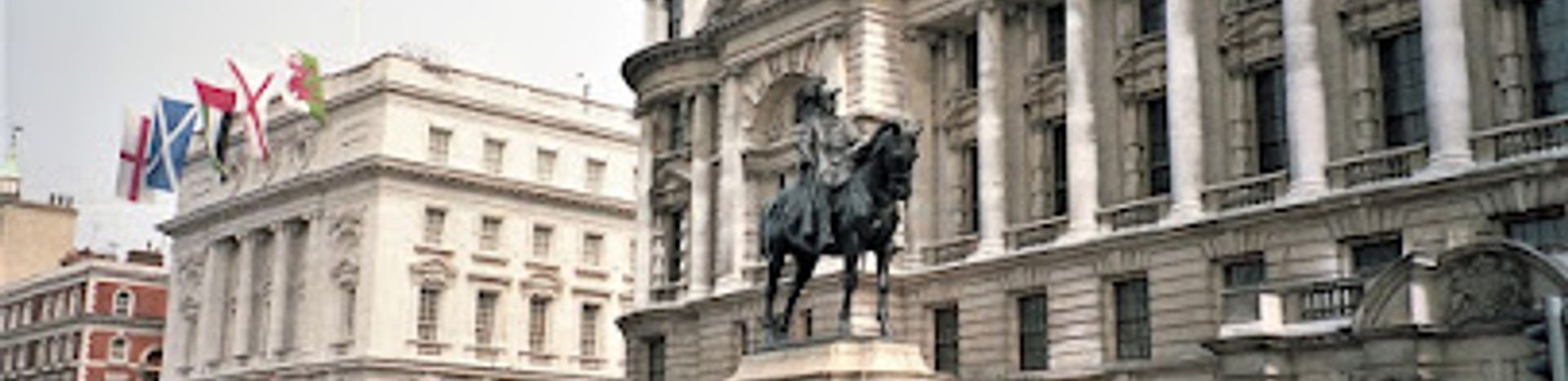
Equestrian Statue of Prince George, Duke of Cambridge in Whitehall
A commanding bronze tribute to Prince George, Duke of Cambridge, standing proudly on Whitehall as a symbol of military heritage.
The equestrian statue of Prince George, Duke of Cambridge, is a life-size bronze memorial located prominently on Whitehall in Westminster, London. Sculpted by Adrian Jones and unveiled in 1907, it depicts the Duke in full Field Marshal uniform atop a majestic horse, commemorating his long military leadership as Commander-in-Chief of the British Army. The statue stands on a granite plinth adorned with bas-reliefs reflecting his military affiliations.
A brief summary to George Duke of Cambridge statue
- London, SW1A 2AY, GB
- Visit website
- Duration: 0.25 to 1 hours
- Free
-
 Outdoor
- Mobile reception: 5 out of 5
Local tips
- View the statue safely from the footpath before crossing to the traffic island to read the detailed plaques on the plinth.
- Visit during quieter times to avoid heavy traffic on Whitehall and enjoy unobstructed views.
- Look for the bas-reliefs on the plinth that depict the Duke’s military affiliations with the Grenadier Guards and 17th Lancers.
- During Christmas, notice the festive tradition of hay and sawdust placed at the horse’s feet.

For the on-the-go comforts that matter to you
- Restrooms
- Drink Options
- Food Options
- Seating Areas
- Information Boards
Getting There
-
London Underground
Take the District or Circle Line to Embankment Station, approximately a 5-minute walk to Whitehall. The station is well-served with frequent trains, and the walk is mostly flat and accessible. No additional charges beyond the standard fare apply.
-
Bus
Several London bus routes stop near Whitehall, including routes 12, 24, and 148. Buses run frequently throughout the day, with travel times varying by traffic but typically around 15 to 25 minutes from central London hubs. Use an Oyster card or contactless payment for fares.
-
Walking
From Trafalgar Square, a 10 to 15-minute walk along pedestrian-friendly streets leads directly to Whitehall. The terrain is flat and suitable for most visitors, with ample sidewalks and crossings.
George Duke of Cambridge statue location weather suitability
-
 Any Weather
-
 Rain / Wet Weather
-
 Clear Skies
-
 Mild Temperatures
Discover more about George Duke of Cambridge statue
A Tribute to a Military Leader
The statue commemorates Prince George, Duke of Cambridge (1819–1904), who served as Commander-in-Chief of the British Army from 1856 to 1895. This life-size bronze equestrian statue was sculpted by Adrian Jones and unveiled on 15 June 1907 by King Edward VII. It honors the Duke’s significant military career and royal heritage, capturing him in full Field Marshal uniform with detailed medals and orders of knighthood. The baton he holds symbolizes a baton presented to his father by King William IV.Artistic and Architectural Details
The statue is mounted on a substantial granite plinth weighing forty-five tonnes, reaching a combined height of about 25 feet (7.6 meters). The plinth features two bas-relief panels on its sides that illustrate the Duke’s connections with the Grenadier Guards and the 17th Lancers, regiments with which he was closely associated. The horse is depicted with a flowing mane and tail, appearing alert and ready, enhancing the dynamic presence of the Duke.Location and Surroundings
Situated in the middle of Whitehall, a historic ceremonial street in Westminster, the statue stands near the Horse Guards building and the former War Office, placing it at the heart of Britain's military and governmental district. Its position on a traffic island amidst a busy central London road makes it a prominent yet sometimes overlooked monument. Nearby landmarks include the Cenotaph and other military memorials, contributing to the area's rich commemorative atmosphere.Historical Context and Legacy
The statue was commissioned by a committee chaired by Prince Arthur, Duke of Connaught and Strathearn, a cousin of the Duke of Cambridge. Initially planned for outside the Horse Guards, it was ultimately placed outside the War Office building after its completion in 1906. The statue reflects the Victorian and Edwardian era’s respect for military leadership and royal service, embodying the Duke’s steadfast resistance to army reforms and his long tenure in command.Traditions and Anecdotes
A unique tradition surrounds the statue during Christmas: the horse is given a bale of hay and a bed of sawdust, reflecting a playful homage to the equestrian figure. Despite its central location, the statue’s placement on a traffic island requires visitors to cross part of the road to view the inscribed plaques on the plinth, which detail the Duke’s titles and honours.Preservation and Cultural Significance
Maintained as part of London’s public statues collection, the Duke of Cambridge statue is a significant historical landmark that contributes to the narrative of Britain’s military heritage. It stands as a reminder of the era’s military traditions and the Duke’s prominent role in shaping the British Army during the 19th century.For the vibe & atmosphere seeker
- Historic
- Scenic
- Tranquil
- Unique
For the design and aesthetic lover
- Vintage Styles
For the architecture buff
- Historic
- Landmarks
For the view chaser and sunset hunter
- Iconic Views
For the social media creator & influencer
- Photo Spots
- Architectural Shots
For the eco-conscious traveler
- Public-Transport Accessible
- Locally Managed
For the kind of experience you’re after
- Cultural Heritage
- Photowalk
- Day Trip
For how adventurous you want the journey to be
- Easy Access
Location Audience
- Family Friendly
- Senior Friendly
- Child Friendly
- Teen Friendly
- Wheelchair Access
- Solo Friendly
- Couple Friendly
- Vegetarian Friendly
- Vegan Friendly


