
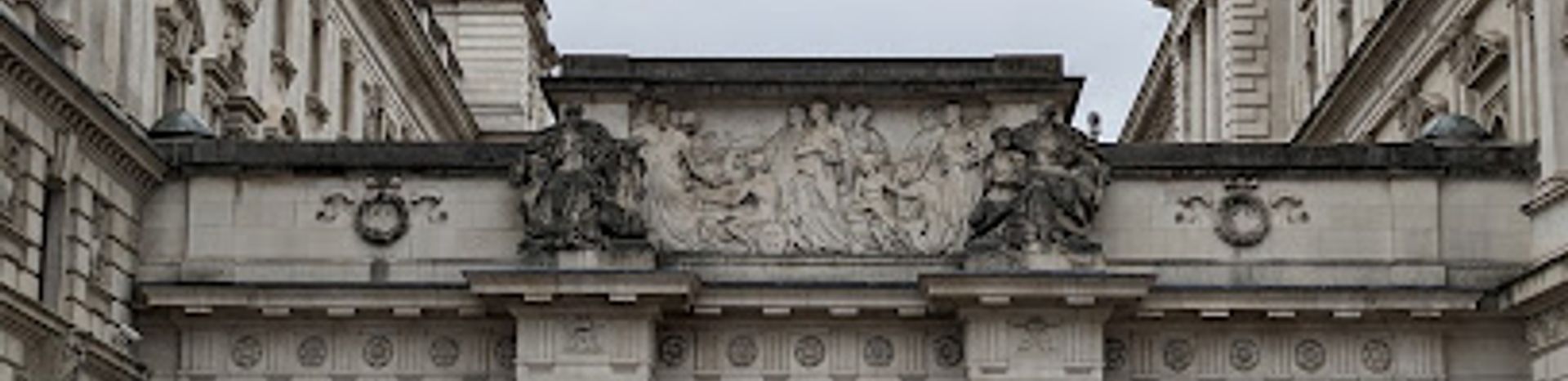
King Charles Street Arch: A Majestic Historical Gateway in London
A grand 1908 architectural gateway adorned with intricate sculptures, marking the historic heart of London’s government district.
The King Charles Street Arch is a striking historical landmark located at 100 Parliament Street in London. Completed in 1908 and designed by John McKean Brydon, this grand three-arched structure features intricate stonework and sculptural reliefs by William Silver Frith and Paul Raphael Montford. It serves as an imposing entrance to the courtyard of important government buildings, blending architectural grandeur with rich historical significance in the heart of Whitehall.
A brief summary to King Charles Street Arch
- 100 Parliament St, London, SW1A 2NH, GB
- Duration: 0.5 to 1.5 hours
- Free
-
 Outdoor
- Mobile reception: 5 out of 5
Local tips
- Visit early in the morning for quieter surroundings and better photographic light.
- Combine your visit with nearby iconic sites like the Houses of Parliament and Westminster Abbey.
- Take time to admire the detailed sculptures by William Silver Frith and Paul Raphael Montford on the arch.
- Enjoy a relaxing break in the nearby gardens that surround the arch.

For the on-the-go comforts that matter to you
- Seating Areas
- Information Boards
- Restrooms
- Trash Bins
Getting There
-
Public Transport - Bus
Catch buses 11, 24, or 88 to Parliament Square, then walk approximately 5 minutes east along Parliament Street to reach King Charles Street Arch. Bus services run frequently throughout the day with fares around £1.75-£2.50 using contactless payment.
-
Walking from Westminster Abbey
A pleasant 10-15 minute walk along Broad Sanctuary and Parliament Street brings you directly to the arch. The route is mostly flat and accessible, suitable for all fitness levels.
-
Walking from Trafalgar Square
Walk south along Whitehall for about 15 minutes until Parliament Street, then continue for 5 minutes to the arch. The path is paved and well-signposted, offering views of key London landmarks en route.
King Charles Street Arch location weather suitability
-
 Any Weather
-
 Clear Skies
-
 Mild Temperatures
-
 Rain / Wet Weather
Discover more about King Charles Street Arch
Architectural Grandeur Rooted in History
The King Charles Street Arch stands as a testament to early 20th-century architectural craftsmanship. Designed by John McKean Brydon and completed in 1908, the arch features a commanding three-arched structure lined with classical columns. The detailed stonework and sculptural reliefs, created by artists William Silver Frith and Paul Raphael Montford, adorn the facade with figurative representations symbolizing themes such as Government, Shipping, and Navigation. This blend of architectural and sculptural artistry reflects the importance of the site within London's governmental precinct.Context within London's Governmental Landscape
Situated at 100 Parliament Street, the arch marks the entrance to King Charles Street, a cul-de-sac that functions as a courtyard for key government offices, including the Foreign, Commonwealth and Development Office (FCDO). The surrounding buildings, many dating from the 19th century, exhibit a balance between neo-classical sobriety and Victorian decorative richness. The arch thus serves not only as a physical gateway but also as a symbolic portal to the heart of British political power and history.Artistic Details and Symbolism
The sculptural elements on the arch are of particular note. The lower reliefs by William Silver Frith and the upper sculptures by Paul Raphael Montford contribute to a layered narrative of Britain's imperial and governmental identity. Semi-reclining figures represent abstract concepts such as Government and Maritime prowess, integrating artistic storytelling with architectural function. These embellishments invite close inspection and appreciation, enriching the visitor's experience.The Arch’s Role in Ceremonial and Public Life
Historically, King Charles Street and its arch have been part of ceremonial routes and official events. The adjacent quadrangle and courtyards have hosted state occasions and receptions, underscoring the arch’s role as a dignified threshold. The area has undergone restoration and careful preservation efforts to maintain its grandeur and accessibility, ensuring the arch remains a vibrant part of London’s living heritage.Surrounding Environment and Visitor Experience
The arch is surrounded by well-maintained gardens and pathways, offering a tranquil oasis amid the bustling governmental district. Its proximity to landmarks such as the Houses of Parliament and Westminster Abbey makes it an ideal stop for those interested in London's political and architectural history. Visitors can enjoy a peaceful moment here, capturing photographs of the impressive stonework or simply absorbing the atmosphere of this historic corridor.Conservation and Modern Relevance
The King Charles Street Arch has been preserved as part of the Grade I listed government buildings complex. Restoration efforts have balanced the need to maintain historical authenticity with modern requirements for accessibility and functionality. Today, the arch continues to symbolize London's rich heritage while standing as a proud architectural landmark in the city’s evolving urban fabric.For the vibe & atmosphere seeker
- Historic
- Scenic
- Tranquil
- Unique
For the design and aesthetic lover
- Vintage Styles
- Art Deco Styles
For the architecture buff
- Historic
- Landmarks
- Heritage Neighborhoods
For the view chaser and sunset hunter
- Iconic Views
For the social media creator & influencer
- Instagrammable
- Photo Spots
- Architectural Shots
For the eco-conscious traveler
- Public-Transport Accessible
- Locally Managed
For the kind of experience you’re after
- Cultural Heritage
- Photowalk
- Day Trip
For how adventurous you want the journey to be
- Easy Access
Location Audience
- Family Friendly
- Senior Friendly
- Child Friendly
- Teen Friendly
- Wheelchair Access
- Solo Friendly
- Couple Friendly
- Vegetarian Friendly
- Vegan Friendly


