Cross Kirk Travel Guide
Free Guide: Explore the evocative ruins of Cross Kirk, a medieval pilgrimage church in Peebles steeped in sacred relics and centuries of Scottish history.


A brief summary of Cross Kirk
Explore the evocative ruins of Cross Kirk, a medieval pilgrimage church in Peebles steeped in sacred relics and centuries of Scottish history.
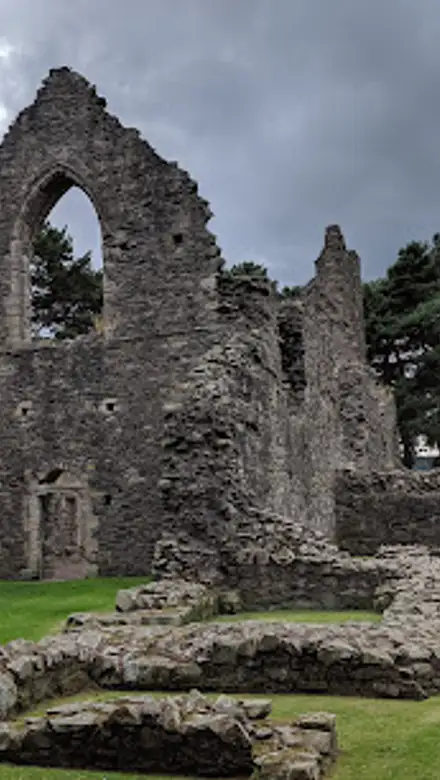
Cross Kirk is a striking ruin of a medieval church and former monastery in Peebles, Scotland, founded in the 13th century to house relics of St Nicholas. Set in a tranquil glade with mature Scots pine, it was a pilgrimage centre until the early 1600s and later served as the parish church before being abandoned in 1784. The site features impressive nave walls, a bell tower, and traces of cloisters, offering a peaceful glimpse into Scotland’s religious heritage.
On-site amenities
 Information boards
 Seating areas
 Trash bins
- Address
- Cross Rd, Peebles EH45 8DH
Getting there
Bus
Car
Walking
Discover more about Cross Kirk
Origins Rooted in Sacred Discoveries
Cross Kirk’s origins date back to 1241 when a fine cross and a stone urn believed to contain the cremated remains of St Nicholas were discovered on the site. These relics, found reportedly in the presence of King Alexander III, led to the founding of a church and priory dedicated to St Nicholas and the Holy Rood. This connection to the saint, who inspired the figure of Santa Claus and is revered as a patron of sailors, made Cross Kirk a significant pilgrimage destination throughout the medieval period.
Architectural Evolution and Monastic Life
Initially a simple rectangular church with a vaulted vestry, Cross Kirk became a house for Trinitarian friars (Redfriars) in 1474, which brought expansions including a stone bell tower and cloister ranges. The church endured damage during the Rough Wooing war in 1549 but was repaired shortly after. Post-Reformation, it transitioned from monastery to parish church, replacing the burned St Andrew’s Church. Structural changes included shortening the church, adding galleries, and burial aisles, reflecting evolving religious and community needs.
Decline and Ruin Amid Changing Times
By 1784, Cross Kirk was abandoned when a new parish church was built in Peebles. Though still largely intact except for the roof in 1790, the monastery buildings had been dismantled for stone. Over the 19th century, the site fell into ruin, with walls collapsing and the once-grand complex reduced to evocative remnants. Despite this, it remains the best-preserved urban friary ruin in Scotland, cared for by Historic Environment Scotland.
Atmosphere and Setting Today
Nestled within a quiet, grassy glade surrounded by mature Scots pine, Cross Kirk offers a tranquil and reflective environment. Visitors can appreciate the height of the nave walls, the picturesque bell tower, and the faint outlines of cloisters and burial aisles. The site’s peaceful ambience contrasts with its turbulent history, inviting contemplation of centuries of faith, devotion, and community life.
Historical Significance and Cultural Legacy
Cross Kirk stands as a testament to Scotland’s medieval religious heritage and the enduring legacy of St Nicholas. The site embodies layers of history, from early Christian relic veneration to monastic life and post-Reformation parish worship. Its association with miracles and pilgrimage enriches its cultural narrative, while its ruins evoke the passage of time and changing spiritual landscapes.
Preservation and Visitor Experience
Managed by Historic Environment Scotland, Cross Kirk is accessible to the public with some restrictions around the bell tower for safety. The site is free to visit, offering a unique opportunity to explore a historic religious monument within the heart of Peebles. Its quiet setting and evocative ruins make it a meaningful stop for history enthusiasts, pilgrims, and those seeking a serene cultural experience.
Evendo Review Centre
 Google
Guest reviews
Best time to go
Quietest: Jan, Feb & Dec · before 6am or at 9pm
Busy times are Evendo estimates for a typical year, to help you plan. Actual crowds vary with events, school holidays and the weather.
Explore Cross Kirk on the map
A handpicked selection of must-see spots near Cross Kirk, mapped for you.
Get your free copy of our complete guide to Cross Kirk, delivered straight to you.
Everything on this page, from opening hours and how to get there to Eve’s tips and the best time to go, in one PDF you can read offline, print or share.
Already have an account? Sign in
Your Cross Kirk guide is ready.
We'll send it to · Not you? Sign out

Getting your guide ready…
We are putting together a fresh copy of the Cross Kirk guide. This can take up to a minute.
This can take a few moments. If your browser asks, choose Allow so the download can start. You'll find the guide in your Downloads folder.
Nothing happened? Download it again
Sorry, the guide is taking longer than usual. Please try again in a minute, or get it by email instead.
Other nearby places you may find interesting
The closest places of the same kind, if this one is not quite what you had in mind.
-
-
-
-
-


Swipe for more places
More to explore near Cross Kirk

 Best experiences near Cross Kirk
 Best hotels near Cross Kirk
 Best landmarks near Cross Kirk
 Best attractions near Cross Kirk
 Best shops near Cross Kirk
 Best restaurants near Cross Kirk
 Best bars near Cross Kirk
Do you manage this location?
Take control to get all the benefits, like improved information, better appearance, and stronger visibility across AI-powered discovery.
Explore more
Explore more of Roxburghshire
Discover the enchanting landscapes and rich history of Roxburghshire, a picturesque region in the Scottish Borders known for its ancient castles, scenic hills, and vibrant market towns.
Explore Roxburghshire
Explore more of United Kingdom
Discover the United Kingdom: A blend of rich history, stunning landscapes, and vibrant cities, offering a unique travel experience for every visitor.
Explore United Kingdom