Abbeydale Industrial Hamlet, Sheffield Travel Guide
Free Guide: Explore Sheffield's industrial soul at this complete 18th-century scythe works powered by the River Sheaf.


A brief summary of Abbeydale Industrial Hamlet
Explore Sheffield's industrial soul at this complete 18th-century scythe works powered by the River Sheaf.
Step into Sheffield's industrial past at this remarkably complete 18th and 19th-century scythe and steelworks. Located on the River Sheaf, Abbeydale Industrial Hamlet preserves original buildings, waterwheels, forges, and the last surviving crucible steel furnace in the UK. Explore the Manager's House, workers' cottages, grinding hull, and tilt forge to understand the skilled craftsmanship and dangerous conditions that shaped the Steel City. Free entry with a suggested donation makes this heritage site accessible to all history enthusiasts.
On-site amenities
 Restrooms
 Drink options
 Food options
 Seating areas
 Sheltered areas
 Trash bins
 Information boards
 Visitor centre
Opening hours
- MonClosed
- TueClosed
- WedClosed
- Thu10 am–4 pm
- Fri10 am–4 pm
- Sat10 am–4 pm
- Sun11 am–4 pm
Opening hours as listed on the venue’s Google Business Profile. Hours can change for services and special events, so check with the venue before you go.
- Address
- Abbeydale Rd S, Beauchief, Sheffield S7 2QW
- Phone
- Website
Getting there
Public Transport from Sheffield City Centre
Car from Sheffield City Centre
Walking from Millhouses Park
Cycling from Sheffield City Centre
Discover more about Abbeydale Industrial Hamlet
Five Centuries of Steel and Skill on the River Sheaf
Abbeydale Industrial Hamlet stands as one of the world's most complete surviving examples of an integrated water-powered industrial site. The story of this place stretches back at least 500 years, with evidence of iron forging and metalwork dating to medieval times. In the 13th century, monks from nearby Beauchief Abbey operated a smithy in the vicinity, establishing the spiritual and practical foundations for centuries of metalworking to follow. By 1685, Hugh Stephenson rented 'New Wheel' from rent books that can be traced to this same location, and formal records of Abbeydale Works itself begin in 1713, though the site may have been occupied even earlier.The River Sheaf, which flows through the hamlet, became the lifeblood of the operation. During the 17th and 18th centuries, Sheffield's rivers supported over 160 mills, and Abbeydale emerged as one of the largest and most productive. The site's expansion accelerated in 1777 when the dam was enlarged during the Goddard family's tenancy, initiating a period of rapid development. The Tilt Forge was constructed in 1742, the workers' cottages by 1793, and the iconic Grinding Hull in 1817. By the 1830s, the complex included a crucible steel furnace of the type invented by Benjamin Huntsman in 1742, multiple hand forges, warehouses, and administrative offices. The Manager's House, built in 1838, and the Coach House and Stables around 1840 completed the ensemble, with a warehouse added above the Blacking Shop in 1876.
Scythes, Tools, and the Craft of Edge-Making
Abbeydale's primary product was the crown scythe—a precision agricultural tool forged under tilt hammers and refined through meticulous hand processes. The works also produced patent riveted scythes, grass hooks, hay knives, and other edge tools essential to farming across the British Empire. At its peak in the mid-19th century, the site produced thousands of high-quality implements annually, many exported to distant colonies including Australia, India, and Canada. The manufacturing process was complex and dangerous: workers began by making blister steel, which was then converted into crucible steel in the furnace, forged into blades by skilled smiths, sharpened on massive grindstones, and finally chemically treated to prevent rust. Each stage required generations of inherited knowledge, passed from master to apprentice, creating a community of highly specialized craftspeople.The waterwheels powered by the River Sheaf drove the grinding stones and forging equipment, making Abbeydale dependent on water flow. When the dam ran low, a steam engine built by Davey Brothers in 1855 provided backup power. This hybrid system—water primary, steam secondary—represented the transition between two industrial eras, a physical embodiment of Sheffield's evolution from rural mill sites to urban manufacturing centers.
Danger, Discord, and the Human Cost of Industry
Behind the machinery and precision lay a darker reality. The 19th century brought industrial accidents and labor unrest that scarred the site. In 1842, the Grinding Hull was deliberately blown up with gunpowder by the Grinders Union to protest manager Mr. Dyson's employment of non-union workers. Two decades later, in 1862, joint manager Joshua Tyzack was shot at five times, and accidental explosions also occurred. In 1870, the central heating boiler in the Blacking Shop exploded, killing two men. In 1912, a grindstone burst in the Grinding Hull, killing a scythe grinder. These tragedies underscore the hazardous nature of metalworking—the intense heat, flying fragments, and mechanical power that made the work both essential and deadly.
Decline, War, and Preservation
By the early 20th century, mechanized alternatives to hand tools began eroding demand for scythes. The firm of Tyzack Sons and Turner, tenants since 1849, finally ceased production in 1933 to concentrate manufacturing at their Little London Works downstream. During the Second World War, the Crucible Furnace was briefly relit to produce high-quality steel for Britain's war effort, a final moment of industrial purpose before the site fell silent. In 1935, the Alderman J. G. Graves Trust purchased the works and donated them to Sheffield. Restoration began in 1964 under the Council for the Conservation of Sheffield Antiquities, during which archaeologists discovered the remains of six additional buildings—a hardening shop, open furnace shed, lime and coke shed, boiler house, steam engine housing, and clay and anvil store—identified from a 1924 site map. The museum opened to the public in April 1970, closed briefly in 1997 as a cost-cutting measure, and was reopened in 1998 by the Sheffield Industrial Museums Trust, where it remains today.
The Buildings and Machinery That Tell the Story
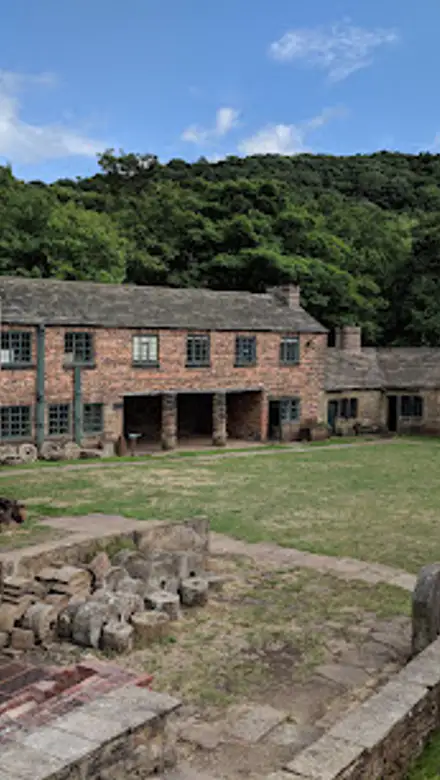
Visitors encounter a courtyard arrangement of preserved structures, each revealing different aspects of life and labor. The Manager's House and Worker's Cottage offer intimate glimpses into domestic conditions—the relative comfort of management versus the modest quarters of laborers. The Counting House, dressed as it might have appeared in the 1920s, displays the administrative machinery that coordinated production. The Tilt Forge, Grinding Hull, and Blacking Shop showcase the sequential stages of tool manufacture. Four waterwheels and the picturesque dam remain visible, their engineering elegance evident even in stillness. The crucible steel furnace—the last complete surviving example in the UK—stands as a monument to Huntsman's 18th-century innovation, capable of reaching temperatures exceeding 1,600 degrees Celsius. The steam engine, restored after years of outdoor exposure, represents the technological transition that ultimately made water-powered sites obsolete.
A Living Testament to Industrial Heritage
Today, Abbeydale Industrial Hamlet functions as both museum and historical document. Information boards guide visitors through the scythe-making process, while the physical landscape—the dam, the river, the buildings arranged as they were—allows visitors to reconstruct the rhythms of work and community. The site remains a Scheduled Ancient Monument comprising Grade I and Grade II listed buildings, recognized internationally for its completeness and authenticity. It stands as a bridge between the rural, water-powered mills of the 17th and 18th centuries and the urban, steam-driven factories that would define Sheffield's industrial dominance. For those seeking to understand how Sheffield earned its reputation as the Steel City, Abbeydale offers an unparalleled window into the skill, danger, innovation, and human effort that shaped the modern world.
Evendo Review Centre
 Google
Guest reviews
Best time to go
Quietest: Jan, Feb & Dec · before 9am or from 5pm
Busy times are Evendo estimates for a typical year, to help you plan. Actual crowds vary with events, school holidays and the weather.
Explore Abbeydale Industrial Hamlet on the map
A handpicked selection of must-see spots near Abbeydale Industrial Hamlet, mapped for you.
Get your free copy of our complete guide to Abbeydale Industrial Hamlet, delivered straight to you.
Everything on this page, from opening hours and how to get there to Eve’s tips and the best time to go, in one PDF you can read offline, print or share.
Already have an account? Sign in
Your Abbeydale Industrial Hamlet guide is ready.
We'll send it to · Not you? Sign out

Getting your guide ready…
We are putting together a fresh copy of the Abbeydale Industrial Hamlet guide. This can take up to a minute.
This can take a few moments. If your browser asks, choose Allow so the download can start. You'll find the guide in your Downloads folder.
Nothing happened? Download it again
Sorry, the guide is taking longer than usual. Please try again in a minute, or get it by email instead.
Other nearby places you may find interesting
The closest places of the same kind, if this one is not quite what you had in mind.
-
-
-
-
-


Swipe for more places
More to explore near Abbeydale Industrial Hamlet
-
 Best experiences near Abbeydale Industrial Hamlet
-
 Best hotels near Abbeydale Industrial Hamlet
-
 Best landmarks near Abbeydale Industrial Hamlet
-
 Best attractions near Abbeydale Industrial Hamlet
-
 Best shops near Abbeydale Industrial Hamlet
-
 Best restaurants near Abbeydale Industrial Hamlet
-
 Best bars near Abbeydale Industrial Hamlet


Do you manage this location?
Take control to get all the benefits, like improved information, better appearance, and stronger visibility across AI-powered discovery.
Explore more

Explore more of Sheffield
Discover Sheffield: A dynamic city where industrial heritage meets abundant green spaces, thriving culture, and culinary delights in the heart of the UK.
Explore Sheffield
Explore more of United Kingdom
Discover the United Kingdom: A blend of rich history, stunning landscapes, and vibrant cities, offering a unique travel experience for every visitor.
Explore United Kingdom