

Ardvreck Castle Travel Guide
Free Guide: Explore the evocative ruins of Ardvreck Castle, a 15th-century Highland fortress steeped in history, legend, and stunning lochside scenery.


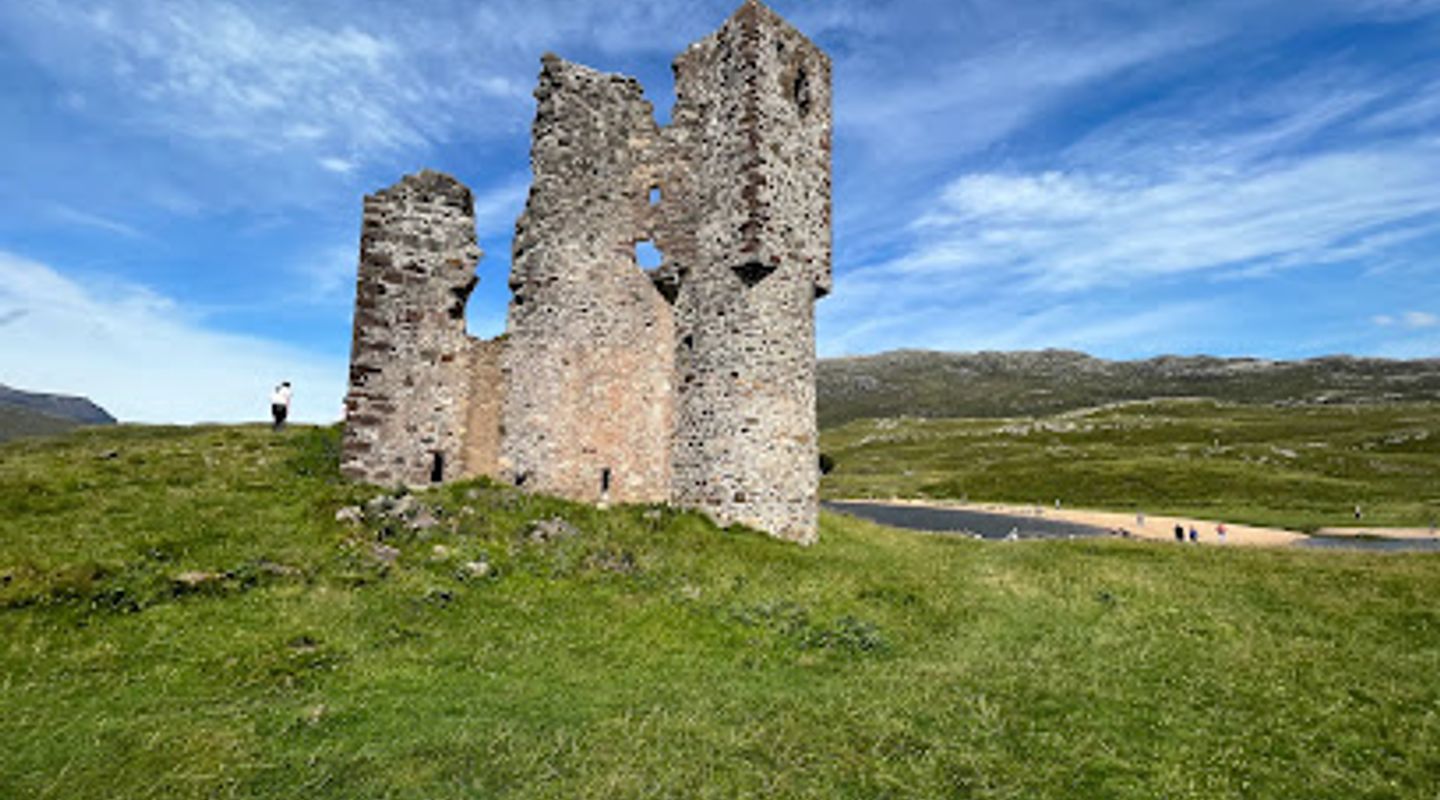
A brief summary of Ardvreck Castle
Explore the evocative ruins of Ardvreck Castle, a 15th-century Highland fortress steeped in history, legend, and stunning lochside scenery.
Ardvreck Castle is a dramatic ruined 15th-century tower house perched on a promontory into Loch Assynt in Sutherland, Scotland. Built around 1490 by Clan MacLeod, it is steeped in history, including the betrayal and capture of the Royalist Marquis of Montrose in 1650. Though now a fragment of its former self, the castle’s atmospheric remains, surrounded by rugged Highland landscapes, offer a poignant glimpse into Scotland’s turbulent past.
On-site amenities
 Information boards
 Seating areas
 Trash bins
Opening hours
- Every dayOpen 24 hours
Opening hours as listed on the venue’s Google Business Profile. Hours can change for services and special events, so check with the venue before you go.
- Address
- Lairg IV27 4HL
- Website
Getting there
Car
Bus and Walking
Walking
Discover more about Ardvreck Castle
Origins and Strategic Location of Ardvreck Castle
Ardvreck Castle was constructed circa 1490 by the Clan MacLeod of Assynt, serving as their stronghold in the remote Scottish Highlands. The castle was built as a three-storey tower house, a typical defensive residence of the period, designed to withstand clan conflicts and external threats. Its placement on a narrow promontory jutting into Loch Assynt provided natural defenses, with a dry stone wall and traces of a defensive ditch enhancing its security. The castle’s thick stone walls, narrow windows, and vaulted basement reflect its dual role as a fortress and noble residence.
A Notorious Historical Episode: The Marquis of Montrose’s Capture
Ardvreck Castle is famously linked to the dramatic capture of James Graham, the 1st Marquis of Montrose, in 1650. After his defeat at the Battle of Carbisdale, Montrose sought refuge here, only to be betrayed by Christine MacLeod, the wife of the castle’s owner, Neil MacLeod. Montrose was tricked into the castle dungeon and handed over to government forces, leading to his execution in Edinburgh. This episode remains one of the most infamous betrayals in Scottish history, marking Ardvreck as a site of political intrigue and tragedy.
Decline, Capture, and the Rise of Calda House
In 1672, the castle was captured by the Clan Mackenzie of Assynt after a 14-day siege, signaling a shift in regional power. The Mackenzies soon commissioned Calda House nearby in 1726, a more modern and comfortable residence intended to replace Ardvreck Castle. However, financial difficulties and political upheavals, including the Jacobite Rising of 1745, led to the abandonment and eventual ruin of both structures. Calda House was burned down in 1737 and again in 1760, while Ardvreck Castle was left to decay, its stones partly recycled for the newer house.
Architectural Features and Present-Day Ruins
Today, Ardvreck Castle survives as a haunting finger of stone reaching skyward. Remnants include the corbelled stair tower, vaulted cellar, and portions of thick defensive walls. Unlike the more complex Z-plan castles of the era, Ardvreck’s compact design focuses on practicality and defense. The site includes a dry stone wall marking the old defensive perimeter and offers panoramic views of Loch Assynt and the surrounding mountains. The ruins evoke a melancholic atmosphere, enhanced by the harsh Highland weather that has weathered the stone over centuries.
Local Legends and Ghostly Tales
The castle is steeped in folklore, including tales of a weeping woman’s ghost, said to be the daughter of a MacLeod chief who tragically drowned or transformed into a selkie after a pact with the Devil. Another ghost story speaks of a tall man clad in grey haunting the ruins. These legends contribute to Ardvreck’s eerie and romantic aura, attracting visitors intrigued by its mysterious past and spectral lore.
Visiting Ardvreck Castle Today
Accessible via a well-maintained path from a nearby parking area, Ardvreck Castle offers visitors a chance to explore one of Scotland’s most atmospheric ruins. The site’s information boards provide historical context, while the surrounding landscape delivers some of the finest views in central Sutherland. Though only fragments remain, the castle’s story of loyalty, betrayal, and resilience continues to resonate amid the tranquil beauty of Loch Assynt.
Evendo Review Centre
 Google
Guest reviews
Best time to go
Quietest: Jan, Feb & Dec · before 6am or at 9pm
Busy times are Evendo estimates for a typical year, to help you plan. Actual crowds vary with events, school holidays and the weather.
Explore Ardvreck Castle on the map
A handpicked selection of must-see spots near Ardvreck Castle, mapped for you.
Get your free copy of our complete guide to Ardvreck Castle, delivered straight to you.
Everything on this page, from opening hours and how to get there to Eve’s tips and the best time to go, in one PDF you can read offline, print or share.
Already have an account? Sign in
Your Ardvreck Castle guide is ready.
We'll send it to · Not you? Sign out

Getting your guide ready…
We are putting together a fresh copy of the Ardvreck Castle guide. This can take up to a minute.
This can take a few moments. If your browser asks, choose Allow so the download can start. You'll find the guide in your Downloads folder.
Nothing happened? Download it again
Sorry, the guide is taking longer than usual. Please try again in a minute, or get it by email instead.
Unlock the best of Ardvreck Castle
Skip-the-line tickets, guided tours with entry, and walking tours of the area, booked in a few clicks.
 Tour with entry
Scottish Highlands Adventure Small Group Tour from Inverness
from $75.40 Tour with entry
Ullapool Port Ardvreck Castle and the Highlands of Assynt
from $162.66 Tour with entry
Ullapool Shore Excursion Castles, Beaches and Coastal Views Tour
from $200.49 Tour with entry
3-Day North Coast 500 Small-Group Tour from Inverness
from $703.41
Other nearby places you may find interesting
The closest places of the same kind, if this one is not quite what you had in mind.
-
-
-
-
-


Swipe for more places
More to explore near Ardvreck Castle

 Best experiences near Ardvreck Castle
 Best hotels near Ardvreck Castle
 Best landmarks near Ardvreck Castle
 Best attractions near Ardvreck Castle
 Best shops near Ardvreck Castle
 Best restaurants near Ardvreck Castle
 Best bars near Ardvreck Castle
Do you manage this location?
Take control to get all the benefits, like improved information, better appearance, and stronger visibility across AI-powered discovery.
Explore more
Explore more of Sutherland
Discover Sutherland, the untamed beauty of the Scottish Highlands, where rugged landscapes, serene lochs, and dramatic coastlines await the adventurous traveler.
Explore Sutherland
Explore more of United Kingdom
Discover the United Kingdom: A blend of rich history, stunning landscapes, and vibrant cities, offering a unique travel experience for every visitor.
Explore United Kingdom
