
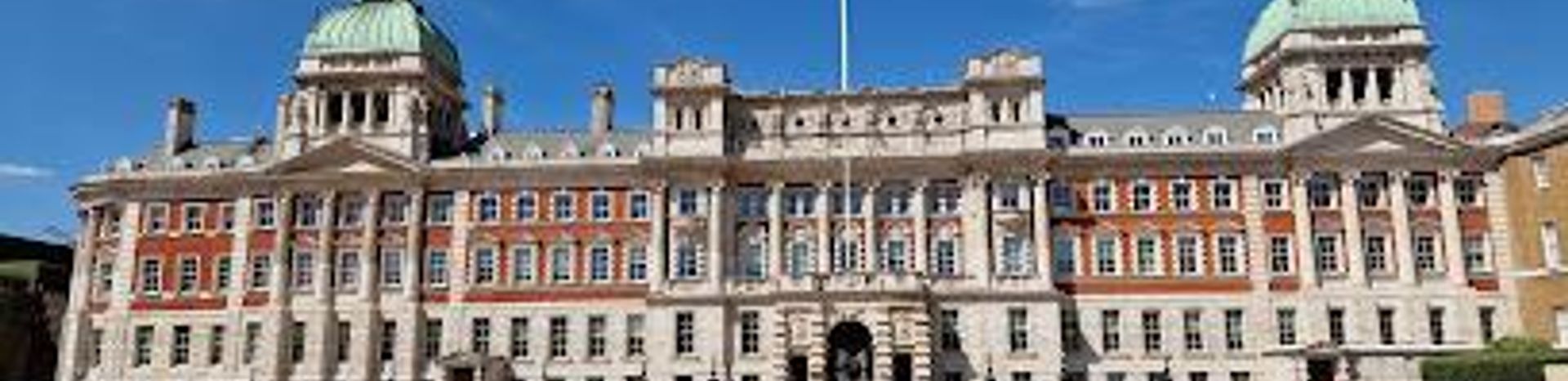
Old Admiralty Building, London
Historic heart of Britain’s naval command, blending grand architecture with pivotal moments in London’s maritime legacy.
Architectural Grandeur and Historic Origins
The Old Admiralty Building, completed in 1905, stands prominently on Whitehall, London, adjacent to Horse Guards Parade. It is a Grade II listed structure characterized by its red brick and Portland stone construction, slate and lead roofs, and detailed French Grand Siècle and English Baroque stylistic elements. Designed as a purpose-built government office block, it replaced smaller townhouses to accommodate the expanding civil service needs of the Admiralty. The building’s distinctive copper-topped towers, now verdigris green, and its grand facade symbolize the prestige and power of the British Empire during the height of its naval supremacy.Role in British Naval History and Government
For over a century, the Old Admiralty Building was the nerve center of the Royal Navy’s global affairs. It housed the Lords Commissioners of the Admiralty who directed naval operations until the Admiralty was subsumed into the Ministry of Defence in 1964. The building contains historically significant rooms such as the Admiralty Board Room, featuring exquisite carvings attributed to Grinling Gibbons’ workshop, and the room where Admiral Nelson’s body lay overnight before his state funeral in 1806. It was also the site where critical WWII operations were planned, including the famous deception plan Operation Mincemeat.Notable Figures and Cultural Legacy
The Old Admiralty Building has been associated with many notable historical figures. Winston Churchill worked here as First Lord of the Admiralty, and Ian Fleming, the creator of James Bond and a former naval intelligence officer, was based in the building’s famed Room 39. The character “M” in the Bond series is believed to be inspired by Admiral John Godfrey, Fleming’s superior. The building’s rich legacy extends into cultural diplomacy through the Government Art Collection housed within, featuring over 15,000 works spanning centuries.Modern Adaptations and Preservation
Between 2016 and 2021, the Old Admiralty Building underwent extensive restoration and modernization, including the replacement of bespoke lifts and asbestos removal, to meet contemporary government office standards while preserving its historic fabric. It now serves as the London headquarters of the Department for Business and Trade, continuing its role as a vital government hub. Despite its active use, public access to the interior is restricted, but the building remains a focal point for historical tours and ceremonial events in central London.Surrounding Context and Visitor Experience
Situated in the heart of Whitehall, the Old Admiralty Building is surrounded by other historic landmarks such as Admiralty Arch, Horse Guards Parade, and St. James’s Park. Its imposing presence and architectural beauty make it a popular subject for photography and a significant stop on London sightseeing routes. Visitors can appreciate the building’s exterior grandeur and its place within the rich tapestry of Britain’s naval and governmental history, enhanced by the nearby green spaces and ceremonial routes.Symbol of Maritime Heritage and National Identity
The Old Admiralty Building stands as a testament to Britain’s maritime heritage and its evolution as a modern state. Its enduring presence reflects centuries of naval power, government administration, and cultural significance. As part of the historic Admiralty complex, it connects the past with the present, symbolizing the continuity of British governance and the nation’s global maritime legacy.Local tips
- Admire the building’s exterior and architectural details, as interior access is restricted due to government use.
- Visit nearby landmarks such as Horse Guards Parade and St. James’s Park to enrich your historical experience.
- Explore the surrounding Whitehall area on foot to appreciate the ceremonial route and other historic government buildings.
- Photography enthusiasts should capture the building’s distinctive red brick facade and verdigris copper towers in natural light.

A brief summary to Old Admiralty Building
- London, GB
Getting There
-
London Underground
Take the Jubilee or District Line to Westminster Station, then walk approximately 8–12 minutes through Parliament Square and along Whitehall to reach the Old Admiralty Building. The station is well-serviced with frequent trains; a single journey costs around £2.50–£4.00 with an Oyster card or contactless payment.
-
Bus
Several bus routes, including numbers 11, 24, and 148, stop near Whitehall and Horse Guards Parade. Travel times vary from 15 to 30 minutes depending on traffic. Bus fares are approximately £1.75 with contactless payment. Buses provide a scenic approach but may be slower during peak hours.
-
Walking
If you are near Trafalgar Square or Buckingham Palace, walking to the Old Admiralty Building takes about 10–15 minutes on mostly flat, paved terrain. This route offers views of key London landmarks and is accessible for most visitors.


