

Pô Travel Guide - Free Web & App
Your ultimate guide to Pô. Discover top landmarks, proposed trips, and local tips. Free on the web or via the Evendo companion app.


Pô, Burkina Faso, opens onto Nahouri’s hills, Kassena heritage, Kaboré-Tambi landscapes and wildlife excursions near the Ghana border, from a southern gateway town.
A Southern Gateway
Pô is a small town in Burkina Faso’s Nahouri Province, close to the Ghanaian border and roughly 140 kilometres south of Ouagadougou by road. Its importance to visitors lies less in urban attractions than in its position among the wooded savannahs, escarpments and culturally distinctive communities of the country’s south. The town is a practical base for exploring the surrounding Nahouri landscape, although travel should be planned carefully because security conditions and access arrangements can change.Read more about Pô
Landscape and Wildlife
Kassena Heritage
When is the best time to visit Pô?
Best: December–February · 39–42°C| Month | High (°C) | Rainfall (mm) |
|---|---|---|
| January (best) | 39 | 0 |
| February (best) | 42 | 0 |
| March | 47 | 0 |
| April | 49 | 6 |
| May | 48 | 47 |
| June | 44 | 108 |
| July | 43 | 189 |
| August | 43 | 170 |
| September | 42 | 106 |
| October | 43 | 55 |
| November | 42 | 11 |
| December (best) | 40 | 0 |
Getting to and around Pô
How to get there
Transportation
Best attractions in Pô
Pô’s principal attractions lie in the landscapes surrounding the town. The Nahouri massif provides the area’s defining hills and opportunities for guided walks where access is appropriate, while Kaboré-Tambi National Park, formerly known as Pô National Park, protects extensive wooded savannah and seasonal waterways. Nearby Nazinga is associated with managed wildlife viewing, particularly elephants and other large mammals, although sightings and access depend on season, conservation arrangements and security conditions. The cultural highlight is Tiébélé, a nearby Kassena town famed for decorated earthen compounds marked with geometric designs and maintained within a living architectural tradition. Pô itself offers a modest provincial-town atmosphere, local markets and a useful base for arranging transport, provisions and guides. The attraction of the wider area is therefore cumulative: hills, woodland, wildlife and distinctive settlement traditions rather than a concentration of formal museums or urban monuments.
-
 Garden
Po
Experience the tranquility of Po Gardens in Pô, a lush haven of biodiversity and beauty perfect for relaxation and exploration.
-
Park
Parc w
Explore the tranquil beauty of Parc W in Pô, Burkina Faso, a serene park perfect for nature lovers and peaceful retreats.
-
Tourist attraction
Po-Eco-village
Experience sustainable living at Po-Eco-village, a unique eco-tourism destination in Burkina Faso that blends culture, nature, and community in harmony.

Best landmarks in Pô
The Nahouri massif is Pô’s most powerful natural landmark, rising above the surrounding savannah and giving the province its geographical identity. The wider woodland and seasonal watercourses of Kaboré-Tambi National Park form an important protected landscape, while the adjacent Nazinga area is recognised for wildlife-management and elephant habitat rather than monumental architecture. Tiébélé’s decorated Kassena compounds are the region’s most significant cultural landmark: their painted geometric façades, earthen construction and enclosed domestic layouts express a living architectural heritage. The Ghanaian frontier is also a defining geographical feature, placing Pô within a historically connected southern border zone. These landmarks are dispersed across town, countryside and neighbouring communities, so their significance is best understood through the relationship between terrain, settlement, conservation and regional identity.
-
Market
Place du Marché de Tiébélé
Experience the vibrant culture of Burkina Faso at Place du Marché de Tiébélé, a bustling hub of local crafts, produce, and traditions.

Explore Pô on the map
Plan your trip on one map. See where the top attractions, landmarks, restaurants and hotels are, and book hotels and experiences in a few clicks.
Best hotels in Pô
Best bars in Pô
Pô has a quiet evening scene shaped by local cafés, informal drinking places and neighbourhood bars rather than nightclubs or a substantial entertainment district. Evenings may involve conversation, music and refreshments in town, but opening times, atmosphere and availability are variable. Outside Pô, particularly around Tiébélé and rural wildlife areas, nightlife infrastructure is very limited and evenings are generally spent at accommodation or within organised local arrangements. Visitors should avoid moving around unfamiliar rural areas after dark, especially when security conditions, road quality and communications are uncertain. Ouagadougou offers much broader entertainment options, but it is outside the Pô destination and should be treated as a separate urban stop rather than an extension of the local evening scene.
-
Restaurant
Tantie Energie
Discover authentic local cuisine at Tantie Energie, a vibrant restaurant in Pô, where every dish tells a story of culinary tradition.
-
Restaurant
Le Glacier Burkina Faso
Savor authentic Burkinabe cuisine at Le Glacier, a vibrant restaurant in Pô known for its delightful dishes and inviting atmosphere.
-
Bar
Maquis Espace Barbara
Experience the vibrant nightlife at Maquis Espace Barbara, a lively bar in Nahouri known for its music and affordable drinks.
-
Restaurant
Restaurant Eliqua
Discover authentic local flavors at Restaurant Eliqua in Pô, where every dish tells a story of Burkina Faso's rich culinary heritage.


Best shops in Pô
Shopping in Pô is practical and local, with everyday goods, foodstuffs, clothing and household necessities concentrated around the town’s market areas and small shops. Visitors may find locally produced grains, vegetables, prepared foods and other provisions for journeys into the countryside, while crafts and textiles are more likely to be encountered through community contacts or in larger regional markets than in a dedicated tourist shopping quarter. Tiébélé and the wider Kassena area are associated with distinctive architectural and artistic traditions, but visitors should buy crafts respectfully and avoid materials that appear to come from cultural sites or protected landscapes. Retail choice becomes more limited beyond Pô, so specialised equipment, medicines and travel supplies are better obtained before leaving Ouagadougou or another major urban centre.
-
Shopping mall
Nerwaya Yaourt
Discover the vibrant Nerwaya Yaourt Shopping Mall in Pô, where local culture meets a shopper's paradise.
-
Electronics store
Wend Panga Telecom
Explore cutting-edge technology and exceptional service at Wend Panga Telecom in Pô, Burkina Faso, your go-to electronics store for all your tech needs.
-
Computer store
NAHOURI TECH
Explore Nahouri Tech, a vibrant computer store in Pô, offering custom t-shirt printing and a unique blend of technology and creativity.
-
Consignment shop
TotalEnergies PÔ
Explore TotalEnergies PÔ in Pô, Burkina Faso, for unique consignment treasures and authentic local craftsmanship.


Get your free copy of our complete guide to Pô, delivered straight to you.
Everything on this page, from attractions and restaurants to essentials and local phrases, in one PDF you can read offline, print or share.
Already have an account? Sign in
Your Pô guide is ready.
We'll send it to · Not you? Sign out

Getting your guide ready…
We are putting together a fresh copy of the Pô guide. This can take up to a minute.
This can take a few moments. If your browser asks, choose Allow so the download can start. You'll find the guide in your Downloads folder.
Nothing happened? Download it again
Sorry, the guide is taking longer than usual. Please try again in a minute, or get it by email instead.
Pô essentials
Currency and Payment
Safety
Emergency Situations
Do's and Don'ts
Local Tips
From Eve
Local phrases worth knowing
You don't need to get them perfect. A few words go a long way, and locals appreciate the effort.
Basics
| English | Local | Say it |
|---|---|---|
| Hello | Salut | [sa-LOO] |
| Goodbye | Adieu | [ah-DYOO] |
| Yes | Oui | [wee] |
| No | Non | [nohn] |
| Please/You're welcome | S'il vous plaît | [seel voo PLEH] |
| Thank you | Merci | [mehr-SEE] |
| Excuse me/Sorry | Pardon | [pahr-DOHN] |
| How are you? | Comment ça va? | [koh-mohn sa vah] |
| Fine. And you? | Bien. Et toi? | [byen. ay twah] |
| Do you speak English? | Parlez-vous anglais? | [pahr-lay voo ahn-GLAY] |
| I don't understand | Je ne comprends pas | [zhuh nuh kohm-PRAHND pah] |
Eating & Drinking
| English | Local | Say it |
|---|---|---|
| I'd like to see the menu, please | Je voudrais voir le menu, s'il vous plaît | [zhuh voo-DREH vwahr luh meh-NOO seel voo PLEH] |
| I don't eat meat | Je ne mange pas de viande | [zhuh nuh mahnj pah duh vee-AND] |
| Cheers! | Santé! | [sahn-TAY] |
| I would like to pay, please | Je voudrais payer, s'il vous plaît | [zhuh voo-DREH pay-YEH seel voo PLEH] |
Emergencies
| English | Local | Say it |
|---|---|---|
| Help! | Au secours! | [oh suh-KOOR] |
| Go away! | Allez-vous en! | [ah-lay voo zahn] |
| Call the Police! | Appelez la police! | [ah-pleh lah pee-LEES] |
| Call a doctor! | Appelez un médecin! | [ah-pleh uhn meh-duh-SAN] |
| I'm lost | Je suis perdu(e) | [zhuh swee pair-DYUH] |
| I'm ill | Je suis malade | [zhuh swee mah-LAHD] |
Shopping
| English | Local | Say it |
|---|---|---|
| I'd like to buy... | Je voudrais acheter... | [zhuh voo-DREH ash-TEH...] |
| I'm just looking | Je regarde juste | [zhuh ruh-GAHRD zhoo-st] |
| How much is it? | Combien ça coûte? | [kohm-BYEH sah KOOHT] |
| That's too expensive | C'est trop cher | [say troh shehr] |
| Can you lower the price? | Pouvez-vous baisser le prix? | [poo-VEH voo beh-SAY luh pree] |
Time & Numbers
| English | Local | Say it |
|---|---|---|
| What time is it? | Quelle heure est-il? | [KEHL uhr eh-TEEL] |
| It's one o'clock | Il est une heure | [eel eh oon uhr] |
| Half past (10) | Dix et demi | [dees ay duh-MEE] |
| Morning | Matin | [mah-TAN] |
| Afternoon | Après-midi | [ah-PRAY mee-DEE] |
| Evening | Soir | [swahr] |
| Yesterday | Hier | [yehr] |
| Today | Aujourd'hui | [oh-zhoor-DWEE] |
| Tomorrow | Demain | [duh-MAN] |
| 1 | Un | [uhn] |
| 2 | Deux | [duh] |
| 3 | Trois | [twah] |
| 4 | Quatre | [kahtr] |
| 5 | Cinq | [sank] |
| 6 | Six | [sees] |
| 7 | Sept | [sett] |
| 8 | Huit | [weet] |
| 9 | Neuf | [nuhf] |
| 10 | Dix | [dees] |
Transport & Directions
| English | Local | Say it |
|---|---|---|
| Where's a/the...? | Où est...? | [OO eh...] |
| What's the address? | Quelle est l'adresse? | [KEHL eh lah-DREHS] |
| Can you show me (on the map)? | Pouvez-vous me montrer (sur la carte)? | [poo-VEH voo muh mohn-TRAY (soor lah kart)] |
| When's the next (bus)? | Quand est le prochain (bus)? | [kahnd eh luh proh-SHAN (boos)] |
| A ticket (to ....) | Un billet (pour ...) | [uhn bee-YAY (poor ...)] |
History of Pô
A Landscape Shaped by Ancient Earth
The hills around Pô belong to the southern Burkina Faso zone where wooded savannah meets more elevated and seasonally wetter terrain. The Nahouri massif is the area’s most recognisable physical feature, rising prominently above the surrounding plains. Its geological story is far older than human settlement, while the seasonal rivers, woodland and grassland have influenced where communities farm, graze animals and establish settlements. The combination of hill country and savannah also helped give the southern border region a character distinct from the drier landscapes of northern Burkina Faso.
Mossi and Kassena Cultural Landscapes
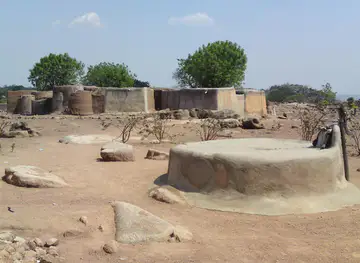
Pô lies within a culturally complex part of Burkina Faso, where Mossi political influence and Kassena cultural traditions have long shaped settlement and identity. Kassena communities are particularly associated with decorated earthen architecture, in which geometric motifs are painted onto house façades and renewed as part of community life. Tiébélé, southwest of Pô, remains the best-known expression of this tradition. These compounds are not simply historic displays: they are homes and social spaces whose designs reflect local ideas of protection, status and belonging.
Colonial Borders and Regional Connections
During the colonial period, the area was incorporated into French West Africa and administered within the territory that later became Upper Volta, now Burkina Faso. The modern frontier with Ghana formalised an older zone of movement, trade and cultural contact rather than creating an entirely new relationship between neighbouring communities. Pô’s position on the southern route from Ouagadougou consequently gave it continuing importance as a provincial and transport centre. The town’s history is therefore closely linked to roads, administration, cross-border exchange and the surrounding rural economy.
Protected Landscapes and Wildlife Management
The wooded savannah south and east of Pô became the focus of state conservation and wildlife-management initiatives during the twentieth century. Kaboré-Tambi National Park, formerly called Pô National Park, protects a large area of savannah and drainage corridors, while the nearby Nazinga Game Ranch was established as a managed wildlife area in the late twentieth century. These landscapes reflect an ongoing tension between habitat protection, farming, pastoral use and tourism. Conservation conditions, access and visitor facilities can change, making current local guidance essential before entering protected areas.
Pô in Photos
Browse through our photo collection highlighting the charm and character of the destination.
Neighbouring destination travel guides
The closest destinations to Pô, if you have time for more than one.
-
-

-
-

-


Swipe for more destinations
Explore more

Explore more of Centre-South
Centre-South Burkina Faso combines Kassena architecture, Pô’s savanna landscapes, wildlife areas and rural markets in the country’s southern belt.
Explore Centre-South
Explore more of Burkina Faso
Discover Burkina Faso: An authentic African destination with rich culture, stunning landscapes, and warm hospitality, offering a memorable and enriching travel experience.
Explore Burkina Faso