Background

Superkilen Park

A bold, three-part urban park in Nørrebro where neon geometry, global design objects and soft green lawns turn everyday Copenhagen into a multicultural playground.

4.2

Superkilen Park is Copenhagen’s bold, multicultural playground in the heart of Nørrebro, a long, wedge-shaped urban park that doubles as an open‑air design gallery. Split into the electric Red Square, the striped Black Market and the leafy Green Park, it weaves bike lanes, playgrounds and sports courts through a landscape dotted with objects from more than 50 countries. Part social experiment, part neighborhood backyard, it’s a vibrant place to linger, photograph and people‑watch at any time of day.

A brief summary to Superkilen Park

  • Nørrebrogade 210, Copenhagen, Nørrebro, 2200, DK
  • Visit website
  • Duration: 1 to 3 hours
  • Free
  • Environment icon Outdoor
  • Mobile reception: 5 out of 5
  • Monday 12 am-12 am
  • Tuesday 12 am-12 am
  • Wednesday 12 am-12 am
  • Thursday 12 am-12 am
  • Friday 12 am-12 am
  • Saturday 12 am-12 am
  • Sunday 12 am-12 am

Local tips

  • Bring a camera or phone with plenty of battery – the Red Square’s bold colors, striped Black Market and cherry trees in the Green Park are exceptionally photogenic.
  • If you enjoy quieter moments, come in the early morning or later evening when the bike traffic thins and the plazas feel more spacious.
  • Pack snacks or a simple picnic for the Green Park; seating is scattered, but the grassy mounds make comfortable informal spots.
  • Look out for small plaques near some objects to learn which country they reference – spotting and decoding them turns the walk into a gentle scavenger hunt.
  • In spring, time your visit for cherry blossom season when parts of the Green Park are covered in pink petals, adding another layer of color to the design.
widget icon

Getting There

  • Metro and bus

    From central Copenhagen, take the M3 Cityringen metro to Nørrebro Station, a ride of about 8–10 minutes, with trains running every few minutes. From there, local buses toward Nørrebro Parken or Tagensvej bring you close to Superkilen in roughly 5–10 minutes, with typical single tickets in the Copenhagen area costing around DKK 20–30 depending on zones. Services run frequently throughout the day, and vehicles are low-floor, making this option convenient for wheelchairs and strollers.

  • Bicycle

    Cycling from the historic center to Superkilen usually takes 15–25 minutes, depending on your starting point and pace. Copenhagen’s dense network of separated cycle lanes includes a major bike route that passes directly through the park, so the approach is straightforward and comfortable for most riders. You can rent a city bike or from private rental shops, with typical rates starting around DKK 100–150 per day. Be prepared for moderate traffic at peak commuting times, though drivers and cyclists are generally accustomed to sharing the road.

  • Taxi or rideshare

    A taxi from central Copenhagen to Nørrebrogade near Superkilen typically takes 10–20 minutes, depending on traffic, and costs in the region of DKK 120–200. This is the most direct option if you are traveling with luggage, young children, or have limited mobility. Taxis can usually drop you on nearby side streets, from which the park’s entrances are a short, level walk, but parking for private cars in the neighborhood is regulated and can be limited at busy times.

Superkilen Park location weather suitability

  • Weather icon Any Weather
  • Weather icon Clear Skies
  • Weather icon Mild Temperatures
  • Weather icon Hot Weather
  • Weather icon Cold Weather

Unlock the Best of Superkilen Park

Buy tickets

    No tickets available

Book tours with entry

    No tours available

Book tours without entry

    No tours available

Discover more about Superkilen Park

A vivid slice of global culture in Nørrebro

Superkilen Park stretches like a colorful ribbon through Nørrebro, one of Copenhagen’s most diverse districts. Conceived as a celebration of the neighborhood’s many backgrounds, it turns an ordinary strip of urban land into a surreal world exhibition, where everyday objects from dozens of countries share space with bold contemporary design. Everywhere you look, something familiar sits beside something surprising: a streetlamp model from one continent, a bench from another, a fountain from yet another. Designed by the Bjarke Ingels Group in collaboration with artists Superflex and landscape architects Topotek1, the park opened in 2012 with a clear mission: to let local residents see their own heritage reflected in public space. The result feels both intensely local and quietly global – a community living room that tells stories from far beyond Denmark.

The Red Square’s electric geometry

At the southern end you step into the Red Square, the park’s most photographed section. Underfoot, waves of red, pink and orange paint roll across the asphalt in sharp geometric patterns, wrapping around basketball hoops, small stages and seating. The atmosphere here is energetic and urban, closer to an outdoor plaza than a traditional park. Cafés and sports facilities spill activity into the square, while smooth surfaces tempt skateboarders and scooter riders. The strong colors make everything pop: cyclists streak past in neon layers, children dart between sculptural objects, and the whole scene becomes an ever‑changing backdrop for photographers. Even when it is quiet, the vibrant palette lends the space an almost cinematic quality.

The Black Market’s graphic stripes

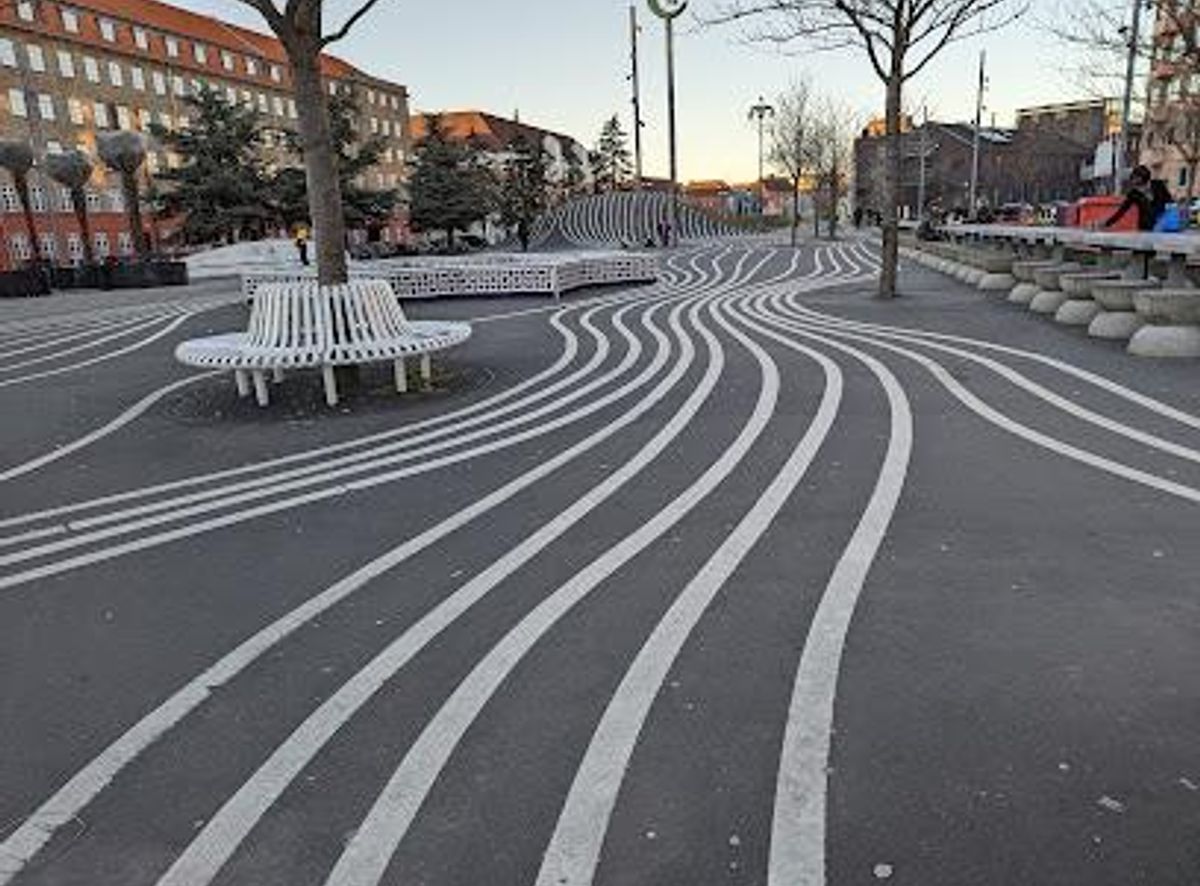
Moving north, the mood shifts on the Black Market, a wide expanse of dark asphalt wrapped in stark white lines. These stripes swoop and bend across the ground and up low walls, visually pulling the space together and guiding your eye toward clusters of benches, chess tables and a central fountain. This is the contemplative heart of Superkilen, a place to linger over a game, meet friends on curved benches from far‑flung cities, or sit by a Moroccan-style fountain and listen to the splash of water. The graphic patterning remains playful, but the color palette is restrained, allowing the imported objects – lamp posts, swings, even roadside fixtures – to stand out as small monuments to everyday life elsewhere.

The Green Park’s softer contours

At the northern end, hard edges melt into lawns, small hills and playgrounds in the Green Park. Here, the design loosens into a more traditional sense of greenery: clusters of trees, including much‑loved Japanese cherry trees that explode into blossom in spring, surround winding paths and picnic corners. Families gravitate to climbing frames, slides and sports areas, while dog walkers and joggers share the softer surfaces. The park’s famous black octopus slide, inspired by Japanese playground design, adds a touch of whimsy against the grass. In warm weather this section feels almost like a neighborhood garden, with blankets spread on the lawns and barbecues scenting the air.

Objects, stories and community threads

Scattered throughout Superkilen are more than fifty design objects sourced or replicated from around the world, chosen with input from local residents. You might pass a battered‑looking neon sign in a foreign script, a set of swings based on Iraqi designs, or a Brazilian bench that invites you to sit and imagine the climate it came from. Many items carry small plaques explaining their origin, turning a casual stroll into a low‑key cultural lesson. The idea is not to create a polished museum, but to fold personal memories and migrant histories into the everyday landscape of the city. In doing so, Superkilen quietly challenges older ideas of national identity and instead presents diversity as something playful, tangible and woven into daily routines.

Experiencing the park throughout the day

Because a major bike route cuts straight through it, Superkilen never fully switches off. Mornings bring commuters streaming along the cycle path, framed by almost empty plazas. By afternoon the playgrounds fill up, basketballs echo in the Red Square and picnic groups stake out spots in the Green Park. As evening falls, lighting and lingering daylight transform the colored surfaces in different ways. The Red Square glows softly, the Black Market’s stripes sharpen into crisp contrasts, and shadows stretch across the lawns. Whether you come to photograph its architecture, to let kids run free, or simply to absorb a different side of Copenhagen, the park rewards slow wandering and repeated visits, each time revealing another detail that slipped past before.

Busiest months of the year

Busiest hours of the day

Popular Experiences near Superkilen Park

Popular Hotels near Superkilen Park

Select Currency