Background

Gutenberg Monument: A Tribute to Printing

A historical landmark in Frankfurt's city center, commemorating Johannes Gutenberg's revolutionary invention of printing with movable type and its impact on the world.

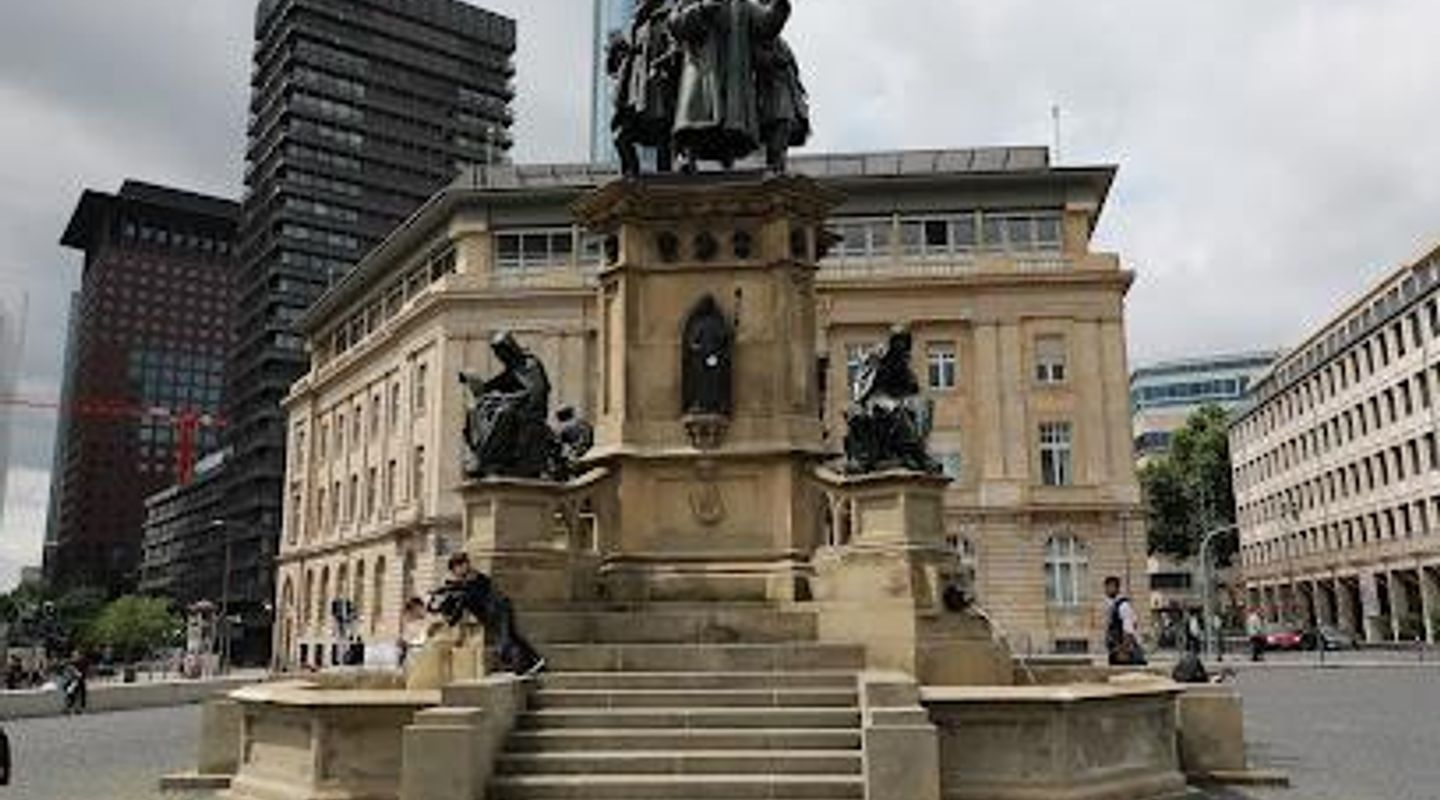
The Gutenberg Monument, standing proudly on Frankfurt's Roßmarkt, commemorates Johannes Gutenberg, the inventor of printing with movable type, and his Frankfurt-based collaborators, Johannes Fust and Peter Schöffer. Erected in the late 1850s, the neo-Gothic sandstone fountain features statues of the three pivotal figures, along with allegorical representations of theology, poetry, industry, and science, reflecting the impact of printing on these fields. The monument also displays medallion portraits of famous printers and the coat of arms of cities significant in the history of printing. Located in the heart of Frankfurt, it serves as a reminder of the city's historical connection to this groundbreaking invention and its role in disseminating knowledge. A visit to the Gutenberg Monument offers a chance to reflect on the profound impact of printing on society and culture.

A brief summary to Gutenberg-Denkmal

  • Roßmarkt, Frankfurt, Innenstadt I, 60311, DE

Local tips

  • Visit during the Frankfurt Christmas Market for a festive atmosphere with the monument illuminated amidst holiday stalls.
  • Combine your visit with a stroll along the Zeil, Frankfurt's famous shopping street, located nearby.
  • Take a moment to appreciate the allegorical figures at the base, representing the impact of printing on theology, poetry, industry, and science.
widget icon

Getting There

  • Public Transport

    The Gutenberg Monument is easily accessible via Frankfurt's efficient public transport system. Take the U-Bahn (subway) lines U1, U2, U3, U8 or the S-Bahn (suburban train) lines S1-S6, S8, S9 to Hauptwache station. From Hauptwache, it's a short 2-minute walk west along the pedestrian zone to Roßmarkt. Single ride tickets cost approximately €2.75.

  • Walking

    From the Hauptbahnhof (Frankfurt Central Station), the Gutenberg Monument is approximately a 20-minute walk. Head northeast along Kaiserstraße, a major thoroughfare, until you reach Roßmarkt on your left. The monument is located in the center of the square.

  • Taxi/Ride-Share

    A taxi or ride-share from Frankfurt Central Station to the Gutenberg Monument will take approximately 5-10 minutes, depending on traffic. The estimated fare is between €10-€15. Ask to be dropped off at Roßmarkt.

  • Driving

    Driving to the Gutenberg Monument is possible, but parking in the immediate vicinity can be challenging and expensive. Several parking garages are located near Roßmarkt, including the Hauptwache multi-story car park (Kornmarkt 10) and the MyZeil - PalaisQuartier APCOA (Große Eschenheimer Straße 10). Hourly parking rates typically range from €3-€5, with daily maximums around €25-€30. Be aware of heavy traffic in the city center, especially during peak hours.

Unlock the Best of Gutenberg-Denkmal

Buy tickets

    No tickets available

Book tours with entry

    No tours available

Book tours without entry

    No tours available

Discover more about Gutenberg-Denkmal

The Gutenberg Monument, a prominent landmark gracing Frankfurt's Roßmarkt, stands as a lasting tribute to Johannes Gutenberg, the ingenious inventor of printing with movable type. More than just a statue, it's a celebration of the power of the printed word and its transformative impact on society. The monument also honors Gutenberg's colleagues, Johannes Fust and Peter Schöffer, who were instrumental in bringing his vision to life in Frankfurt. The monument's history dates back to the mid-19th century when, in 1840, sculptor Eduard Schmidt von der Launitz created terracotta statues of the three printers for the city's 400th-anniversary celebration of Gutenberg's invention. These statues were met with great public enthusiasm. However, the actual monument wasn't erected until later, between 1856 and 1858, replacing a former Hercules fountain on the Roßmarkt. The monument was officially inaugurated on October 20, 1858. The Gutenberg Monument is a neo-Gothic sandstone structure with a fountain. Three life-size statues of Johannes Gutenberg, Johannes Fust, and Peter Schöffer stand on the monument's base. Gutenberg, the central figure, is often depicted holding a book and letters, symbolizing his revolutionary invention. Fust, Gutenberg's financier, is shown with books on his arm, while Schöffer, who took over Gutenberg's workshop, is represented with a stamping hammer, representing his contributions to the printing process. Beneath the main cornice, fourteen medallion portraits of renowned letterpress printers are displayed, each bearing their name in inscription. These portraits serve as a reminder of the many individuals who contributed to the development and spread of printing across Europe. Below the medallion portraits are escutcheons displaying the coat of arms of cities that played a vital role in the early history of printing, including Mainz, Strasbourg, Venice, and Frankfurt. These cities were centers of innovation and commerce, fostering the growth of the printing industry. At the base of the monument, allegorical figures representing theology, poetry, industry, and science sit at the corners. These figures symbolize the profound impact that printing had on these key areas of human endeavor. Printing facilitated the spread of religious ideas, enabled the creation and dissemination of literature, fostered industrial growth through the printing of manuals and technical documents, and promoted scientific inquiry by making knowledge more accessible. The monument is a fountain, with water flowing from spouts located beneath the allegorical figures. The fountain adds to the monument's aesthetic appeal and provides a refreshing oasis in the bustling city center. The Gutenberg Monument is located on the Roßmarkt, a centrally located square in Frankfurt's Innenstadt district. The square is a hub of activity, with shops, restaurants, and cafes surrounding the monument. The Roßmarkt is also a transportation hub, with several subway and tram lines converging at the nearby Hauptwache station. Visiting the Gutenberg Monument offers a chance to reflect on the profound impact of printing on society and culture. Gutenberg's invention revolutionized communication, making knowledge more accessible and paving the way for the modern information age. The monument serves as a reminder of the importance of innovation and the power of ideas to shape the world. The Gutenberg Monument is easily accessible by public transportation. The Hauptwache station, a major transportation hub, is located just a short walk from the Roßmarkt. Several subway and tram lines stop at the Hauptwache, making it easy to reach the monument from anywhere in the city. While visiting the Gutenberg Monument, take some time to explore the surrounding area. The Roßmarkt is a vibrant square with a variety of shops, restaurants, and cafes. The nearby Zeil is Frankfurt's main shopping street, offering a wide selection of department stores, boutiques, and specialty shops. The Goethe House and Museum, the birthplace of Germany's most famous writer, is also located within walking distance of the monument. The Gutenberg Monument is a must-see attraction for anyone interested in the history of printing, the power of ideas, and the cultural heritage of Frankfurt. It is a place to reflect on the transformative impact of Gutenberg's invention and its enduring legacy in the modern world. The monument is particularly striking during the Frankfurt Christmas Market, when the Roßmarkt is transformed into a festive wonderland. The monument is illuminated with Christmas lights, and the square is filled with stalls selling traditional Christmas treats and handicrafts. The Gutenberg Monument stands as a testament to human ingenuity and the enduring power of the printed word. It is a reminder of the importance of innovation, the value of knowledge, and the transformative impact of ideas on society. A visit to this iconic landmark is an enriching experience for anyone seeking to understand the history of communication and the cultural heritage of Frankfurt. The four walls of the pedestal are decorated with the coats of arms and heraldic supporters of the three places associated with Gutenberg: Mainz, Frankfurt and Strasbourg, as well as the printing city of Venice as an important printing location of the Renaissance and Baroque periods. On the four galleries on the base below the pedestal there are four allegories. The allegory of science (Latin scientia = knowledge), industry (Latin industria = diligence), poetry and theology. Below the four allegories there are four gargoyles in the form of four animal heads, which are supposed to represent the four continents.

Popular Experiences near Gutenberg-Denkmal

Popular Hotels near Gutenberg-Denkmal

Select Currency