

Auroville (Puducherry) Travel Guide - Free
Explore Auroville in Puducherry with Evendo's free guide. Find the best shops, historic streets, restaurants, and gems on web or mobile.


Auroville near Puducherry explores intentional community life, the Matrimandir, reforested landscapes, sustainable design, cafés and creative workshops.
A Planned Community in a Rural Landscape
Auroville lies about 10 kilometres north of Puducherry, amid the red earth, casuarina groves and villages of coastal Tamil Nadu. It is not a conventional neighbourhood but an international township founded in 1968 around the ideals of human unity, shared work and sustainable living. Its scattered settlements, forest paths, workshops and farms extend across a broad rural landscape rather than forming a compact urban centre, so exploring it requires patience and an interest in its underlying experiment.Read more about Auroville
The Matrimandir and the Township's Symbolism
Forest, Craft and Everyday Participation
Best landmarks in Auroville
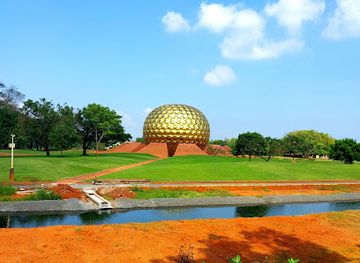
The Matrimandir is Auroville's defining landmark: its faceted golden exterior and spherical form were designed as the architectural focus of the Peace Area, while the inner chamber is intended for silent concentration rather than ordinary sightseeing. The Banyan Tree beside the Amphitheatre has symbolic importance as the natural centre of the township, and the urn at the Amphitheatre recalls the international inauguration of 1968. Bharat Nivas represents the planned international zone and cultural exchange central to Auroville's founding vision, while Savitri Bhavan is associated with study and interpretation of the writings of Sri Aurobindo and the Mother. Across the wider settlement, experimental structures in compressed earth, recycled materials and climate-responsive design form a less monumental but equally characteristic architectural landscape. These landmarks are interwoven with working communities, planted woodland and rural roads rather than arranged along a conventional civic boulevard.
-
Tourist information center
Auroville Visitors Centre
Discover Auroville's vision of unity and sustainability at the Auroville Visitors Centre, your gateway to this unique spiritual township.
14 min walk · 1.1 km from neighbourhood centre
-
Tourist attraction
Matrimandir View Point
Discover the serene beauty of Matrimandir View Point, a must-visit spiritual oasis in Auroville, offering breathtaking views and a peaceful atmosphere.
3 min walk · 0.2 km from neighbourhood centre
-
Park
Auroville Matrimandir
Explore the breathtaking architecture and serene gardens of Matrimandir in Auroville, a haven for meditation and self-discovery.
1 min walk · 0.1 km from neighbourhood centre
-
Tourist attraction
Auroville Golden Globe Viewpoint
Experience breathtaking panoramic views and embrace the spirit of unity at the Auroville Golden Globe Viewpoint in Tamil Nadu.
2 min walk · 0.2 km from neighbourhood centre


Explore Auroville on the map
A handpicked selection of must-see spots in Auroville, mapped for you.
Best hotels in Auroville
Best restaurants in Auroville
Eating in Auroville reflects its experimental, international and environmentally conscious character more than a single local cuisine. Around the Visitors Centre and dispersed community areas, cafés and small eateries serve vegetarian meals, baked goods, coffee, juices and dishes influenced by Indian, European and other global traditions. Auroville's farms and food-related units have encouraged interest in organic cultivation, natural products and plant-based cooking, although the scale and availability of individual outlets can change. The township's cafés are useful places to observe the rhythms of residents, volunteers and visitors, but they should not be treated as a conventional restaurant district: venues are separated by woodland and working communities, and some operate on limited schedules. For Tamil food, roadside eateries and restaurants in the villages and along the approach roads offer a different, locally rooted dining experience from Auroville's international café culture.
-
Vegetarian
Hope cafe @Auroville Main Road
Discover Hope Cafe in Auroville: where fresh vegetarian cuisine meets sustainable living in a serene setting.
7 min drive · 2.4 km from neighbourhood centre
-
Hungarian
Kurtosshhh Auroville
Discover authentic Hungarian cuisine at Kurtosshhh Auroville—where every dish tells a story in a cozy family-friendly setting.
5 min drive · 1.8 km from neighbourhood centre
-
 South Indian
The Secret Garden Restaurant
Experience the flavors of South India at The Secret Garden Restaurant - where nature meets culinary excellence in Auroville.
19 min walk · 1.5 km from neighbourhood centre
-
Pizza
RED CHILLY CAFE
Discover authentic Italian flavors at Red Chilly Cafe in Auroville - where delicious pizzas meet a warm atmosphere.
5 min drive · 1.8 km from neighbourhood centre


Best bars in Auroville
Auroville is quiet after dark and does not have a concentrated bar or nightclub scene. Evening life centres instead on cafés, community dining, talks, film screenings, music, cultural programmes and small gatherings whose schedules may be seasonal or announced locally. Some resident communities and cultural spaces host performances or workshops, but these are part of Auroville's participatory life rather than a conventional entertainment circuit, and visitors should check current arrangements rather than assume entry. Alcohol-focused nightlife is limited compared with central Puducherry, while roads between communities can be dark and spread out at night. Quiet behaviour is particularly important around residential areas, meditation spaces and forest paths, where the township's evening atmosphere is shaped more by stillness, conversation and occasional organised events than by late-night commercial venues.
-
Hungarian
Kurtosshhh Auroville
Experience the authentic taste of Hungary at Kurtosshhh in Auroville, a delightful café offering a family-friendly atmosphere and a diverse menu of European dishes.
5 min drive · 1.8 km from neighbourhood centre
-
North Indian
Bro's plan B restaurant
Discover authentic North Indian flavors at Bro's Plan B Restaurant in Auroville, Puducherry, offering a serene dining experience amidst lush surroundings.
17 min walk · 1.3 km from neighbourhood centre
-
Restaurant
The Urban Cafe
Experience diverse flavors from Indian, Italian, and Chinese cuisines at The Urban Cafe in Auroville, a family-friendly destination for food lovers.
6 min drive · 1.9 km from neighbourhood centre
-
Asian
The Grove
Experience the best of Southeast Asian cuisine at The Grove, a must-visit restaurant nestled in the tranquil surroundings of Auroville.
6 min drive · 2.1 km from neighbourhood centre


Best nightclubs in Auroville
Auroville is quiet after dark and does not have a concentrated bar or nightclub scene. Evening life centres instead on cafés, community dining, talks, film screenings, music, cultural programmes and small gatherings whose schedules may be seasonal or announced locally. Some resident communities and cultural spaces host performances or workshops, but these are part of Auroville's participatory life rather than a conventional entertainment circuit, and visitors should check current arrangements rather than assume entry. Alcohol-focused nightlife is limited compared with central Puducherry, while roads between communities can be dark and spread out at night. Quiet behaviour is particularly important around residential areas, meditation spaces and forest paths, where the township's evening atmosphere is shaped more by stillness, conversation and occasional organised events than by late-night commercial venues.
-
Bar
BAR Puducherry
Discover the vibrant BAR Puducherry, a perfect blend of relaxation and entertainment in the heart of Auroville.
7 min drive · 2.3 km from neighbourhood centre
-
Night club
Aura Cafe
Discover the vibrant nightlife of Auroville at Aura Cafe, where culture, music, and community come alive in a unique spiritual setting.
7 min drive · 2.5 km from neighbourhood centre
-
Bar
Leox_villa 2
Discover the vibrant nightlife at Leox Villa 2, a lively bar in Auroville offering a diverse drink menu and a welcoming atmosphere.
7 min drive · 2.4 km from neighbourhood centre


Best shops in Auroville
Shopping in Auroville is centred on resident-run units and craft outlets rather than a conventional high street. Visitors may find handmade clothing, incense, pottery, paper goods, leatherwork, natural body products, books, food products and small design objects connected with the township's craft, ecological and educational projects. The Visitors Centre area is the easiest place to begin, while individual units and community shops are scattered across the settlement and may have distinct access arrangements. Auroville's commercial identity is closely tied to experimentation in materials, sustainable production and small-scale manufacture, although products and opening patterns can change. Nearby Tamil villages provide a contrasting everyday retail environment, with provisions, snacks and local services along the roads leading towards Puducherry and the East Coast Road. Bargaining should not be assumed in organised Auroville outlets; ask politely about prices and support the terms of each unit.
-
Clothing store
Fashion Stories
Discover unique, sustainable fashion at Fashion Stories in Auroville, where every piece reflects the creativity and spirit of the community.
5 min drive · 1.6 km from neighbourhood centre
-
Gift shop
Auro Crafts
Discover the charm of Auro Crafts, where unique handcrafted gifts and local artistry come together in Auroville, Tamil Nadu.
6 min drive · 1.9 km from neighbourhood centre
-
Cosmetics store
Kalki Auroville
Discover the essence of natural beauty at Kalki Auroville, where handmade cosmetics meet sustainability in a serene setting.
14 min walk · 1.1 km from neighbourhood centre
-
Designer Clothing Store
Miniature Auroville
Explore the unique blend of tradition and modernity at Miniature Auroville, a premier designer clothing store in the heart of Auroville.
15 min walk · 1.2 km from neighbourhood centre


Auroville essentials
Getting There
Getting Around
Safety
Emergency Situations
Do's and Don'ts
Local Tips
History of Auroville
From Dry Plateau to Green Settlement
Before Auroville was founded, the site consisted largely of eroded plateau, scrub and agricultural land associated with surrounding Tamil villages. The area had suffered from tree loss, grazing pressure and seasonal water runoff, leaving exposed red soil in many places. Early township workers treated ecological restoration as a central part of settlement rather than as decorative landscaping. Tree planting, bunding, water conservation and soil work gradually established the green framework visible today, although the surrounding villages and their agricultural life remained an essential part of the locality.
The Inauguration of Auroville
Auroville was inaugurated on 28 February 1968, following a vision developed by Mirra Alfassa, known as the Mother, and architect Roger Anger. Young representatives from many countries placed soil from their homelands in an urn at the inauguration ceremony, expressing the township's international ideal. The location north of Puducherry was selected for a planned community intended to explore new forms of collective living, education, work and spiritual practice. Its founding connected the site to the wider Sri Aurobindo and Mother tradition centred in nearby Puducherry without making Auroville a conventional extension of that city.
Planning the Galaxy
Roger Anger's master plan arranged Auroville as a series of zones around a central Peace Area, with residential, cultural, industrial and international sectors linked by green belts and radial routes. Development proceeded incrementally through small communities, farms, workshops and service units rather than through a single completed urban scheme. Buildings such as Bharat Nivas, the international pavilion complex, and later experimental structures expressed the ambition to combine global cultural exchange with local materials, climate-sensitive design and cooperative work. The township's built form therefore remained dispersed and provisional, shaped by available resources and changing resident projects.
Institutional Recognition and Continuing Experiment
Auroville's international profile grew through its educational, ecological and architectural work, including experiments in earth construction, renewable energy, water management and reforestation. UNESCO adopted resolutions supporting the project during its early decades, while the Government of India established the Auroville Foundation Act in 1988 to provide a legal framework for its administration and development. Contemporary Auroville still combines idealistic international aims with practical questions about land, governance, funding and relations with neighbouring villages. Its significance lies in this ongoing experiment, not in a finished model of urban life.
Auroville in Photos
Browse through our photo collection highlighting the charm and character of the destination.
Neighbourhoods near Auroville
The closest neighbourhoods to Auroville, if you have time for more than one stop.
-

-


Swipe for more neighbourhoods
Explore more

Explore more of Puducherry
Puducherry blends French-colonial streets, Tamil heritage, seaside promenades, spiritual traditions and memorable South Indian cuisine on India’s Coromandel Coast.
Explore Puducherry