

Cerro Cora National Park Travel Guide - Free Web & App
Your ultimate guide to Cerro Cora National Park. Discover top landmarks, proposed trips, and local tips. Free on the web or via the Evendo companion app.


Cerro Corá National Park in Paraguay combines cerrado landscapes, wildlife, river scenery and the historic site of the War of the Triple Alliance.
Landscape and Natural Heritage
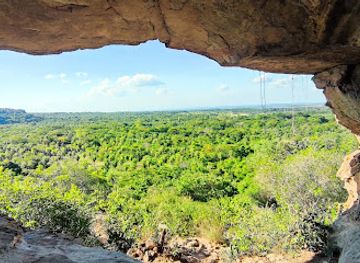
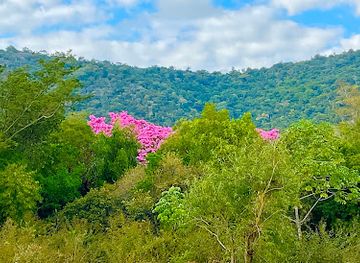
Cerro Corá National Park occupies a forested and grassland landscape in Paraguay’s Amambay Department, close to the Brazilian frontier and south of Pedro Juan Caballero. Covering roughly 5,500 hectares, the park protects a meeting point of woodland, cerrado-like vegetation, rocky hills and riverine habitats. The terrain is shaped by low ridges and red-earth tracks rather than high mountains, with the Aquidabán River and smaller watercourses adding seasonal variation to the landscape. Birdlife is an important reason to visit, while the surrounding habitats support a range of mammals, reptiles and native plant species; sightings depend on season, weather and patience.Read more about Cerro Cora National Park
A Place of National Memory
Visiting the Park
When is the best time to visit Cerro Cora National Park?
Best: June–August · 25–26°C| Month | High (°C) | Rainfall (mm) |
|---|---|---|
| January | 35 | 201 |
| February | 34 | 190 |
| March | 34 | 180 |
| April | 31 | 171 |
| May | 28 | 160 |
| June (best) | 25 | 151 |
| July (best) | 25 | 140 |
| August (best) | 26 | 130 |
| September | 28 | 121 |
| October | 31 | 115 |
| November | 33 | 111 |
| December | 35 | 105 |
Getting to and around Cerro Cora National Park
How to get there
Transportation
Best attractions in Cerro Cora National Park
-
Nature preserve
Cerro Arco Tobati
Experience the serene beauty of Cerro Arco Tobati, a nature preserve in Potrero, Paraguay, where adventure meets tranquility amid breathtaking landscapes.
-
Hiking area
Reserva Biológica Manantiales
Explore the breathtaking landscapes and diverse wildlife of Reserva Biológica Manantiales, a paradise for hiking and nature enthusiasts in Paraguay.
Explore Cerro Cora National Park on the map
Plan your trip on one map. See where the top attractions, landmarks, restaurants and hotels are, and book hotels and experiences in a few clicks.
Best hotels in Cerro Cora National Park
Best shops in Cerro Cora National Park
Shopping opportunities are limited within Cerro Corá National Park, where there are no extensive retail areas and visitors should arrive with food, water, fuel and outdoor essentials already arranged. Pedro Juan Caballero is the principal shopping centre and offers supermarkets, pharmacies, general stores, vehicle services and informal commercial areas useful to travellers preparing for the park. Its border-city economy also reflects exchange between Paraguay and Brazil, although visitors should check current customs requirements before carrying goods across an international boundary. Regional food products such as chipa, mandioca-based specialities and locally purchased provisions may be available in the city, while small roadside shops on the approach may provide basic refreshments rather than a dependable range of supplies. Shopping here is practical and preparatory rather than a major tourism activity.
-
 General store
Colonia guavira
Experience the vibrant local culture at Colonia Guavira, a charming general store in Maria Auxiliadora, Paraguay, filled with unique goods and friendly service.
Get your free copy of our complete guide to Cerro Cora National Park, delivered straight to you.
Everything on this page, from attractions and restaurants to essentials and local phrases, in one PDF you can read offline, print or share.
Already have an account? Sign in
Your Cerro Cora National Park guide is ready.
We'll send it to · Not you? Sign out

Getting your guide ready…
We are putting together a fresh copy of the Cerro Cora National Park guide. This can take up to a minute.
This can take a few moments. If your browser asks, choose Allow so the download can start. You'll find the guide in your Downloads folder.
Nothing happened? Download it again
Sorry, the guide is taking longer than usual. Please try again in a minute, or get it by email instead.
Cerro Cora National Park essentials
Currency and Payment
Safety
Emergency Situations
Do's and Don'ts
Local Tips
From Eve
Local phrases worth knowing
You don't need to get them perfect. A few words go a long way, and locals appreciate the effort.
Basics
| English | Local | Say it |
|---|---|---|
| Hello | Mba'éichapa | [mba-eh-ee-cha-pa] |
| Goodbye | Jajotopata | [ha-ho-to-pa-ta] |
| Yes | Ha | [ha] |
| No | Nde | [n-de] |
| Please/You're welcome | Por favor | [por fa-vor] |
| Thank you | Aguyje | [a-gu-yhe] |
| Excuse me/Sorry | Rohechakuaa | [ro-he-cha-kwa-a] |
| How are you? | Mba'éichapa | [mba-eh-ee-cha-pa] |
| Fine. And you? | Che ra'y | [che ra-y] |
| Do you speak English? | Añembo'ekuri inglés-pe? | [an-yem-bo-e-ku-ri in-gles-pe] |
| I don't understand | Nde aheno | [n-de a-he-no] |
Eating & Drinking
| English | Local | Say it |
|---|---|---|
| I'd like to see the menu, please | Ojapo mba'épa menu, pyahu | [o-ha-po mba-eh-pa me-nu, pja-hu] |
| I don't eat meat | Nde ne ari kavaju | [n-de ne a-ri ka-va-hu] |
| Cheers! | Viva! | [vi-va] |
| I would like to pay, please | Ojapo mba'épa hagua, pyahu | [o-ha-po mba-eh-pa ha-gua, pja-hu] |
Emergencies
| English | Local | Say it |
|---|---|---|
| Help! | Ñandejára! | [njan-de-ha-ra] |
| Go away! | Jepépe! | [he-pe-pe] |
| Call the Police! | Ko'ẽmbotá pe | [ko-enm-bo-ta pe] |
| Call a doctor! | Ko'ẽmbotá itá | [ko-enm-bo-ta i-ta] |
| I'm lost | Nde raye | [n-de ra-ye] |
| I'm ill | Nde mbo'ehára | [n-de mbo-e-ha-ra] |
Shopping
| English | Local | Say it |
|---|---|---|
| I'd like to buy... | Ojapo mba'épa... | [o-ha-po mba-eh-pa] |
| I'm just looking | Nde reikopa | [n-de rei-ko-pa] |
| How much is it? | Piko mba'épa? | [pi-ko mba-eh-pa] |
| That's too expensive | He'i hikuái | [he-i hi-kwa-i] |
| Can you lower the price? | Mba'éichapa che mo'ãi peteî? | [mba-eh-ee-cha-pa che mo-a-i pe-tei] |
Time & Numbers
| English | Local | Say it |
|---|---|---|
| What time is it? | Piko ore? | [pi-ko o-re] |
| It's one o'clock | Piko pópe | [pi-ko po-pe] |
| Half past (10) | Jajapotáva (10) | [ha-ho-po-ta-va (10)] |
| Morning | Aña | [a-nja] |
| Afternoon | Upépe | [u-pe-pe] |
| Evening | Jasy | [ha-si] |
| Yesterday | Añoite | [a-njo-i-te] |
| Today | Jepénte | [he-pe-ne] |
| Tomorrow | Apu'ánte | [a-pu-a-ne] |
| 1 | Peteĩ | [pe-tei] |
| 2 | Mokõi | [mo-ko-i] |
| 3 | Mbohapy | [mbo-ha-pi] |
| 4 | Ivai | [i-va-i] |
| 5 | Irupé | [i-ru-pe] |
| 6 | Arambái | [a-ram-ba-i] |
| 7 | Tapicha | [ta-pi-cha] |
| 8 | Guasu | [gua-su] |
| 9 | Jagua | [ha-gua] |
| 10 | Purahe'i | [pu-ra-he-i] |
Transport & Directions
| English | Local | Say it |
|---|---|---|
| Where's a/the...? | Mba'e... | [mba-e] |
| What's the address? | Mba'éichapa... | [mba-eh-ee-cha-pa] |
| Can you show me (on the map)? | Mba'éichapa che ñe'ẽmapa-pe? | [mba-eh-ee-cha-pa che nje-em-ma-pa-pe] |
| When's the next (bus)? | Mba'éichapa ha'e... | [mba-eh-ee-cha-pa ha-e] |
| A ticket (to ....) | Tikéta (pa ...) | [ti-ke-ta pa] |
History of Cerro Cora National Park
A Frontier Landscape Before the War
The area now protected as Cerro Corá National Park forms part of the Amambay uplands, a frontier zone of woodland, grassland, streams and rocky elevations. Long before the modern park existed, the wider region was used and travelled through by Indigenous peoples, including Guaraní-speaking communities associated with the northern Paraguayan frontier. Its distance from the country’s principal colonial centres meant that settlement remained comparatively dispersed, while paths, rivers and ridges gave the landscape strategic importance. The name Cerro Corá is generally translated from Guaraní as ‘surrounded hill’ or ‘encircled hill’, reflecting the character of the terrain rather than an urban settlement.
The War of the Triple Alliance
Cerro Corá became central to Paraguay’s national history during the War of the Triple Alliance, fought from 1864 to 1870 between Paraguay and the alliance of Brazil, Argentina and Uruguay. By early 1870, Paraguay’s remaining forces had retreated northwards through difficult territory. The final major confrontation took place at Cerro Corá on 1 March, when Paraguayan troops were defeated. Francisco Solano López, Paraguay’s president and commander-in-chief, was killed during the battle, bringing the war to its effective close. The site’s forests and hills therefore preserve the setting of a decisive event whose demographic, political and economic consequences shaped modern Paraguay.
Memory, Monuments and National Identity
After the war, Cerro Corá acquired a powerful place in Paraguay’s public memory. Accounts of the final battle, the death of López and the suffering of the Paraguayan population became closely linked with ideas of sovereignty, sacrifice and national survival. Memorial structures and commemorative markers were established at the battlefield area, allowing the site to function as both a historical place and a landscape of remembrance. Interpretations of the war remain emotionally significant and can differ according to political perspective, so visitors encounter more than a simple military narrative: Cerro Corá is also connected with debates about leadership, national identity and the human cost of conflict.
National Park Protection
Cerro Corá was designated a national park in 1976, bringing the historical battlefield and its surrounding natural habitats under formal protection. The designation joined cultural conservation with the safeguarding of woodland, cerrado-type vegetation, waterways and wildlife in a region affected by agricultural expansion and changing land use. Today the park is administered as a protected natural and historical area, although its visitor infrastructure remains modest compared with Paraguay’s more developed destinations. Conservation and interpretation are consequently important parts of the experience: the landscape is valued both for its ecological character and for the physical setting in which the country’s final wartime events unfolded.
Cerro Cora National Park in Photos
Browse through our photo collection highlighting the charm and character of the destination.
Neighbouring destination travel guides
The closest destinations to Cerro Cora National Park, if you have time for more than one.
-

-

-

-

-


Swipe for more destinations
Explore more
Explore more of Northern Paraguay
Discover the hidden treasures of Northern Paraguay, where the wild Gran Chaco meets vibrant indigenous cultures and charming rural villages.
Explore Northern Paraguay
Explore more of Paraguay
Discover Paraguay: A blend of history, culture, and natural beauty in the heart of South America. Visit Asunción, explore Jesuit ruins, and experience the local cuisine.
Explore Paraguay