C. de Alcalá, Madrid Travel Guide
Free Guide: Madrid's storied avenue where neoclassical arches frame the city's relentless march from Roman paths to vibrant present.


A brief summary of C. de Alcalá
Madrid's storied avenue where neoclassical arches frame the city's relentless march from Roman paths to vibrant present.
Calle de Alcalá stretches as one of Madrid's most iconic thoroughfares, lined with architectural marvels like the Puerta de Alcalá and Cibeles Fountain. This vibrant artery pulses with history from Roman origins to modern grandeur, offering grand vistas, bustling cafes, and a front-row seat to the city's elegant rhythm. Stroll its length to encounter neoclassical splendor amid the hum of daily life.
On-site amenities
 Restrooms
 Drink options
 Food options
 Seating areas
 Sheltered areas
 Trash bins
 Information boards
- Address
- Madrid
Getting there
Metro
Bus
Walking
Bicycle
Discover more about C. de Alcalá
Historical Foundations
Calle de Alcalá traces its roots to Roman times when it formed part of a key route into Hispalis, evolving through medieval expansions into a vital artery of Madrid. Named after the nearby Convent of San Cayetano de los Alcála, it gained prominence in the 16th century as the city grew under Habsburg rule. Felipe II's designation of Madrid as capital in 1561 spurred its development, transforming it into a showcase boulevard flanked by noble residences and religious institutions. By the 18th century, under Carlos III's urban reforms, it became a symbol of Enlightenment progress, with widened pavements and uniform facades reflecting Bourbon neoclassicism.
Architectural Highlights
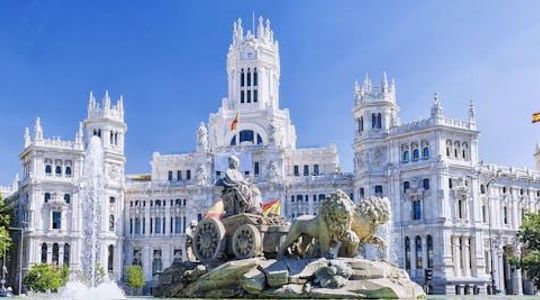
The street's crowning jewel is the Puerta de Alcalá, a triumphal arch commissioned by Carlos III in 1764 and completed in 1778 by Francesco Sabatini. Inspired by ancient Roman gates yet distinctly Spanish, its Doric columns and intricate sculptures commemorate the king's entry into Madrid. Nearby rises the Palacio de Cibeles, formerly the General Post Office, now Madrid's City Hall, blending Plateresque Revival with modernist elements since its 1907 completion. The Cibeles Fountain, sculpted by Ventura Rodríguez in 1780, depicts the goddess on a chariot drawn by lions, serving as a monumental roundabout centerpiece. Further along, the Círculo de Bellas Artes building from 1926 showcases eclectic art nouveau and deco influences, housing cultural spaces amid its ornate tower.
Cultural and Social Vibe
Calle de Alcalá embodies Madrid's blend of solemn history and lively contemporaneity. Daytime reveals professionals striding past grand banks and offices, while evenings bring locals and visitors to terrazas for coffee or tapas. Its position linking Puerta del Sol to Plaza de Cibeles makes it a natural parade route for celebrations, protests, and festivals like Pride or New Year's. The street's wide sidewalks foster pedestrian flow, with shadows from horse chestnut trees offering respite. Street performers, vendors, and the distant chime of church bells create an auditory tapestry, while the scent of churros wafts from nearby cafes.
Landmark Connections
This boulevard anchors Madrid's cultural core, mere steps from Retiro Park's greenery and the Prado Museum's masterpieces. It fronts the Bank of Spain headquarters, a 19th-century bastion of neoclassical might, and passes the neoclassical Iglesia de las Calatravas. The street's eastern stretch approaches Salamanca's upscale boutiques, contrasting its central grandeur with refined residential calm. Cyclists and buses weave through, underscoring its role as a connective tissue in the city's layout.
Visitor Expectations
Wanderers encounter a linear gallery of Madrid's evolution, from Bourbon arches to 20th-century eclecticism. Expect throngs near landmarks, easing toward quieter ends. The avenue invites contemplation of urban layers—ancient paths beneath modern strides—while its energy mirrors the capital's unyielding vitality. Photographers capture golden-hour glows on stone facades, history buffs decode plaques, and casual strollers absorb the theatrical backdrop of Spanish life.
Evendo Review Centre
 Google
Guest reviews
Best time to go
Quietest: Jan, Feb & Mar
Busy times are Evendo estimates for a typical year, to help you plan. Actual crowds vary with events, school holidays and the weather.
Explore C. de Alcalá on the map
A handpicked selection of must-see spots near C. de Alcalá, mapped for you.
Get your free copy of our complete guide to C. de Alcalá, delivered straight to you.
Everything on this page, from opening hours and how to get there to Eve’s tips and the best time to go, in one PDF you can read offline, print or share.
Already have an account? Sign in
Your C. de Alcalá guide is ready.
We'll send it to · Not you? Sign out

Getting your guide ready…
We are putting together a fresh copy of the C. de Alcalá guide. This can take up to a minute.
This can take a few moments. If your browser asks, choose Allow so the download can start. You'll find the guide in your Downloads folder.
Nothing happened? Download it again
Sorry, the guide is taking longer than usual. Please try again in a minute, or get it by email instead.
Unlock the best of C. de Alcalá
Skip-the-line tickets, guided tours with entry, and walking tours of the area, booked in a few clicks.
 Tour with entry
Madrid Walking Tour from Puerta del Sol to Retiro Park
from $3.19 Tour with entry
Walking Tour of Madrid Modern
from $3.20 Tour with entry
Madrid : Gran Via, Cibeles, Paseo del Prado and Retiro
from $4.25 Tour with entry
Madrid: Tuk Tuk Greatest Panoramic Tour + LOCAL GUIDE + PICK UP
from $186.54


Other nearby places you may find interesting
The closest places of the same kind, if this one is not quite what you had in mind.
-
-
-
-
-


Swipe for more places
More to explore near C. de Alcalá

 Best experiences near C. de Alcalá
 Best hotels near C. de Alcalá
 Best landmarks near C. de Alcalá
 Best attractions near C. de Alcalá
 Best shops near C. de Alcalá
 Best restaurants near C. de Alcalá
 Best bars near C. de Alcalá
Do you manage this location?
Take control to get all the benefits, like improved information, better appearance, and stronger visibility across AI-powered discovery.
Explore more

Explore more of Madrid
Discover Madrid: A city of art, culture, and culinary delights, where history and modern vibrancy meet in the heart of Spain.
Explore Madrid
Explore more of Spain
Discover Spain: A vibrant tapestry of culture, history, and breathtaking landscapes, where every city offers a unique adventure and unforgettable experiences.
Explore Spain