Museo Nacional del Prado, Madrid Travel Guide
Free Guide: Europe's supreme canvas chronicle, where Velázquez gazes pierce souls and Goya's shadows ignite revolutions in Madrid's eternal art bastion.


A brief summary of Museo Nacional del Prado
Europe's supreme canvas chronicle, where Velázquez gazes pierce souls and Goya's shadows ignite revolutions in Madrid's eternal art bastion.
Spain's premier art museum houses an unrivaled collection of European masterpieces from the 12th to 19th centuries. Goya, Velázquez, and Titian dominate vast galleries filled with royal treasures, religious icons, and Renaissance marvels that defined artistic history. A must-visit for anyone tracing the evolution of Western painting amid neoclassical grandeur.
On-site amenities
 Restrooms
 Drink options
 Food options
 Seating areas
 Sheltered areas
 Information boards
 Visitor centre
Opening hours
- Mon–Sat10 am–8 pm
- Sun10 am–7 pm
Opening hours as listed on the venue’s Google Business Profile. Hours can change for services and special events, so check with the venue before you go.
- Address
- Retiro, 28014 Madrid
- Phone
- Website
Getting there
Metro
Bus
Walking
Taxi
Discover more about Museo Nacional del Prado
Historical Foundations
The Museo Nacional del Prado stands as one of the world's foremost repositories of European art, originating from the Spanish royal collections amassed over centuries by the Habsburg and Bourbon monarchs. Founded in 1819 by royal decree of Ferdinand VII, it opened its doors to the public during a time of political upheaval following the Napoleonic Wars. The museum's core holdings stem from private royal galleries at the nearby Palacio del Buen Retiro, which were nationalized to create a public institution dedicated to preserving Spain's artistic patrimony. This royal legacy imbues the Prado with an aura of regal authority, its walls echoing the tastes of kings who commissioned works from the finest masters across Europe.
Masterpieces and Collections
At the heart of the Prado's allure lies its extraordinary assembly of paintings, spanning from medieval Italian primitives to the heights of Spanish Golden Age brilliance. Diego Velázquez's Las Meninas commands a central gallery, its intricate interplay of gazes and mirrored depths captivating viewers with its revolutionary realism and psychological depth. Francisco Goya's Third of May 1808 confronts with raw drama, depicting Spanish resistance against French forces in stark chiaroscuro that prefigures modern expressionism. Titian's sensual Venus del espejo and Hieronymus Bosch's hallucinatory Garden of Earthly Delights exemplify the museum's depth in Venetian Renaissance and Northern Gothic traditions. The collection extends to Raphael, El Greco, Rubens, and Caravaggio, offering a comprehensive narrative of artistic evolution through over 8,000 paintings, 10,000 drawings, 6,000 prints, and numerous sculptures.
Architectural Splendor
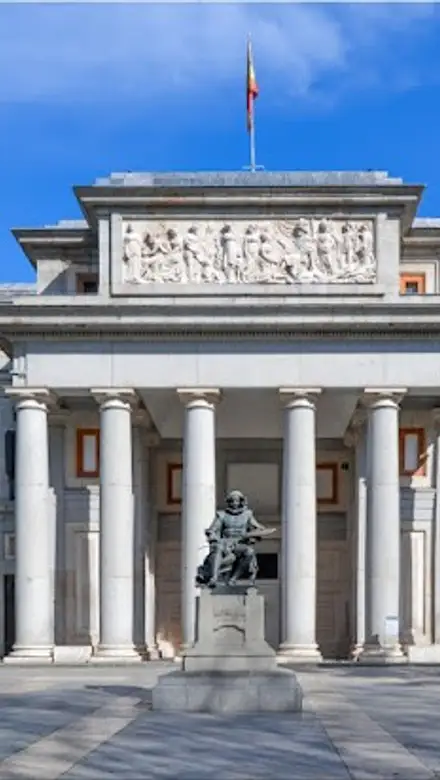
Housed in a neoclassical edifice designed by Juan de Villanueva in 1785, originally intended as a natural history cabinet, the Prado's architecture enhances its treasures. Expansive galleries with high ceilings and natural light flood canvases with illumination, while ornate detailing and symmetrical facades evoke 18th-century Enlightenment ideals. Expansions in the 20th and 21st centuries, including the Jerónimos and Isabel la Católica wings, have tripled the display space without diluting the original harmony. The central rotunda serves as a grand orientation point, its dome symbolizing the museum's role as a cultural pinnacle.
Artistic Movements Represented
The Prado excels in Spanish art from the 16th to 19th centuries, with Velázquez, Goya, and Murillo forming a national triad unmatched elsewhere. Italian painting shines through Titian, Raphael, and Correggio, while Flemish masters like Rubens and Van Dyck contribute baroque opulence. French, German, and Dutch schools round out the panorama, including Poussin's classicism and Rembrandt's introspective portraits. Thematic displays explore genres from portraiture and mythology to landscape and still life, revealing how patronage, religion, and politics shaped visual expression across eras.
Visitor Experience and Atmosphere
Wandering the Prado immerses visitors in a contemplative realm where time slows amid silent admiration. Crowds cluster around icons, yet quieter wings offer intimate encounters with lesser-known gems. The atmosphere blends scholarly reverence with accessible wonder, appealing to novices and connoisseurs alike. Rotating exhibitions draw from vast reserves, introducing fresh perspectives on familiar themes. The museum's scale rewards repeat visits, its labyrinthine layout encouraging serendipitous discoveries amid the weight of history.
Cultural Significance
As a cornerstone of Madrid's Golden Triangle of Art, alongside the Reina Sofía and Thyssen-Bornemisza, the Prado anchors Spain's cultural identity. It preserves not just artworks but narratives of empire, faith, and innovation that propelled Europe forward. Globally recognized by UNESCO as part of Madrid's cultural heritage, it continues to inspire scholarship, conservation, and pilgrimage, affirming art's enduring power to provoke, console, and elevate.
Evendo Review Centre
 Google
Guest reviews
Best time to go
Quietest: Jan, Feb & Dec · before 11am or from 6pm
Busy times are Evendo estimates for a typical year, to help you plan. Actual crowds vary with events, school holidays and the weather.
Explore Museo Nacional del Prado on the map
A handpicked selection of must-see spots near Museo Nacional del Prado, mapped for you.
Get your free copy of our complete guide to Museo Nacional del Prado, delivered straight to you.
Everything on this page, from opening hours and how to get there to Eve’s tips and the best time to go, in one PDF you can read offline, print or share.
Already have an account? Sign in
Your Museo Nacional del Prado guide is ready.
We'll send it to · Not you? Sign out

Getting your guide ready…
We are putting together a fresh copy of the Museo Nacional del Prado guide. This can take up to a minute.
This can take a few moments. If your browser asks, choose Allow so the download can start. You'll find the guide in your Downloads folder.
Nothing happened? Download it again
Sorry, the guide is taking longer than usual. Please try again in a minute, or get it by email instead.
Unlock the best of Museo Nacional del Prado
Skip-the-line tickets, guided tours with entry, and walking tours of the area, booked in a few clicks.


Other nearby places you may find interesting
The closest places of the same kind, if this one is not quite what you had in mind.
-
-
-
-
-


Swipe for more places
More to explore near Museo Nacional del Prado
-
 Best experiences near Museo Nacional del Prado
-
 Best hotels near Museo Nacional del Prado
-
 Best landmarks near Museo Nacional del Prado
-
 Best attractions near Museo Nacional del Prado
-
 Best shops near Museo Nacional del Prado
-
 Best restaurants near Museo Nacional del Prado
-
 Best bars near Museo Nacional del Prado


Do you manage this location?
Take control to get all the benefits, like improved information, better appearance, and stronger visibility across AI-powered discovery.
Explore more

Explore more of Madrid
Discover Madrid: A city of art, culture, and culinary delights, where history and modern vibrancy meet in the heart of Spain.
Explore Madrid
Explore more of Spain
Discover Spain: A vibrant tapestry of culture, history, and breathtaking landscapes, where every city offers a unique adventure and unforgettable experiences.
Explore Spain