

Dunnottar Castle Travel Guide
Free Guide: Clifftop fortress where Scottish crown jewels were hidden from Cromwell's army.


A brief summary of Dunnottar Castle
Clifftop fortress where Scottish crown jewels were hidden from Cromwell's army.
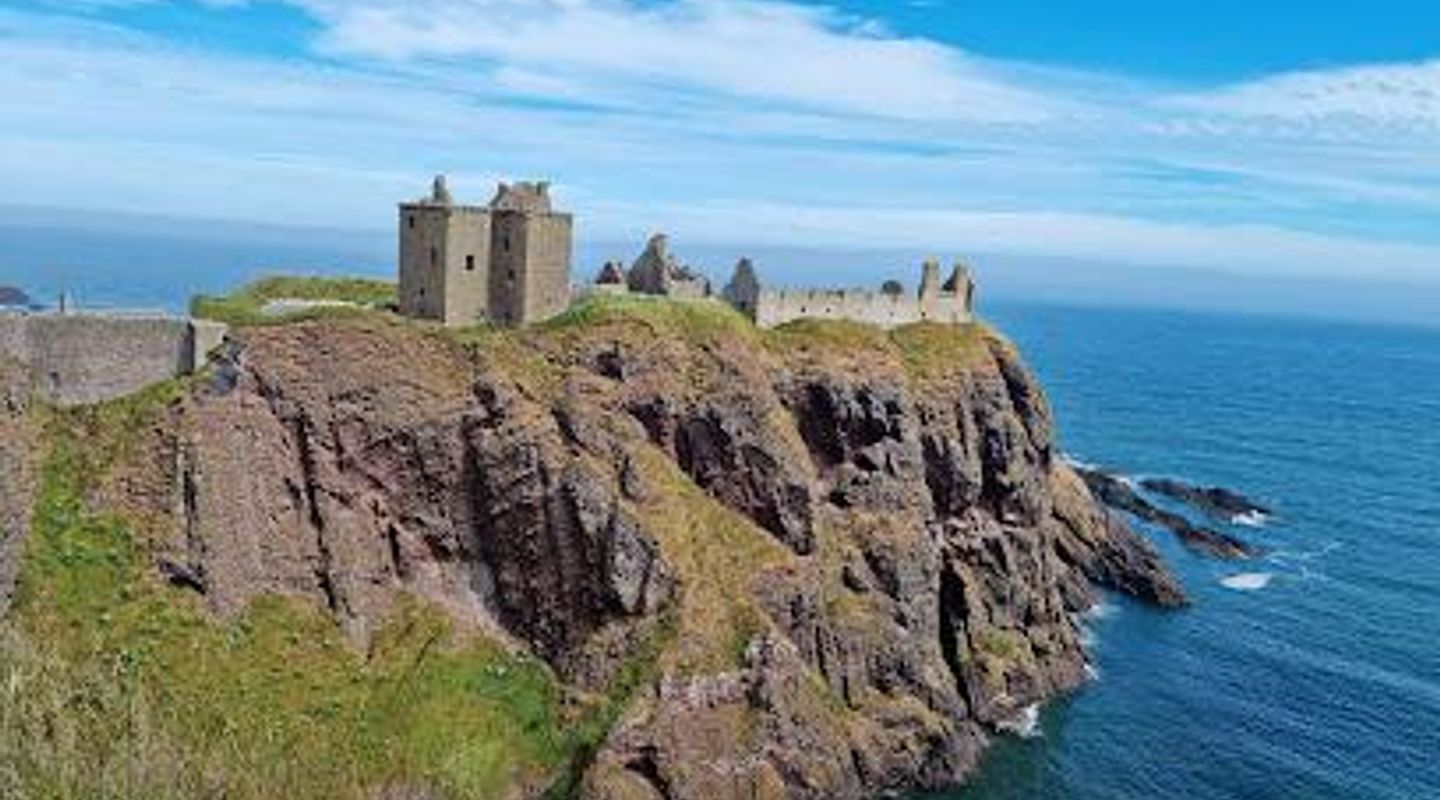
Perched dramatically on a 160-foot rocky promontory along the Aberdeenshire coast near Stonehaven, Dunnottar Castle stands as one of Scotland's most iconic and historically significant ruins. This clifftop fortress, surrounded by the North Sea on three sides, has witnessed over 1,500 years of turbulent Scottish history—from Pictish stronghold to Viking raids, Wars of Independence, and its most famous role as the secret refuge of the Honours of Scotland during Oliver Cromwell's siege in the 1650s. Today, visitors explore evocative roofless ruins dominated by the well-preserved 14th-century keep, wandering through the remnants of a once-impregnable seat of the powerful Earl Marischal family.
On-site amenities
 Restrooms
 Drink options
 Food options
 Seating areas
 Information boards
 Visitor centre
Opening hours
- Mon10 am–2 pm
- Tue10 am–2 pm
- WedClosed
- Thu10 am–2 pm
- Fri10 am–2 pm
- Sat10 am–2 pm
- Sun10 am–2 pm
Opening hours as listed on the venue’s Google Business Profile. Hours can change for services and special events, so check with the venue before you go.
- Address
- Stonehaven AB39 2TL
- Phone
- Website
Getting there
By Car from Stonehaven
By Bus from Aberdeen or Stonehaven
By Train and Bus from Aberdeen
On Foot from Stonehaven
Discover more about Dunnottar Castle
A Fortress Shaped by Centuries of Conflict
Dunnottar Castle's origins stretch back into Scotland's misty past. While legend credits Saint Ninian with establishing a chapel here in the 5th century, the earliest confirmed historical references appear in 7th-century records, when the site served as a Pictish stronghold commanding the northeast coast. The castle's strategic location—perched 160 feet above the turbulent North Sea on three sides—made it an invaluable defensive position, though this advantage would be tested repeatedly throughout the medieval period.The site endured relentless assault from Viking raiders seeking to control Scotland's fertile east coast. In 900 AD, King Donald II of Scotland, the first ruler formally titled King of Alba, was killed at Dunnottar while defending against Scandinavian invaders who subsequently destroyed much of the fortification. Centuries later, English forces under King Æthelstan raided as far north as Dunnottar in 934, demonstrating the castle's continued strategic importance and vulnerability.
The Keith Family and Stone Fortifications
The turning point in Dunnottar's physical resilience came in 1392 when Sir William Keith, Great Marischal of Scotland, constructed the first permanent stone keep—the fortress's oldest surviving major structure. This marked a decisive shift from repeated destruction and rebuilding to genuine architectural permanence. The Keith family's stewardship transformed Dunnottar from a frequently ruined outpost into a seat of considerable power and prestige. By the 16th century, George Keith, 5th Earl Marischal, undertook an ambitious reconstruction project, converting the medieval fortress into a more comfortable residence with multiple buildings arranged around a courtyard, complete with a grand stone gatehouse known as Benholm's Lodging. These improvements created elegant living spaces while maintaining formidable defensive features, including gun ports strategically positioned to command the entrance.
The Honours of Scotland and Cromwell's Siege
Dunnottar achieved its greatest historical prominence during the English Civil War and the subsequent Commonwealth period. When King Charles II visited Scotland in 1650 and was crowned in 1651, the Scottish Crown Jewels—the Honours of Scotland comprising the crown, sword, and scepter—could not safely return to Edinburgh as Oliver Cromwell's invading army advanced northward. The 7th Earl Marischal made the crucial decision to hide these priceless regalia at Dunnottar, smuggling them into the castle hidden within sacks of wool. Sir George Ogilvie took command of the fortress's defense, and for eight months the small garrison withstood Cromwell's relentless siege, enduring bombardment from heavy siege cannons. Against overwhelming odds, the defenders held firm, successfully preserving the Honours of Scotland from capture. This extraordinary feat of loyalty and courage cemented Dunnottar's place in Scottish national memory.
Decline and Romantic Ruin
Following the Jacobite Rising of 1715, in which the 10th Earl Marischal joined the rebellion, the crown forfeited his titles and lands. Dunnottar passed from the Keith family's hands, and by the early 18th century, the castle lost its appeal as a residence. The nobility increasingly preferred more comfortable lowland estates to the windswept clifftop fortress. The castle was largely dismantled and abandoned to the elements, gradually transforming into the evocative ruin that captivates visitors today. What began as a strategic liability—its exposed, storm-battered location—became its greatest asset in the modern era, creating one of Scotland's most photographed and romantically compelling historical sites.
A Living Monument to Scottish Resilience
Today, Dunnottar Castle stands as a powerful testament to Scottish determination and historical significance. The 14th-century keep remains substantially intact, its sturdy stone walls a reminder of medieval engineering prowess. The chapel, parts of which date to the 13th century, survives in fragmentary form. Most other structures exist as roofless ruins, their bare walls silhouetted against the dramatic coastal landscape. The site's theatrical setting—perched above churning seas with panoramic views of the Aberdeenshire coast—enhances its emotional impact, making it far more than a mere historical curiosity. Visitors ascending the steep pathway experience the same sense of isolation and vulnerability that medieval defenders and residents once knew, creating an immersive connection to centuries of Scottish struggle, courage, and cultural pride.
Evendo Review Centre
 Google
Guest reviews
Best time to go
Quietest: Jan, Feb & Nov · before 8am or from 7pm
Busy times are Evendo estimates for a typical year, to help you plan. Actual crowds vary with events, school holidays and the weather.
Explore Dunnottar Castle on the map
A handpicked selection of must-see spots near Dunnottar Castle, mapped for you.
Get your free copy of our complete guide to Dunnottar Castle, delivered straight to you.
Everything on this page, from opening hours and how to get there to Eve’s tips and the best time to go, in one PDF you can read offline, print or share.
Already have an account? Sign in
Your Dunnottar Castle guide is ready.
We'll send it to · Not you? Sign out

Getting your guide ready…
We are putting together a fresh copy of the Dunnottar Castle guide. This can take up to a minute.
This can take a few moments. If your browser asks, choose Allow so the download can start. You'll find the guide in your Downloads folder.
Nothing happened? Download it again
Sorry, the guide is taking longer than usual. Please try again in a minute, or get it by email instead.
Unlock the best of Dunnottar Castle
Skip-the-line tickets, guided tours with entry, and walking tours of the area, booked in a few clicks.
 Tour with entry
Aberdeenshire and Royal Deeside Private Half-day Castle Tour
from $378.31 Tour with entry
Aberdeen Private Half Day Tour: Dunnottar, Crathes Castles +more
from $459.31 Tour with entry
6 Hour Private Aberdeenshire Castle and Historic Building Tour
from $624.17 Tour with entry
Haunted Castles of Scotland Tour of Glamis and Dunnottar
from $626.30
 Tour
Aberdeen Tour App, Hidden Gems Game and Big Britain Quiz (1 Day Pass) UK
from $18.98 Tour
Scottish Castles Glamis and Dunnottar Italian Tour Guide
from $69.59 Tour
Dunnottar Castle and Royal Deeside small-group tour from Aberdeen
from $77.18 Tour
Dunnottar Castle and Royal Deeside Small-Group Tour from Aberdeen
from $78.23
Other nearby places you may find interesting
The closest places of the same kind, if this one is not quite what you had in mind.
-
-
-


Swipe for more places
More to explore near Dunnottar Castle

 Best experiences near Dunnottar Castle

 Best hotels near Dunnottar Castle

 Best landmarks near Dunnottar Castle

 Best attractions near Dunnottar Castle

 Best shops near Dunnottar Castle

 Best restaurants near Dunnottar Castle

 Best bars near Dunnottar Castle
Do you manage this location?
Take control to get all the benefits, like improved information, better appearance, and stronger visibility across AI-powered discovery.
Explore more

Explore more of Aberdeenshire
Discover Aberdeenshire: A land of castles, coastlines, and culinary delights in the heart of Scotland's stunning scenery.
Explore Aberdeenshire
Explore more of United Kingdom
Discover the United Kingdom: A blend of rich history, stunning landscapes, and vibrant cities, offering a unique travel experience for every visitor.
Explore United Kingdom
