Maen Llia Travel Guide
Free Guide: Discover Maen Llia, a majestic Bronze Age standing stone in the Brecon Beacons, steeped in legend, celestial alignments, and prehistoric mystery.


A brief summary of Maen Llia
Discover Maen Llia, a majestic Bronze Age standing stone in the Brecon Beacons, steeped in legend, celestial alignments, and prehistoric mystery.
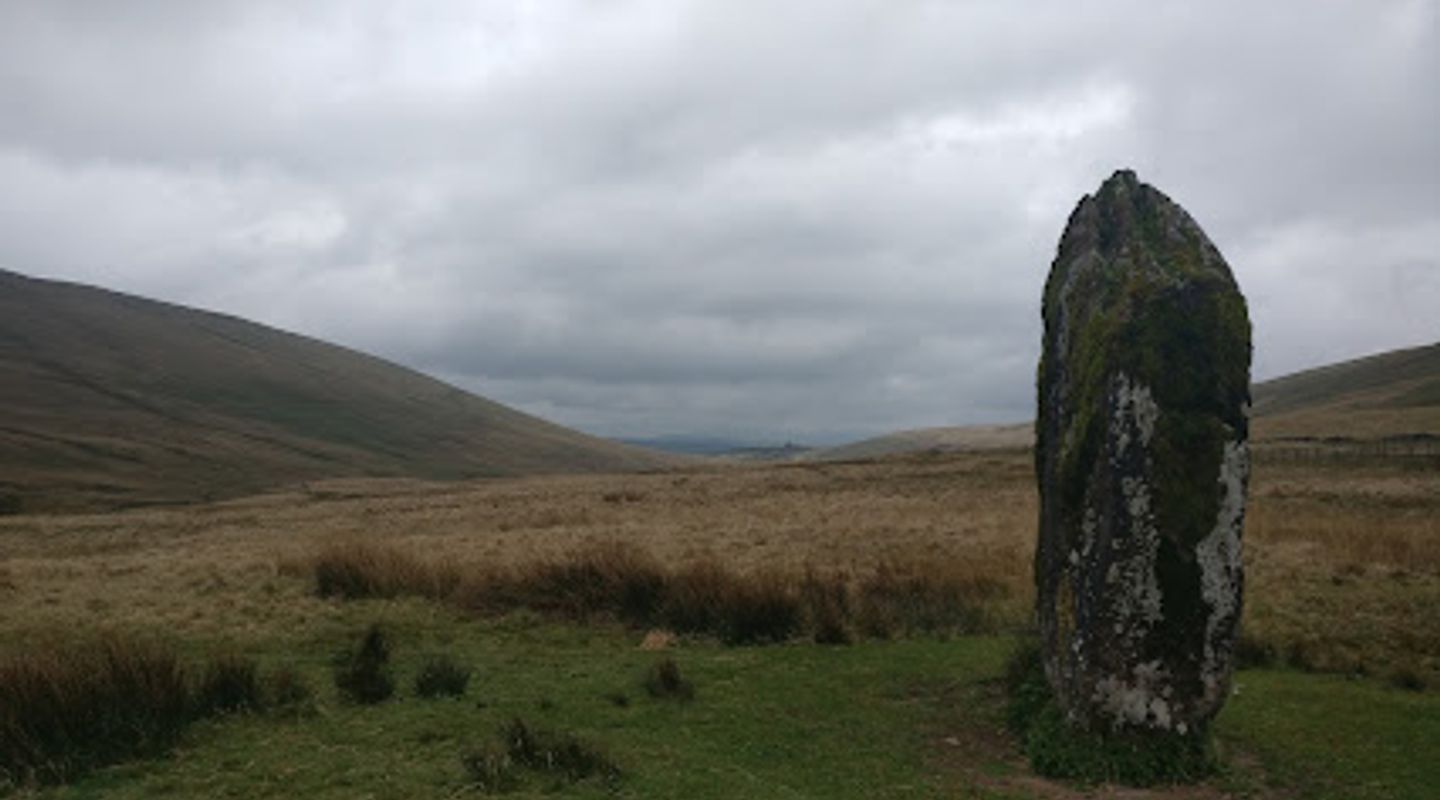
Maen Llia is a towering Bronze Age standing stone located on moorland within the Brecon Beacons National Park, Wales. Standing 12 feet tall and 9 feet wide, this ancient Old Red Sandstone monolith is steeped in legend and archaeological mystery. It aligns with lunar standstills and nearby prehistoric monuments, suggesting celestial and ritual significance. Its striking diamond shape and remote moorland setting make it a captivating historical landmark and tourist attraction.
On-site amenities
 Information boards
 Seating areas
 Trash bins
- Address
- Sarn Helen, Brecon LD3 8SU
Getting there
Car
Bus and Walk
Walking
Discover more about Maen Llia
An Ancient Sentinel on the Moorlands
Maen Llia stands prominently on the windswept moorland of Fforest Fawr in the Brecon Beacons National Park, Powys, Wales. This imposing monolith, made from intraformational conglomerate of Old Red Sandstone, rises approximately 3.7 meters (12 feet) high and spans 2.8 meters (9 feet) wide, tapering to a thickness of about 0.9 meters. Its roughly diamond-shaped form, partly covered in moss, rests on a deliberately constructed stone and earth mound, marking it as a significant prehistoric monument. Erected during the Bronze Age or possibly the later Neolithic period, Maen Llia has stood for over three millennia, witnessing the passage of countless generations across this rugged landscape.
Legends and Lore of the Stone
Local folklore imbues Maen Llia with a mysterious life of its own. A popular legend claims that the stone moves to the nearby Afon Llia river to drink water at dawn, triggered by the crowing of a cock. This enchanting tale likely originates from the stone’s shadow, which stretches across the moorland to the river when the sun is low in the evening from April to September. This shadow alignment has inspired stories that blend natural phenomena with myth, enhancing the stone’s enigmatic aura.
Archaeological and Astronomical Significance
Maen Llia is not an isolated monument; it forms part of a unique geometric pattern with other prehistoric features nearby, including a low heather-covered henge, a recumbent stone row, and a cairn. This arrangement exhibits precise geometry, some aspects of which are unparalleled worldwide, with parallels drawn to Stonehenge. The stone itself aligns roughly north to south and is associated with lunar standstill events—major and minor lunar rising and setting points—suggesting it may have served as a celestial marker or calendar for ancient peoples. While definitive confirmation of these alignments remains a subject of ongoing research, the evidence points to Maen Llia’s role in prehistoric ritual and navigation.
Physical Presence and Environmental Context
Situated near a minor road known as Sarn Helen, a Roman road that once traversed the region, Maen Llia occupies a strategic position on a natural pass between hills. The stone’s large, flat surfaces warm noticeably under the sun, a feature that may have held significance for its builders. Its remote moorland setting, framed by the hills of Fan Fawr and Fan Gihirych, offers visitors a profound sense of solitude and connection to the ancient landscape. Nearby, another notable standing stone, Maen Madoc, lies approximately 2 miles to the south, bearing an inscribed memorial, contrasting with Maen Llia’s unmarked surface.
Visitor Experience and Preservation
Today, Maen Llia is a scheduled ancient monument and a popular destination for those exploring the Brecon Beacons. An information board shaped like the stone itself provides historical context for visitors. While the stone has suffered some modern graffiti, it remains largely intact, inviting contemplation of the prehistoric peoples who erected it. The surrounding moorland, characterized by heather and open skies, enhances the atmospheric experience, especially during the times when the stone’s shadow reaches the river, linking natural cycles with ancient human activity.
Continuing Mysteries and Research
Despite extensive study, many questions about Maen Llia remain unanswered. Its original purpose—whether as a boundary marker, religious symbol, or astronomical tool—is still debated. The ongoing research into its alignments with lunar events and its relationship to nearby monuments continues to shed light on the sophisticated understanding of the cosmos by Bronze Age societies in Wales. Maen Llia stands as a silent testament to this ancient knowledge and the enduring human fascination with the landscape and sky.
Evendo Review Centre
 Google
Guest reviews
Best time to go
Quietest: Jan, Feb & Dec · before 3am
Busy times are Evendo estimates for a typical year, to help you plan. Actual crowds vary with events, school holidays and the weather.
Explore Maen Llia on the map
A handpicked selection of must-see spots near Maen Llia, mapped for you.
Get your free copy of our complete guide to Maen Llia, delivered straight to you.
Everything on this page, from opening hours and how to get there to Eve’s tips and the best time to go, in one PDF you can read offline, print or share.
Already have an account? Sign in
Your Maen Llia guide is ready.
We'll send it to · Not you? Sign out

Getting your guide ready…
We are putting together a fresh copy of the Maen Llia guide. This can take up to a minute.
This can take a few moments. If your browser asks, choose Allow so the download can start. You'll find the guide in your Downloads folder.
Nothing happened? Download it again
Sorry, the guide is taking longer than usual. Please try again in a minute, or get it by email instead.
Other nearby places you may find interesting
The closest places of the same kind, if this one is not quite what you had in mind.
-
-
-
-
-


Swipe for more places
More to explore near Maen Llia

 Best experiences near Maen Llia
 Best hotels near Maen Llia
 Best landmarks near Maen Llia
 Best attractions near Maen Llia
 Best shops near Maen Llia
 Best restaurants near Maen Llia
 Best bars near Maen Llia
Do you manage this location?
Take control to get all the benefits, like improved information, better appearance, and stronger visibility across AI-powered discovery.
Explore more

Explore more of Brecknockshire
Discover the historic charm and natural beauty of Brecknockshire, Wales; a haven for outdoor enthusiasts, history buffs, and those seeking a serene escape.
Explore Brecknockshire
Explore more of United Kingdom
Discover the United Kingdom: A blend of rich history, stunning landscapes, and vibrant cities, offering a unique travel experience for every visitor.
Explore United Kingdom