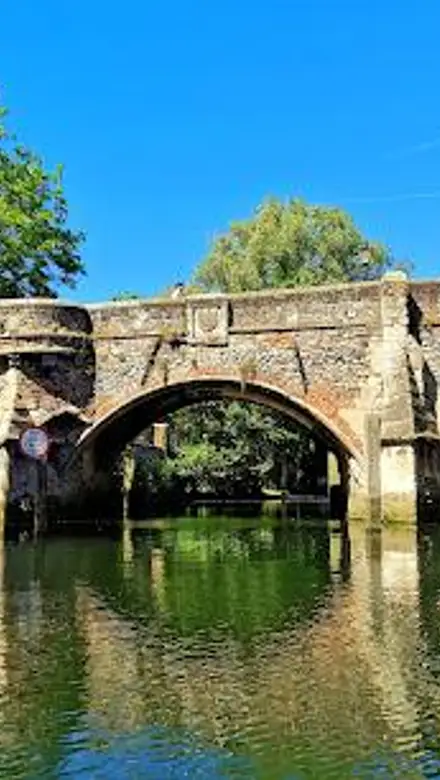
Bishop Bridge, Norwich Travel Guide
Free Guide: Discover Norwich's only medieval bridge: a 14th-century gem spanning the Wensum with historic arches, ancient gate remnants, and timeless riverside charm near the cathedral quarter.


A brief summary of Bishop Bridge
Discover Norwich's only medieval bridge: a 14th-century gem spanning the Wensum with historic arches, ancient gate remnants, and timeless riverside charm near the cathedral quarter.
Bishop Bridge is Norwich's sole surviving medieval bridge, a Grade II* listed structure of brick, stone, and flint spanning the River Wensum. Built around 1340 with a former gatehouse, it offers scenic views near Norwich Cathedral and embodies the city's rich history as one of Britain's oldest bridges still in public use.
On-site amenities
 Trash bins
 Information boards
Opening hours
- Every day12 am–12 am
Opening hours as listed on the venue’s Google Business Profile. Hours can change for services and special events, so check with the venue before you go.
- Address
- Norwich NR1 4AA
- Website
Getting there
Walking
Bus
Biking
Discover more about Bishop Bridge
History and Origins
Bishop Bridge traces its roots to a simple ford, possibly on a Roman road, evolving into a timber bridge by the medieval period. In 1275, Edward I granted permission for a more permanent structure with a gate, replacing earlier wooden crossings repaired as early as 1249. Around 1340, wealthy citizen Richard Spynk financed the current stone bridge and gatehouse, making it the first stone-built bridge in Norwich and one of the UK's oldest in continuous public use.
Architectural Features and Gatehouse
Constructed from brick, stone, and flint, the bridge features three graceful arches with cutwaters. The western side once supported a fortified gatehouse with towers and a drawbridge, guarding access to the Bishop's Palace. Semicircular recesses mark the bases of these towers, visible today. The gatehouse, manned during turbulent times, was demolished in 1791 due to structural decay and narrow passage impeding traffic.
Key Historical Events
The bridge witnessed pivotal moments, including Kett's Rebellion in 1549 when rebels breached the gatehouse using gunpowder from Mousehold Heath, collapsing one tower. Repaired with timber from nearby bridges, it endured further conflicts like the English Civil War. Ownership shifted from the church to the city in 1393, with wards responsible for maintenance. In 1923, the Norwich Society successfully campaigned against demolition, preserving it as a scheduled ancient monument.
Modern Significance
Now pedestrian-only, Bishop Bridge stands at the east end of Bishopsgate, near Norwich Cathedral. Its carved town crest adorns the center, and flood markers recall past inundations exacerbated by its arches. The design influenced the 1933 rebuilding of Fye Bridge. Visitors appreciate its picturesque setting along the River Wensum, blending heritage with serene riverside walks.
Evendo Review Centre
 Google
Guest reviews
Best time to go
Quietest: Jan, Feb & Mar · before 3am
Busy times are Evendo estimates for a typical year, to help you plan. Actual crowds vary with events, school holidays and the weather.
Explore Bishop Bridge on the map
A handpicked selection of must-see spots near Bishop Bridge, mapped for you.
Get your free copy of our complete guide to Bishop Bridge, delivered straight to you.
Everything on this page, from opening hours and how to get there to Eve’s tips and the best time to go, in one PDF you can read offline, print or share.
Already have an account? Sign in
Your Bishop Bridge guide is ready.
We'll send it to · Not you? Sign out

Getting your guide ready…
We are putting together a fresh copy of the Bishop Bridge guide. This can take up to a minute.
This can take a few moments. If your browser asks, choose Allow so the download can start. You'll find the guide in your Downloads folder.
Nothing happened? Download it again
Sorry, the guide is taking longer than usual. Please try again in a minute, or get it by email instead.
Unlock the best of Bishop Bridge
Skip-the-line tickets, guided tours with entry, and walking tours of the area, booked in a few clicks.

Other nearby places you may find interesting
The closest places of the same kind, if this one is not quite what you had in mind.
-
-
-
-
-


Swipe for more places
More to explore near Bishop Bridge

 Best experiences near Bishop Bridge
 Best hotels near Bishop Bridge
 Best landmarks near Bishop Bridge
 Best attractions near Bishop Bridge
 Best shops near Bishop Bridge
 Best restaurants near Bishop Bridge
 Best bars near Bishop Bridge
Do you manage this location?
Take control to get all the benefits, like improved information, better appearance, and stronger visibility across AI-powered discovery.
Explore more

Explore more of Norwich
Norwich travel guide: explore medieval lanes, Norwich Castle, two cathedrals, independent culture, Norfolk food, riverside walks and the Broads nearby.
Explore Norwich
Explore more of United Kingdom
Discover the United Kingdom: A blend of rich history, stunning landscapes, and vibrant cities, offering a unique travel experience for every visitor.
Explore United Kingdom