


Kuala Lumpur Colonial History Walk - Private Guided Tour
 Kuala Lumpur, MY
 100% of travellers recommend this

Highlights
- Immerse yourself in Kuala Lumpur's colonial past
- Discover hidden historical gems with expert guides
- Experience vibrant local culture and storytelling
- Explore stunning architecture with rich heritage
- Enjoy a personalized and intimate walking adventure
-
Duration 4.5 hours
-
Private transportation included
-
Printed materials provided
-
Admission fees included
-
English-speaking guide
Embark on a captivating journey through colonial Kuala Lumpur, where history whispers from every corner. This immersive 4.5-hour walking tour, led by a passionate storyteller, unveils the architectural marvels that shaped the city—from the majestic Kuala Lumpur Railway Station to the serene Jamek Mosque. Travelers will stroll along the Klang River, explore the grandeur of the Sultan Abdul Samad Building, and discover the vibrant tales hidden within the streets of Central Market. Each stop reveals local anecdotes and rich historical insights, weaving a tapestry of Kuala Lumpur's past and present. With personalized attention and an intimate atmosphere, they will experience a unique blend of culture, architecture, and heritage, making the city come alive in a way that cookie-cutter tours simply cannot. This is a history walk that promises to be as enlightening as it is enchanting.
At a Glance
-
 Free cancellation
-
 3 hours
-
 Instant Confirmation
-
 Available in English
-
 Mobile voucher
-
 Private Tour
-
 Guided
-
 Family friendly

Featured Reviews

Explore the rich history of colonial Kuala Lumpur on a captivating walking tour, led by a storytelling expert, uncovering hidden gems and local anecdotes.
Included
-
 OtherPersonalised experience for up to 4 guests
-
Admission feesAdmission fee
-
Other3 - 4 hrs private walking tour of Kuala Lumpur's colonial landmarks
-
OtherPrinted material
Excluded
-
 Bottled waterBottled water
-
MealsMeals
Meeting Point
The firs meeting is old Kuala Lumpur Railway Station, the start of your half-day tour. Your guide will be waiting for you near the ticket office for the station and will be there with a small yellow tour flag.

110, Jalan Sultan Hishamuddin, Kampung Attap, 50000 Kuala Lumpur, Wilayah Persekutuan Kuala Lumpur , Malaysia

End Point
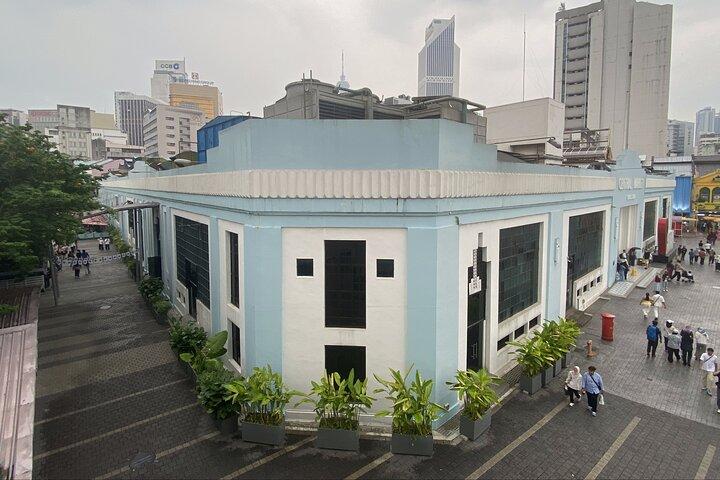
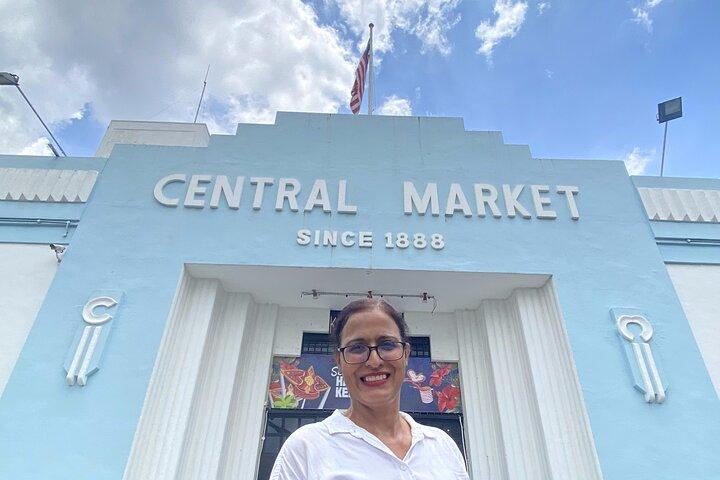
The tour will end at Kuala Lumpur's Central Market, Kuala Lumpur's oldest market building which today houses a bazaar of shops, restaurants and cafes. We will spend half an hour here, after which you will be transported back to your hotel.

Kuala Lumpur City Centre, 50050 Kuala Lumpur, Federal Territory of Kuala Lumpur , Malaysia
What to expect
Kuala Lumpur Railway Station
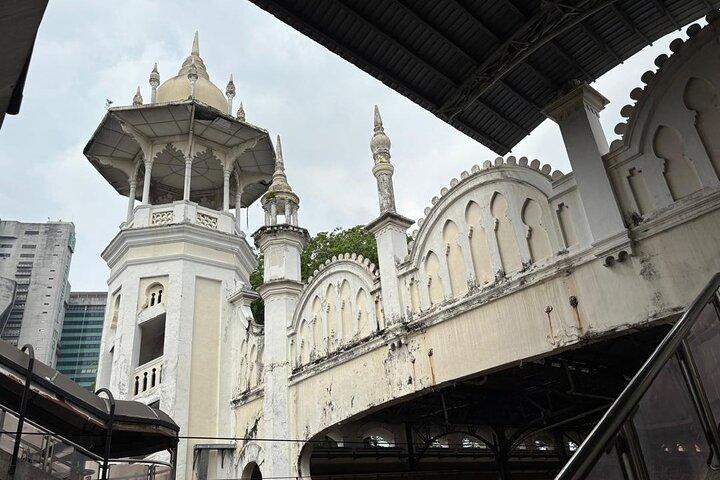
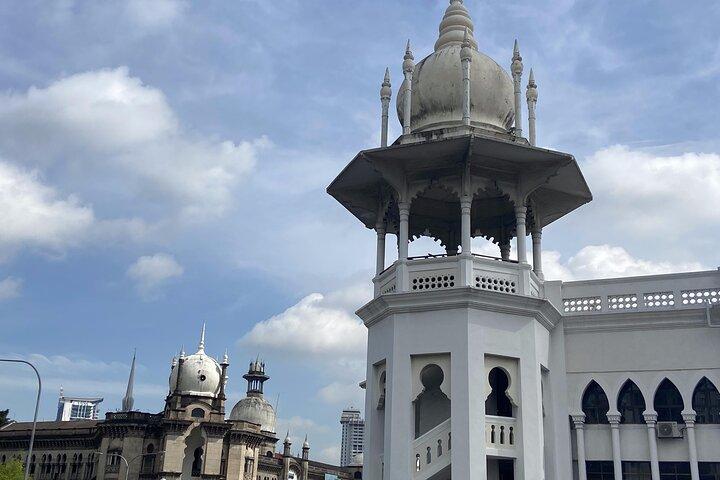
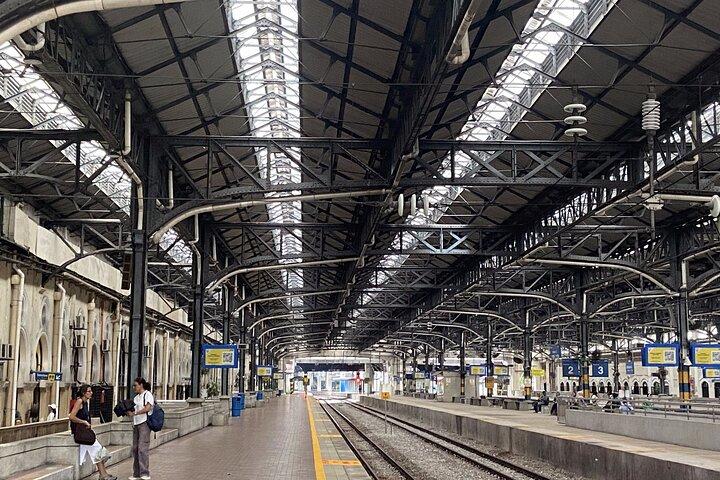
Of all the scenic vistas of Kuala Lumpur, it is, perhaps, the railway station that surely captures the imagination of any foreign traveller. Standing like a confection of domes and minarets, clad in white as though iced for a feast, the station-completed in 1911 under the aegis of the aforementioned A.B. Hubback-was the third to serve the city. Its style, Indo-Saracenic in flavour, evokes the romantic East as dreamt by empire-builders and Orientalists. One half expects a troupe of turbaned guards or the arrival of a princely Maharajah. Yet this station is more than fantasy-it has conveyed governors and sultans alike, and it was instrumental in breathing life into the economic arteries of the colonial Malaya. Today it remains an architectural delight - like a freshly-baked cake covered in buttercream icing in the midst of Kuala Lumpur's urban sprawl.
15 minutes
Malayan Railway Administration Building
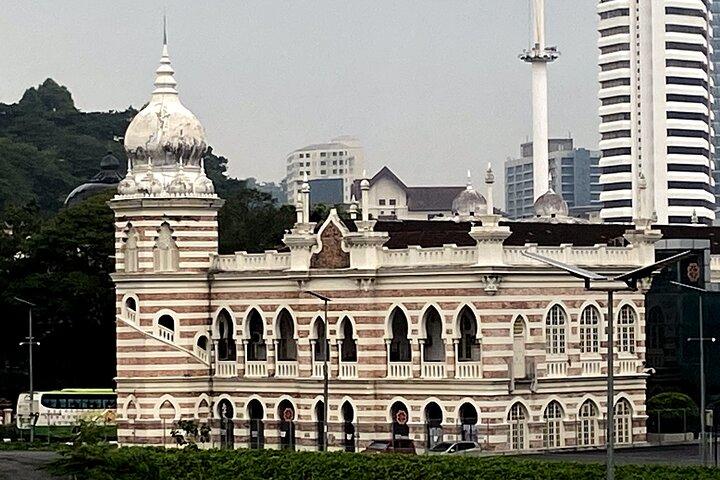
Across from the Kuala Lumpur Railway Station, the FMS Railway Administration Office was designed by Government Architect Arthur Benison Hubback. Construction began in 1914, three years after the station’s completion, and finished in September 1917. It was one of Hubback’s last government buildings and his final work in Kuala Lumpur before he left for England to fight in the First World War, never to return. Like the station, it reflects the Indo-Saracenic style, crowned by four large domes—the central dome with a cupola and three domes on staircase towers—plus four smaller domes. The three-storey façade features arcaded arches: pointed horseshoe arches with pilasters on the ground floor, semi-circular arches with triple columns on the first, and interlocked pointed arches above. The porte-cochère is flanked by minarets and small chhatris, while keyhole arches add ornamentation. Today, the building still serves as the headquarters of Keretapi Tanah Melayu (KTM).
10 minutes
Klang River
The Klang River, about 120 km long, is Selangor’s longest river and Malaysia’s 8th longest. Rising near the Klang Gates Quartz Ridge in the Titiwangsa range, it flows through Kuala Lumpur before reaching the Straits of Malacca at Klang. Kuala Lumpur’s origins are tied to the river: in 1857 Raja Abdullah brought Chinese prospectors up the Klang to Ampang, sparking a tin mining boom. The river had been a tin source since Portuguese times, and its confluence with the Gombak was a vital transport hub. Rivalries over tin trade led to the Klang War (1867–74), after which Britain imposed control by installing a Resident in 1875. The river’s floods shaped the city, with disasters such as the 1926 flood, followed by major ones in 1971 and 2003. Mitigation included forest management and embankments, though flooding persists. By the 1980s the river became heavily polluted, but efforts like the 2011 “River of Life” project aim to restore it as a clean urban waterway
Old Market Square Clock Tower
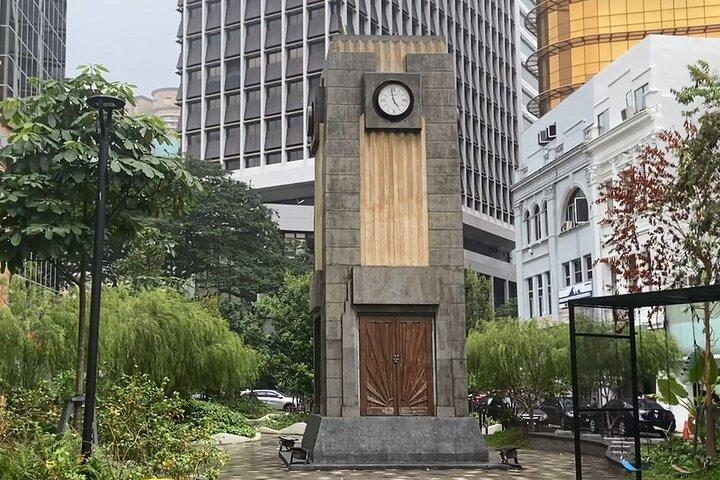
The venerable Old Market Square is distinguished by an elegant clock tower erected in 1937 to mark the coronation of His Majesty King George VI. Conceived by Arthur Oakley Coltman in the fashionable Art Deco style, its geometric features-sunbursts and vertical embellishments-speak of both modernity and optimism, a beacon in the gloaming of the Great Depression. The surrounding shophouses echo this decorative sentiment with angular grace and rhythmic symmetry. Amid the hustle and bustle of the modern-day traffic, history lingers here with a cooling beverage in hand, beneath the steady ticking of time.
10 minutes
Jamek Mosque
The Jamek Mosque is serendipitously positioned at the birthplace of this vibrant city - the confluence of the muddy rivers Klang and Gombak. It is this geographical feature from which the city draws its name ('kuala' being 'confluence' or 'estuary' in Malay, and 'lumpur' meaning 'mud'). This is the oldest and most venerable of the city's mosques. Raised upon an ancient Malay burial ground, its Moorish domes and arched colonnades bespeak the genius of Mr. A.B. Hubback, who laid its plans. The Sultan of Selangor himself consecrated its foundation in 1908 and opened it with solemn ceremony a year later. Though now encircled by a tumult of motorcars and the modern Babel of high towers, the mosque yet retains an air of hallowed tranquillity-a sanctuary amid the din, its leafy palms and the murmuring river presenting an oasis of cool calm that reminds us that this is a city with a soul and its own unique spirituality.
15 minutes
Sultan Abdul Samad Building
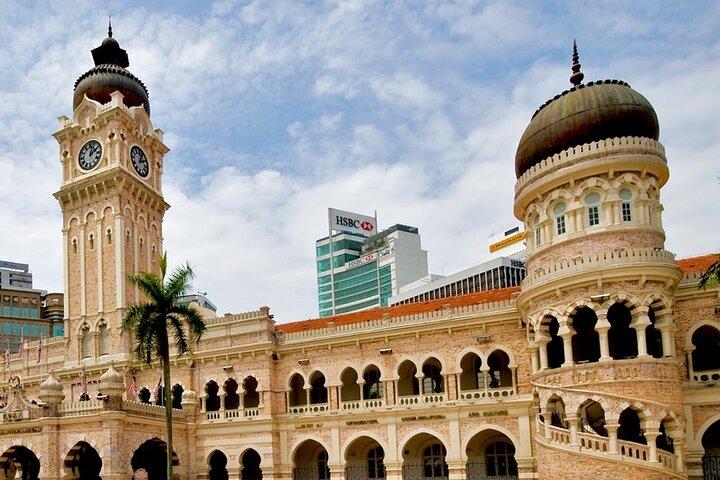
Flanked by the former General Post Office, Magistrate Courts and Kuala Lumpur Council Building, this government office complex was constructed in 1894 for the British colonial administration at a cost of 152,000 Straits dollars, the Government Offices were opened by Sir Frank Swettenham on 4 April 1897. Renamed the Federal Secretariat in 1948 and later, in 1974, the Sultan Abdul Samad Building, it remains one of Kuala Lumpur’s most iconic landmarks. Though formally credited to A.C. Norman, much of the design was by R.A.J. Bidwell with input from A.B. Hubback. The two-storey, F-shaped structure covers 4,200 sq m, with a 450-ft façade and a 135-ft clock tower modeled on Big Ben, its clock chiming first in 1897 for Queen Victoria’s Diamond Jubilee. Used by the Japanese in WWII and later as the site of independence celebrations in 1957, it housed Malaysia’s courts until 2007. Built with flood-resistant foundations, it withstood major floods in 1926 and 1971.
15 minutes
St. Mary's Cathedral
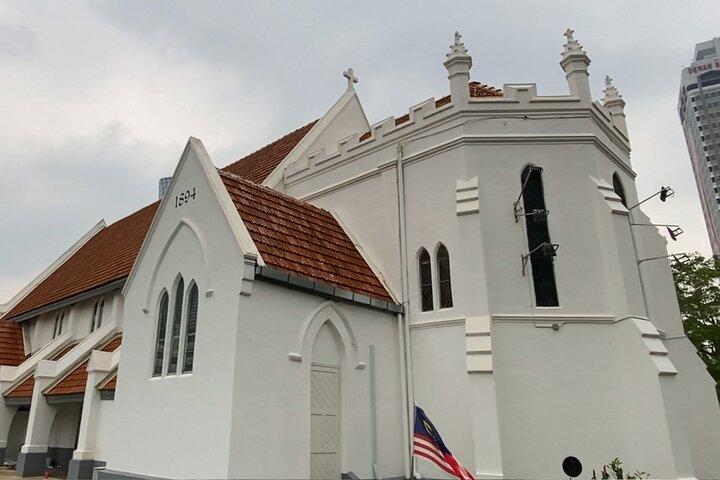
The dignified Anglican Church of St Mary the Virgin was originally a timber edifice of modest ambition atop the nearby Bukit Aman hill in 1887. It was replaced by the present brick structure in 1895. This sanctuary, built near the Parade Ground of the Selangor Club, was the first such church of brick and stone in the Malay States beyond those in the Straits Settlements. Within its venerable nave, one finds an organ by the esteemed Mr. Henry Willis, who also made the organ for St Paul's Cathedral in London and the original Grand Organ of the Royal Albert Hall. The church has received royal attention more than once-Her Majesty Queen Elizabeth II herself having graced its pews on three separate occasions in 1972, 1989, and 1998.
15 minutes
Royal Selangor Club
Founded in 1884, the Selangor Club served as a meeting place for educated and high-ranking members of British colonial society. While most early members were British, admission was based more on education and status than race. Its first attap-roof building near the padang was replaced in 1890 by a two-storey structure designed by A.C. Norman, then rebuilt in 1910 by A.B. Hubback in Mock Tudor style, with two new wings. Nicknamed “The Spotted Dog,” the name is variously said to derive from mixed membership, two Dalmatians owned by H.C. Syers’ wife that guarded the entrance, or a poorly drawn leopard emblem mistaken for a dog. Simply called “The Dog,” the club grew to include local elites such as judges and lawyers. Its location beside the High Courts at Dataran Merdeka cemented its role as a gathering place for the legal fraternity and a social hub of colonial and post-colonial Kuala Lumpur.
Kuala Lumpur Library
Located in the grounds of the Kuala Lumpur Public Library grounds is the former Government Printing Office. Completed in 1899, this beautiful building was where the Government reports, official government books, notifications and even train tickets were printed. News from back home in England was also printed here apart from the local publications at the time, such as the Selangor Journal – the official journal of the Selangor government. It is in an architectural style called Jacobean, with ornamented with Dutch-style gables, red brick, and long, rectangular windows divided by stone or wooden mullions—often arranged in rows across the façade. This was quite different from the surrounding public buildings designed in Indo-Saracenic style. The interior was designed so that it could house printing machinery, in addition to offices. Because of this, its interior had no obstructing columns running in the middle of the building to accommodate a large printing press machine.
10 minutes
2, Jln Ampang
Completed in 1909 on the south side of Independence Square, this building housed the main branch of the Chartered Bank of India, Australia and China—later Standard Chartered. Founded in London in 1853, the bank was the first to open in Kuala Lumpur, beginning in 1888 above shop houses on Market Street before moving in 1891 to this more secure site near the police headquarters. Its first single-storey premises soon proved too small, leading to the present three-storey structure opened in December 1909. In 1926, when the Klang and Gombak rivers flooded, millions of dollars in notes and documents had to be spread outside to dry. The bank remained a major financial hub of colonial Malaya. In the 1960s, during construction of the National Museum, the building was temporarily repurposed as the National History Museum, adding another layer to its long civic and financial legacy.
10 minutes
Queen Victoria Fountain
Situated on the corner of the Selangor Club Padang, the fountain shipped from Britain and sent to Malaya to commemorate Queen Victoria’s diamond jubilee in 1897. Ironically, it was not assembled on site until 1904, by which time the Queen had already died. The delay might have been because it was originally intended to be located in Market Square (Medan Pasar) but the police thought it would cause a traffic obstruction there and was set up on the Padang instead, in front of the Bank.
10 minutes
Old FMS Railway Office
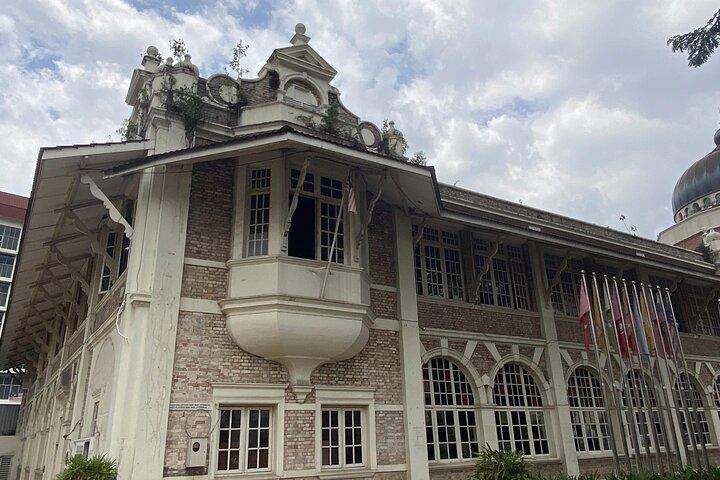
The first headquarters of the Federated Malay States Railways (FMSR), this building marked the shift from fragmented state railways to a unified system. Malaya’s first line opened in 1885 from Taiping to Port Weld, with Kuala Lumpur gaining service in 1886. Its first station stood near Lebuh Pasar, across from this office. Designed by A.B. Hubback, construction began in 1904. The two-and-a-half storey structure features red-and-white brick banding like Jamek Mosque, a corner stair tower crowned by a dome with mini-domes, and an entrance flanked by pylons topped with chhatris. The FMSR central office moved in 1917 to the new administration building opposite the railway station. This building later served various government roles before its 2007 renovation. In 2010, it reopened as the National Textile Museum, showcasing Malaysia’s textile heritage through galleries of fabrics, clothing, and multimedia on production techniques.
10 minutes

First conceived by the redoubtable Kapitan Yap Ah Loy as a humble wet market in 1888, it was then transformed into a splendid hall of commerce. The original structure then gave way to a much grander construction of 1937, under the hand of one TY Lee, an engineer of no small vision. The hall stretches some 401 feet in length and boasts dimensions hitherto unseen in the city, containing chambers cooled by the miracle of electricity-devoted separately to fish, pork, and other meats. Noteworthy, too, is the bluish-green Colorex glass used - marvel of technology then which tempered the sun's ardour whilst permitting daylight to dance within. Colorex glass lets in only 20% of the sun's heat but allows 60% of daylight (ordinary glass normally transmits 70% and 86% respectively). Today, the Market has evolved into a bazaar of treasures, housing over 350 shops that peddle native handicrafts, charming objets d'art, and curiosities sufficient to amuse even the most jaded globe-trotter.
30 minutes
The experience can be subject to change due to bad weather or unforseen circumstances. We always endeavour to give you the best possible experience.
Additional Information
-
 Public transportation options are available nearby
-
Travelers should have at least a moderate level of physical fitness
What our experts say
-
 Grab a refreshing drink at Central Market
-
Wear comfortable shoes for walking
-
Visit nearby Merdeka Square after tour
-
Check local events at the library
-
Capture photos at the railway station

More About this Experience
Introduction
Colonial Kuala Lumpur History Walk is not just a tour; it’s an invitation to step back in time and experience the rich tapestry of history woven into the very fabric of Malaysia's capital. This boutique walking tour, lasting four and a half hours, is led by passionate guides who are not just knowledgeable but are skilled storytellers. They have an uncanny ability to bring the past to life, blending historical insights with vibrant local anecdotes. Unlike typical cookie-cutter tours, this experience offers a more personal and intimate exploration of colonial Kuala Lumpur. Participants will visit iconic landmarks, each brimming with stories of the colonial era, all while enjoying the ease of private transportation and included admission fees. This is an opportunity to immerse oneself in a city where every corner holds a tale, and every structure has a history waiting to be uncovered. Perfect for history buffs, culture enthusiasts, and curious travelers alike, this tour promises an enriching experience within a convenient walking distance of the city’s highlights.What to expect?
Participants can expect a journey through time that highlights the unique blend of colonial architecture and cultural influences that define Kuala Lumpur. The tour begins at the majestic Kuala Lumpur Railway Station, where the Indo-Saracenic style will captivate your imagination. As travelers stroll through the streets, they will witness the grandeur of the Malayan Railway Administration Building and the serene beauty of the Jamek Mosque. Every stop is an opportunity to delve deeper into the city’s past, with tales of the Klang River’s significance to the city’s founding and the vibrant life around the Old Market Square. Expect to engage with history on a personal level as your guide shares lesser-known anecdotes, showcasing the rich narratives often overlooked in standard tours. By the end of this immersive experience, participants will not only have gained knowledge but a deeper appreciation for Kuala Lumpur's cultural heritage and the legacy of its colonial past.Who is this for?
The Colonial Kuala Lumpur History Walk is designed for anyone eager to explore the depths of Malaysia's capital through its historical lens. Whether you're a history aficionado wanting to uncover the stories behind iconic landmarks or a casual traveler curious about the city’s heritage, this tour caters to all. Solo adventurers seeking a unique experience, families wanting to enrich their journey with educational insights, or even groups of friends looking for a fun and engaging way to explore the city will find this tour appealing. The moderate physical activity level makes it accessible to most, ensuring that everyone can partake in this enriching journey. Even those with limited knowledge of Malaysian history will find the captivating storytelling and personal anecdotes engaging, making it a perfect fit for diverse audiences looking to connect with Kuala Lumpur in a meaningful way.Why book this?
Booking the Colonial Kuala Lumpur History Walk is a chance to experience the city like no other. This is not merely a sightseeing tour; it’s a deep dive into the heart of Kuala Lumpur’s colonial heritage, guided by expert storytellers who breathe life into every narrative. Unlike commercial tours, this experience promises a unique and intimate perspective, allowing travelers to engage with the city’s history in a personal way. The small group setting ensures a more interactive atmosphere, where participants can ask questions and delve deeper into their areas of interest. Moreover, the combination of well-researched historical insights and captivating storytelling makes this tour an unforgettable experience. Each location visited tells a compelling story, making it a fantastic choice for those who appreciate culture, history, and the nuances of urban life. This is an opportunity to create lasting memories while gaining a richer understanding of Kuala Lumpur’s past.Good to know
Before embarking on the Colonial Kuala Lumpur History Walk, it’s good to keep a few things in mind. The tour includes private transportation, ensuring comfort and convenience throughout the journey. While meals and bottled water are not included, travelers are encouraged to carry water and perhaps grab a snack at one of the charming cafes along the route. The meeting point is conveniently located at the Old Kuala Lumpur Railway Station, where your guide will be waiting with a friendly smile and a small yellow flag. Participants are advised to wear comfortable shoes, as the walking tour involves moderate activity. With public transportation options nearby, getting to the meeting point is hassle-free. Most importantly, come with an open mind and a curious spirit, ready to soak in the stories that this vibrant city has to share.Reviews
Feedback from those who have experienced the Colonial Kuala Lumpur History Walk has been overwhelmingly positive. Many travelers have praised the tour for its engaging and knowledgeable guides, highlighting their ability to weave captivating stories that breathe life into the historical sites. Participants have expressed appreciation for the intimate atmosphere of the tour, noting that it felt more like a personal exploration than a commercial outing. The depth of information provided, coupled with the delightful anecdotes, has left many feeling a genuine connection to the city’s heritage. The picturesque locations visited, from the stunning architecture of the Sultan Abdul Samad Building to the serene ambiance of the Jamek Mosque, have been frequently mentioned as highlights. Overall, travelers have left the tour feeling inspired and enriched, eager to share their newfound knowledge and experiences with friends and family, making this walking tour a must-do for anyone visiting Kuala Lumpur.
Your all‑in‑one travel companion app
Explore expert travel guides, compare and book tours, experiences, hotels, and more—all from the palm of your hand. Download now for seamless trip planning wherever your wanderlust takes you.


This is a popular product and the date you are looking for just sold out. Next available date is
