Statue of Andersen, Copenhagen Travel Guide
Free Guide: Bronze storyteller in the middle of Rådhuspladsen, gazing toward Tivoli as traffic swirls and Copenhagen’s civic heart beats around him.


A brief summary of Statue of Andersen
Bronze storyteller in the middle of Rådhuspladsen, gazing toward Tivoli as traffic swirls and Copenhagen’s civic heart beats around him.
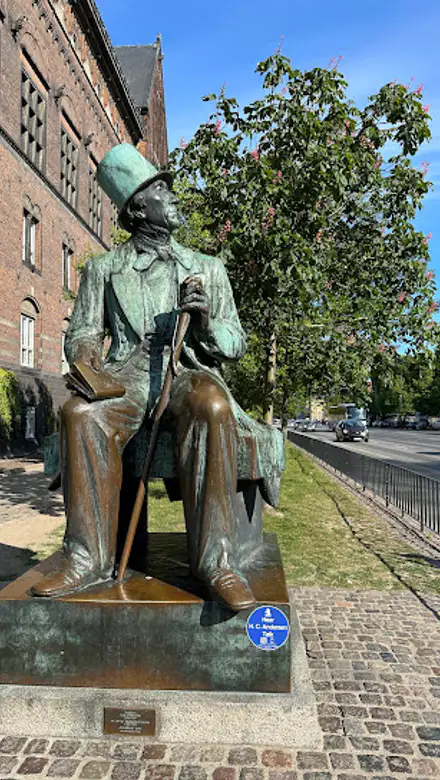
Set on bustling Rådhuspladsen beside Copenhagen City Hall, the bronze statue of Hans Christian Andersen shows Denmark’s beloved fairy‑tale writer seated with a book in his lap, gazing across H.C. Andersens Boulevard toward Tivoli Gardens. Created by sculptor Henry Luckow‑Nielsen and unveiled in 1965, it has become a central city landmark and a favourite photo stop, inviting visitors to pause amid the traffic and plazas and connect the modern capital with the imaginative worlds of Andersen’s stories.
On-site amenities
 Restrooms
 Drink options
 Drinking water
 Food options
 Seating areas
 Sheltered areas
 Trash bins
 Information boards
 Visitor centre
Opening hours
- Every dayOpen 24 hours
Opening hours as listed on the venue’s Google Business Profile. Hours can change for services and special events, so check with the venue before you go.
- Address
- Rådhuspladsen, 1553 København V
- Website
Getting there
Metro
Train and Walk
City Bus
Bicycle
Discover more about Statue of Andersen
A storyteller in the heart of Copenhagen
Hans Christian Andersen’s larger‑than‑life bronze figure sits at the edge of Copenhagen’s City Hall Square, Rådhuspladsen, one of the city’s busiest urban spaces. Here, trams, buses and bicycles stream past while the writer is caught in a moment of quiet reflection, book in hand, coat folded around him, as though he has just paused mid‑tale. The setting is no accident: this is civic ground zero, and placing Andersen here weaves his stories into the daily rhythm of the capital.From the base of the statue, you are ringed by landmark architecture – the red‑brick City Hall on one side, grand façades and neon signs on the other – underlining how closely the author is tied to Copenhagen’s identity. Even in such a modern, traffic‑heavy square, the sculpture creates a small island of stillness where literature, memory and city life intersect.
Symbolic gaze toward Tivoli Gardens
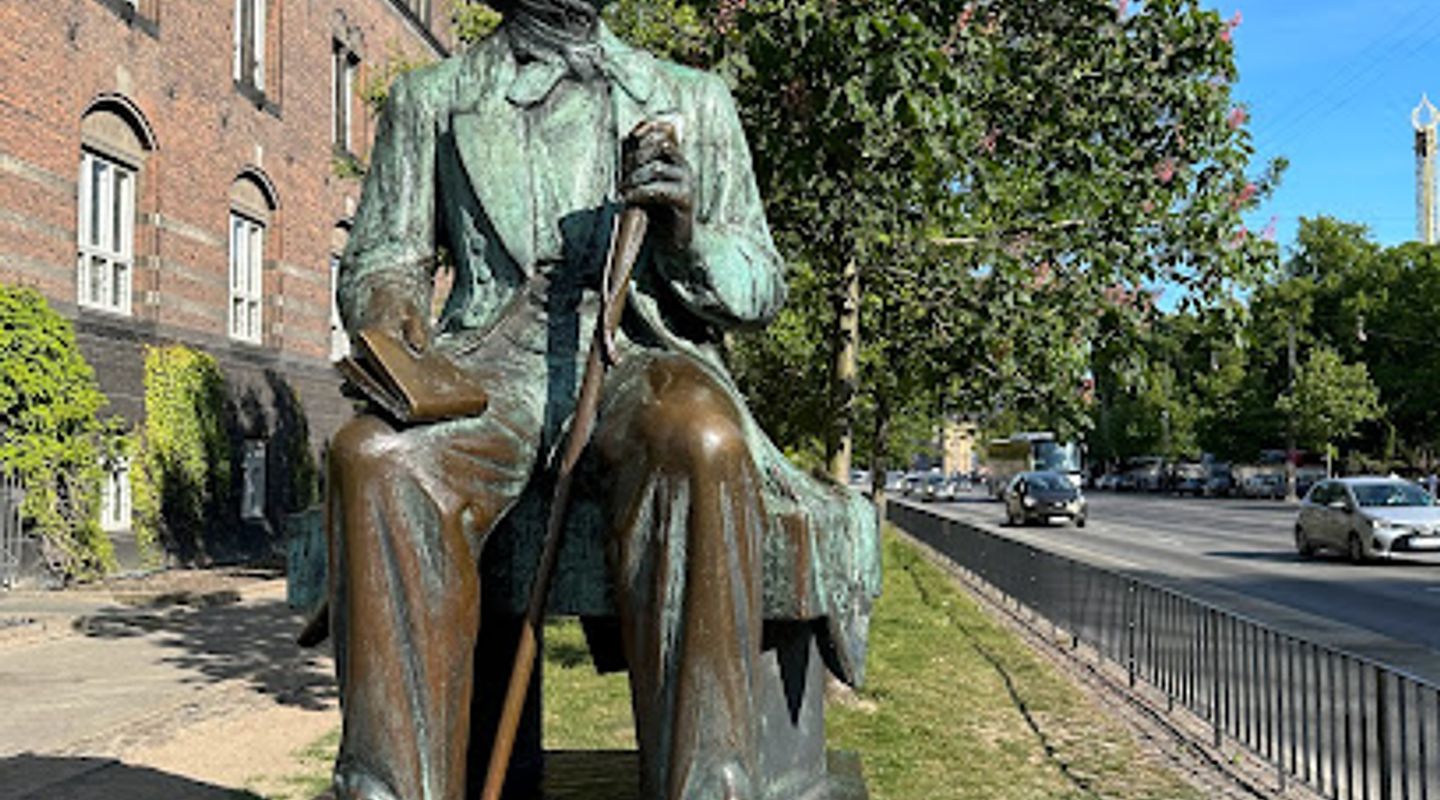
One of the statue’s most evocative details is the way Andersen’s body is turned. He faces H.C. Andersens Boulevard and looks toward Tivoli Gardens, the historic amusement park just across the wide avenue. This orientation has often been read as symbolic: the writer of fantastical tales forever looking toward a place of lights, music and mechanical wonders that could easily have stepped out of his imagination.Standing beside the monument, it is easy to picture the 19th‑century city that Andersen knew – gas lamps instead of traffic lights, carriages instead of buses, Tivoli’s towers and pavilions rising like a fairy‑tale backdrop. The alignment links physical spaces in the modern city to the dreamy landscapes of the stories, inviting visitors to trace invisible lines between fact and fable.
Bronze craft and sculptural detail
The statue was created in 1965 by Danish sculptor Henry Luckow‑Nielsen, whose approach balances realism with an approachable informality. Andersen is not idealised as a remote genius on a high plinth; instead he sits at near‑human scale, cloak draped naturally, hat perched on his head, his features rendered with gentle precision. The open pose, with one leg slightly forward and the book resting on his knee, makes him feel almost conversational.Over time, the bronze has developed a soft patina, but you can still read the crisp folds of fabric, the texture of his shoes, and the careful modelling of his hands. Details such as the walking cane and the well‑defined spine of the book subtly allude to his life of travel and writing. The modest height of the base keeps the figure close to eye level, reinforcing the impression that you are meeting a person rather than viewing a distant monument.
A tactile meeting with a literary icon
Because the statue sits right on the edge of the square, it invites physical interaction. People often perch on the plinth for a picture, or stand shoulder‑to‑shoulder with the bronze author as if listening to a bedtime story. Certain areas of the surface are smoother where countless hands have rested, a visible record of decades of quiet encounters.This informality reflects the way Andersen’s tales seep into daily life in Denmark, told to children, adapted for stage and screen, and echoed in street names and institutions. For many visitors, stopping here is less about ticking off an attraction and more about acknowledging a familiar voice from childhood, now anchored in metal and stone in the centre of the city.
Link in a wider network of Andersen sites
The City Hall Square statue is part of a wider constellation of places connected to Hans Christian Andersen. Elsewhere in Copenhagen stands another major monument in the King’s Garden, and not far away, by the harbour, the Little Mermaid brings one of his most famous characters into sculptural form. Together, these works chart different facets of the author’s legacy: the private storyteller, the public figure and the imaginative worlds he created.Here at Rådhuspladsen, the emphasis is on Andersen as citizen of Copenhagen – a man who walked these streets, watched the crowds and transformed everyday scenes into enduring narratives. Spending time at the statue, with the pulse of the city all around, you are reminded that his fairy tales grew out of very real urban experiences, and that this corner of the square remains a living threshold between the practical and the magical.
Evendo Review Centre
 Google
Guest reviews
Best time to go
Quietest: Jan, Feb & Mar · before 7am
Busy times are Evendo estimates for a typical year, to help you plan. Actual crowds vary with events, school holidays and the weather.
Explore Statue of Andersen on the map
A handpicked selection of must-see spots near Statue of Andersen, mapped for you.
Get your free copy of our complete guide to Statue of Andersen, delivered straight to you.
Everything on this page, from opening hours and how to get there to Eve’s tips and the best time to go, in one PDF you can read offline, print or share.
Already have an account? Sign in
Your Statue of Andersen guide is ready.
We'll send it to · Not you? Sign out

Getting your guide ready…
We are putting together a fresh copy of the Statue of Andersen guide. This can take up to a minute.
This can take a few moments. If your browser asks, choose Allow so the download can start. You'll find the guide in your Downloads folder.
Nothing happened? Download it again
Sorry, the guide is taking longer than usual. Please try again in a minute, or get it by email instead.
Unlock the best of Statue of Andersen
Skip-the-line tickets, guided tours with entry, and walking tours of the area, booked in a few clicks.
 Tour with entry
Copenhagen History and Folklore Self Guided Audio Walking Tour
from $9.26 Tour with entry
Copenhagen: H.C. Andersen Walking Tour with Local Guide
from $49.79 Tour with entry
Historical Walking Tour On the Route of Danish Happiness
from $198.91 Tour with entry
Snaps, Hygge and Nightlife Tour in Copenhagen Nyhavn Bars
from $583.75
Other nearby places you may find interesting
The closest places of the same kind, if this one is not quite what you had in mind.
-
City Hall Square Copenhagen's grand civic plaza where history, culture, and urban life converge in one iconic square.
-
Amalienborg Palace The octagonal heart of Danish monarchy where history, art, and royal tradition converge in perfect Rococo harmony.
-
 The Little Mermaid
Copenhagen’s most famous bronze figure, a small mermaid with a grand story, gazing from Langelinie’s harbour rocks toward the meeting of fairy tale and sea.
The Little Mermaid
Copenhagen’s most famous bronze figure, a small mermaid with a grand story, gazing from Langelinie’s harbour rocks toward the meeting of fairy tale and sea.
-
Frederiksholms Kanal Historic waterway encircling Denmark's political heart, where regal grandeur meets relaxed Nordic charm.
-
Nyhavn Copenhagen's iconic 17th-century harbor where colorful townhouses, maritime history, and vibrant waterfront culture converge.
Swipe for more places
More to explore near Statue of Andersen

 Best experiences near Statue of Andersen
 Best hotels near Statue of Andersen
 Best landmarks near Statue of Andersen
 Best attractions near Statue of Andersen
 Best shops near Statue of Andersen
 Best restaurants near Statue of Andersen
 Best bars near Statue of Andersen
Do you manage this location?
Take control to get all the benefits, like improved information, better appearance, and stronger visibility across AI-powered discovery.
Explore more

Explore more of Copenhagen
Discover Copenhagen: A perfect blend of history, modernity, and vibrant culture, where picturesque canals, stunning architecture, and world-class dining await you.
Explore Copenhagen
Explore more of Denmark
Discover Denmark: A perfect blend of history, modern design, and the cozy concept of hygge. Explore vibrant cities, serene landscapes, and world-class cuisine.
Explore Denmark