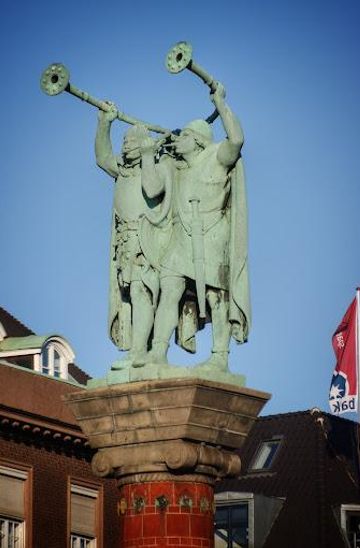
Lur Blowers (Lurblæserne), Copenhagen
Bronze Age horns meet early 20th‑century grandeur in this 20‑metre column, where two silent lur players keep watch over Copenhagen’s bustling City Hall Square.
Towering above Copenhagen’s City Hall Square, the Lur Blowers monument is a 20m‑tall bronze sculpture of two Viking-style figures raising ancient lur horns to the sky. Gifted by the Carlsberg foundations in the early 1900s to mark brewer J.C. Jacobsen’s centenary, the pair stand on a red-brick column with an integrated bench, becoming one of Rådhuspladsen’s most recognisable silhouettes and a classic meeting point beside the bustling heart of the city.
A brief summary to Lur Blowers
- Rådhuspladsen 57, Copenhagen, Indre By, 1550, DK
- Duration: 0.25 to 1 hours
- Free
-
 Outdoor
- Mobile reception: 5 out of 5
- Monday 12 am-12 am
- Tuesday 12 am-12 am
- Wednesday 12 am-12 am
- Thursday 12 am-12 am
- Friday 12 am-12 am
- Saturday 12 am-12 am
- Sunday 12 am-12 am

Know before you go
Hi, I'm Eve. Here are a few practical things to know before exploring Lur Blowers.
- Bring a zoom lens or use your phone’s telephoto mode if you want close-up shots of the lur players’ faces and the horn details high above the square.
- Combine your stop here with a visit to the National Museum of Denmark, where original Bronze Age lurs are displayed, to connect the monument with real artefacts.
- Visit around golden hour for softer light on the bronze figures and to avoid the harsh midday contrast against the sky.
- Use the circular bench at the base as a short rest spot while planning your next move around City Hall Square and Tivoli Gardens.
- In wet or windy weather, take extra care when standing to photograph in the open square, as conditions can feel more exposed around the monument.
Do you manage this location?
Take control to get all the benefits, like improved information, better appearance, and stronger visibility across AI-powered discovery. Learn more
Activate your presenceOther nearby places you may find interesting
Getting There
-
Metro
Take the M3 or M4 metro line to Rådhuspladsen Station, which lies directly beneath City Hall Square. From central areas like Kongens Nytorv or Nørrebro, the ride typically takes 3–8 minutes and trains run every few minutes throughout the day. A single zone 2 ticket costs roughly 20–25 DKK and covers buses, metro and local trains within the city centre.
-
Bus
Several city bus routes stop at Rådhuspladsen, making the Lur Blowers easy to reach from neighbourhoods such as Vesterbro, Nørrebro and Østerbro in about 10–25 minutes depending on traffic. Standard city bus fares are included in a regular zone ticket of about 20–25 DKK. Buses can be busy at rush hour, but they offer step-free boarding and frequent departures.
-
Walking
From Copenhagen Central Station the walk to City Hall Square takes around 5–10 minutes at a relaxed pace along broad pavements. The route is flat and suitable for most mobility levels, though the area can be crowded, particularly in summer and during events on the square.
-
Bicycle
Hiring a city bicycle is a typical Copenhagen way to reach the Lur Blowers, with rides from districts like Nørrebro or Østerbro taking around 10–20 minutes. Expect dense bike traffic near Rådhuspladsen and limited dedicated parking spots immediately beside the monument; lock and leave your bike in marked stands around the square.
For the on-the-go comforts that matter to you
-
 Restrooms
-
 Drink Options
-
 Drinking Water
-
 Food Options
-
 Seating Areas
-
 Trash Bins
-
 Information Boards
-
 Visitor Center
Discover more about Lur Blowers
Bronze horns over Copenhagen’s civic stage
The Lur Blowers (Lurblæserne) rise dramatically at the edge of City Hall Square, their dark bronze figures outlined against Copenhagen’s often windswept sky. Two caped, helmeted men stand shoulder to shoulder, each holding a long curved lur – a Bronze Age horn – angled upwards as if ready to sound a ceremonial call across the square. Perched high on a tall brick column, they watch over the constant choreography of buses, bicycles and pedestrians below.From ground level the figures seem small, but look up and you notice how tightly they are composed, almost merging into a single powerful form. The column itself is built in warm red brick and terracotta that echoes the neighbouring City Hall, visually tying the monument into the architecture around Rådhuspladsen. A circular bench wrapped around its base offers a natural place to pause, rest or simply look out across one of Copenhagen’s busiest urban spaces.From brewery patron to city landmark
The monument owes its existence to the Carlsberg and New Carlsberg Foundations, which donated it to the city to commemorate the 100th birthday of Carlsberg founder J.C. Jacobsen in 1911. Architect Anton Rosen designed the column, while sculptor Siegfried Wagner created the bronze group, completed and inaugurated a few years later. Their collaboration produced something that feels both celebratory and civic – a victory column without a battle, honouring industry, culture and the city itself.Inscribed on the shaft are Jacobsen’s name and the dates that anchor the work in its commemorative purpose. Yet for most passersby today, the monument is less about a specific brewer and more about Copenhagen’s early 20th‑century confidence. It belongs to the same era that gave the city its grand City Hall, elaborate fountains and decorative façades, when public art and architecture were enlisted to project modern identity.Echoes of Bronze Age music
The lurs clutched by the figures are not fantasy instruments but enlarged versions of real Bronze Age horns unearthed in Danish bogs. The original lurs, often found in carefully buried pairs, date back around three thousand years and are thought to have been used in rituals, processions or to signal in warfare. Their distinctive S‑shaped curves and flared bells are faithfully translated here, giving the sculpture a direct line back to prehistoric Scandinavia.The decision to depict two players rather than one reflects that archaeological detail: lurs were tuned in pairs, intended to sound together. Here, the sculptor places the men so close their shoulders almost touch, amplifying the sense of unity and shared purpose. Though you cannot hear them, it is easy to imagine a deep, resonant note rolling down the length of the square each time you glance up.Part of City Hall Square’s living backdrop
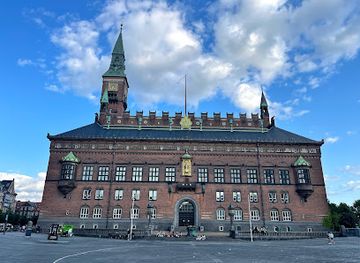
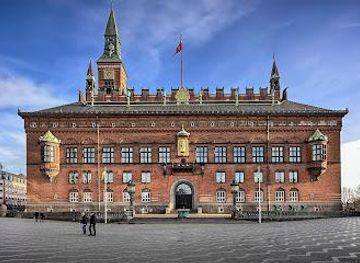
Standing just beside Copenhagen City Hall and near the Dragon Fountain and Hans Christian Andersen statue, the Lur Blowers form part of a dense cluster of monuments that frame Rådhuspladsen. Buses slide past, cyclists weave by, and crowds gather for concerts, demonstrations and celebrations, all under the silent gaze of the horn players. By day they are a popular reference point in a tangle of streets and transit lines; by night they become a dark silhouette against the illuminated façades.Despite their height and heroic style, there is something approachable about the monument. The low brick plinth is close enough to touch, and the bench invites you to sit and watch the city’s theatre unfold. For photographers, the figures offer a striking vertical accent in views across the square, often captured alongside the City Hall tower or the neon of nearby buildings.Quiet details amid the urban rush
Spend a few minutes at the foot of the column and smaller details reveal themselves. The texture of the brickwork, the weathering of the bronze, the careful way each lur curves outwards before turning skyward – all reward a slower look. You may spot locals using the bench as a casual rendezvous point or office workers taking a brief break between buses.In a square dominated by grand architecture and large crowds, the Lur Blowers provide a vertical punctuation mark, a reminder of Denmark’s deep historical layers. From Bronze Age instruments to industrial‑age philanthropy and today’s lively public gatherings, this single column captures several chapters of the country’s story in one compact but memorable piece of cityscape.Explore the best of what Lur Blowers has to offer















More about North Zealand
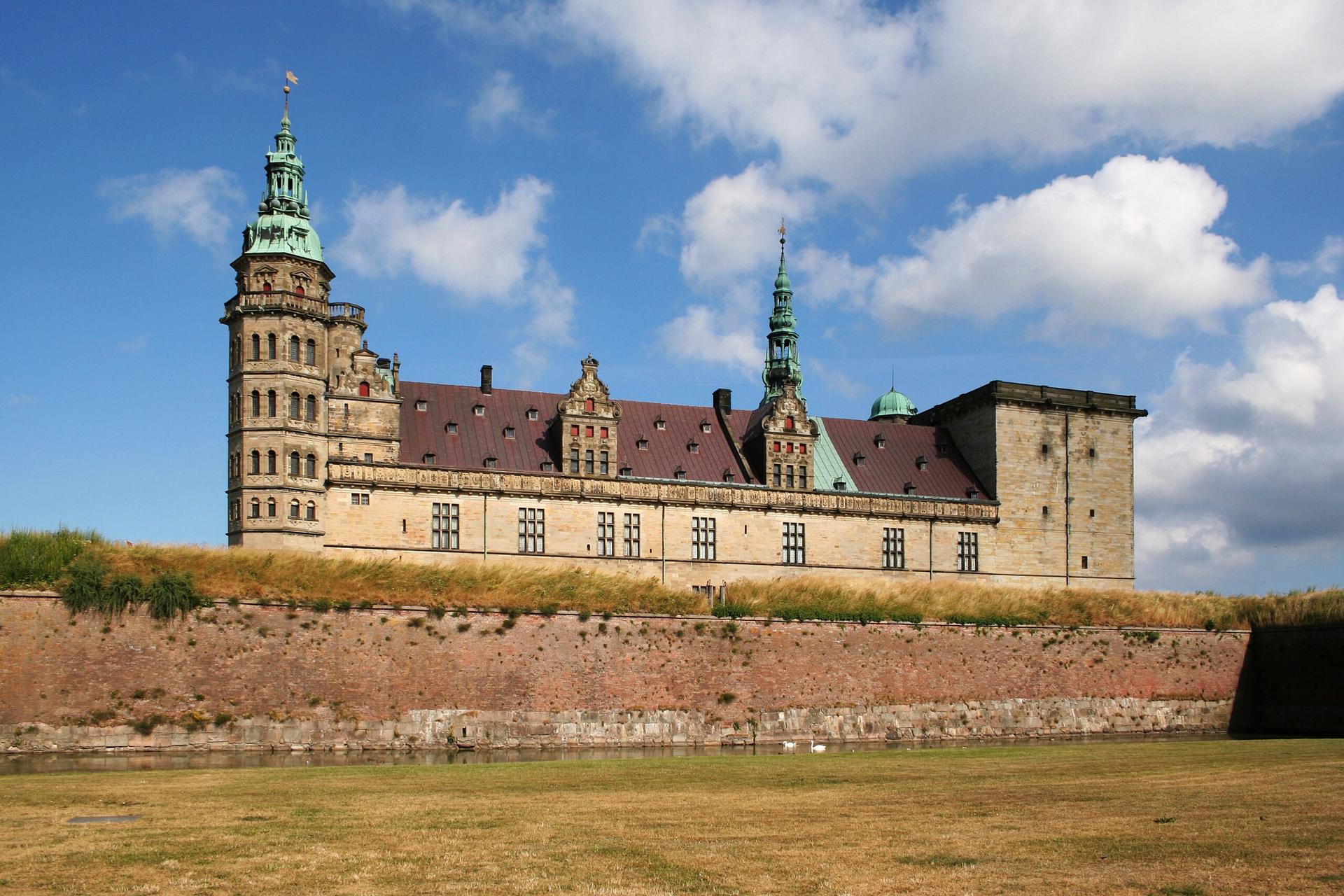
Explore North Zealand, Denmark's enchanting region of castles, beaches, and royal estates, perfect for history buffs, nature enthusiasts, and seaside lovers.
Tell me more about North Zealand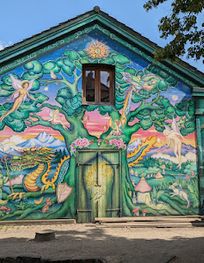
Christiania is Copenhagen’s colorful, self-governed district, renowned for its bohemian spirit, visionary art, communal living, lush parks, and bold counterculture history.
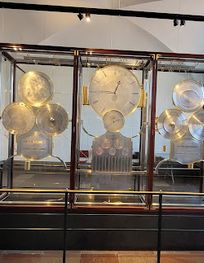
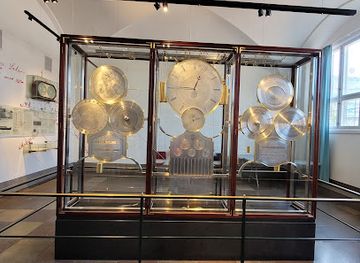
A gilded astronomical masterpiece with 15,448 parts, calculating time and cosmos for the next 2,500 years.