

Omo Valley Travel Guide - Free Web & App
Your ultimate guide to Omo Valley. Discover top landmarks, proposed trips, and local tips. Free on the web or via the Evendo companion app.


Omo Valley, Ethiopia, brings together Lower Omo landscapes, Indigenous cultures, wildlife, river journeys and remote southern adventure, through guided travel.
Landscapes of the Lower Omo
The Omo Valley occupies a vast, remote part of south-western Ethiopia, where the Omo River runs southwards through dry savannah, wooded plains, volcanic hills and deeply eroded escarpments before reaching Lake Turkana on the Kenya border. The term is used broadly, covering the Lower Omo and surrounding parts of the Southern Ethiopia Region rather than one compact, clearly bounded tourist area. Jinka and Arba Minch are important approaches, while Turmi, Dimeka, Key Afer and nearby villages serve as practical bases for different journeys.Read more about Omo Valley
Communities and Cultural Landscapes
Wild Country and Human History
When is the best time to visit Omo Valley?
Best: December–February · 35°C| Month | High (°C) | Rainfall (mm) |
|---|---|---|
| January (best) | 35 | 10 |
| February (best) | 35 | 10 |
| March | 36 | 20 |
| April | 36 | 40 |
| May | 37 | 60 |
| June | 37 | 75 |
| July | 36 | 75 |
| August | 36 | 75 |
| September | 36 | 75 |
| October | 36 | 50 |
| November | 36 | 25 |
| December (best) | 35 | 15 |
Getting to and around Omo Valley
How to get there
Transportation
Explore Omo Valley on the map
Plan your trip on one map. See where the top attractions, landmarks, restaurants and hotels are, and book hotels and experiences in a few clicks.
Best hotels in Omo Valley
Best shops in Omo Valley
Shopping opportunities are limited and concentrated in Jinka, Arba Minch, Turmi, Key Afer and Dimeka rather than at remote viewpoints or park locations. Market days are especially useful for seeing regional exchange, with livestock, grain, fruit, household goods and clothing traded alongside everyday supplies. Visitors may find woven items, beads, leatherwork, baskets and other locally made goods, but designs, materials and availability differ between communities and should not be treated as interchangeable souvenirs. Buying directly through a respectful local arrangement can support makers more effectively than photographing or handling objects without permission. Arba Minch and Jinka have the most practical choices for provisions, batteries and travel necessities. Do not purchase fossils, archaeological material or wildlife products, and remember that a culturally significant item may not be appropriate to remove from its community.
-
Market
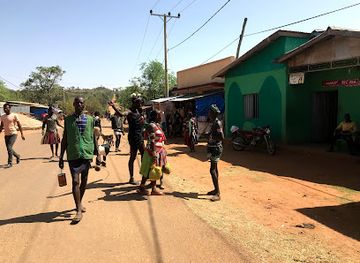
Key Afer Market
Experience the vibrant culture and local flavors at Key Afer Market, a true gem in the heart of Ethiopia's rich heritage.
Get your free copy of our complete guide to Omo Valley, delivered straight to you.
Everything on this page, from attractions and restaurants to essentials and local phrases, in one PDF you can read offline, print or share.
Already have an account? Sign in
Your Omo Valley guide is ready.
We'll send it to · Not you? Sign out

Getting your guide ready…
We are putting together a fresh copy of the Omo Valley guide. This can take up to a minute.
This can take a few moments. If your browser asks, choose Allow so the download can start. You'll find the guide in your Downloads folder.
Nothing happened? Download it again
Sorry, the guide is taking longer than usual. Please try again in a minute, or get it by email instead.
Omo Valley essentials
Currency and Payment
Safety
Emergency Situations
Do's and Don'ts
Local Tips
From Eve
Local phrases worth knowing
You don't need to get them perfect. A few words go a long way, and locals appreciate the effort.
Basics
| English | Local | Say it |
|---|---|---|
| Hello | Selam | [seh-lahm] |
| Goodbye | Addio | [ah-dee-oh] |
| Yes | Eey | [ee-eh] |
| No | Ala | [ah-lah] |
| Please/You're welcome | Jal jina | [jah-l jee-nah] |
| Thank you | Amesiagnalehu | [ah-meh-see-ah-nyah-leh-hoo] |
| Excuse me/Sorry | Ayte | [ah-yeh-teh] |
| How are you? | Dehna neh? | [deh-nah neh] |
| Fine. And you? | Dehna yihun. Ante? | [deh-nah yee-hoon. ahn-teh] |
| Do you speak English? | Inglizegna tiral? | [een-glee-zehg-nah tee-rahl] |
| I don't understand | Aman yehnem | [ah-mahn yeh-nehm] |
Eating & Drinking
| English | Local | Say it |
|---|---|---|
| I'd like to see the menu, please | Menyuwo arifegn | [mehn-yoo-woh ah-ree-feh-gn] |
| I don't eat meat | Siga ayibign | [see-gah ah-yee-beeg-n] |
| Cheers! | Chin chin! | [cheen cheen] |
| I would like to pay, please | Kash woferal | [kahsh woh-feh-rahl] |
Emergencies
| English | Local | Say it |
|---|---|---|
| Help! | Afe! | [ah-feh] |
| Go away! | Abo! | [ah-boh] |
| Call the Police! | Polis yemibel! | [poh-lees yeh-mee-behl] |
| Call a doctor! | Tabib yemibel! | [tah-beeb yeh-mee-behl] |
| I'm lost | Gedam yalew | [geh-dahm yah-lew] |
| I'm ill | Amlak yene | [ahm-lahk yeh-neh] |
Shopping
| English | Local | Say it |
|---|---|---|
| I'd like to buy... | Woyim koyita... | [woh-yeem koy-ee-tah] |
| I'm just looking | Dereja neber | [deh-reh-jah neh-behr] |
| How much is it? | Endet new? | [ehn-deht neh-oo] |
| That's too expensive | Beka new | [beh-kah neh-oo] |
| Can you lower the price? | Beka wutet new? | [beh-kah woo-teht neh-oo] |
Time & Numbers
| English | Local | Say it |
|---|---|---|
| What time is it? | Metachu migna? | [meh-tah-choo meeg-nah] |
| It's one o'clock | And migna | [ahnd meeg-nah] |
| Half past (10) | Anderet | [ahn-deh-reht] |
| Morning | Damera | [dah-meh-rah] |
| Afternoon | Aret | [ah-reht] |
| Evening | Sew | [sew] |
| Yesterday | Dehe | [deh-heh] |
| Today | Indeh | [een-deh] |
| Tomorrow | Yalanchi | [yah-lahn-chee] |
| 1 | And | [ahnd] |
| 2 | Hulet | [hoo-leht] |
| 3 | Sost | [sohst] |
| 4 | Arat | [ah-raht] |
| 5 | Amist | [ah-mist] |
| 6 | Sidist | [see-deest] |
| 7 | Sebat | [seh-baht] |
| 8 | Semen | [seh-men] |
| 9 | Zetegn | [zeh-teh-gn] |
| 10 | Asir | [ah-seer] |
Transport & Directions
| English | Local | Say it |
|---|---|---|
| Where's a/the...? | Endet... | [ehn-deht] |
| What's the address? | Medebegna endat? | [meh-deh-behg-nah ehn-daht] |
| Can you show me (on the map)? | Map-yaderfegn new? | [mahp-yah-dehr-feh-gn neh-oo] |
| When's the next (bus)? | Tiqur sewoch ende? | [tee-koor seh-wohch ehn-deh] |
| A ticket (to ....) | Tikiti (....) | [tee-kee-tee] |
History of Omo Valley
A River Shaped by Rift Geology
The Omo Valley lies within the broader East African Rift system, a zone of tectonic activity that has produced volcanic highlands, faulted escarpments and sediment-filled basins. The Omo River drains the Ethiopian highlands and has cut through these deposits on its course towards Lake Turkana. Seasonal flooding has helped create fertile river margins amid an otherwise dry environment, while the contrast between uplands, plains and waterways has shaped settlement, grazing and cultivation for centuries. Geological and sedimentary conditions also help explain why the Lower Omo is important to palaeoanthropology and the study of early human development.
Archaeology of Early Humanity
The Lower Omo is one of Africa's major archaeological and palaeoanthropological landscapes. Fossils and stone tools recovered from the Omo deposits have provided evidence for human evolution over a very long period, including discoveries associated with early members of the human family. The importance of these finds led UNESCO to inscribe the Lower Valley of the Omo as a World Heritage Site in 1980. Much of the archaeological value lies in the relationship between fossils, tools, sediments and changing environments, rather than in a single monument visible to ordinary visitors. Access to research locations is controlled and should not be assumed.
Pastoral and Farming Communities
Human history in the valley has also been shaped by communities whose livelihoods respond closely to rainfall, river levels, grassland and livestock. Hamar, Karo, Dassanech, Nyangatom, Mursi, Banna and Ari peoples have developed different combinations of pastoralism, cultivation, fishing, hunting traditions and trade. Their histories are not interchangeable, and each community has its own political, linguistic and ceremonial identity. Seasonal movement remains important in some areas, while farming and market exchange connect villages with regional centres. Travel through the valley therefore passes through living cultural landscapes rather than an abandoned archaeological zone.
Trade, Administration and Regional Exchange
For generations, markets and routes across southern Ethiopia have linked pastoral communities, cultivators and traders moving livestock, grain, honey, hides and manufactured goods. Settlements such as Jinka, Turmi, Dimeka and Key Afer developed greater importance as administrative and commercial centres, although the surrounding rural population remains widely dispersed. Modern roads, government services, tourism and regional migration have altered older patterns of movement without replacing the influence of climate and livestock. Market days continue to be significant social occasions, but their timing and character can change with local conditions.
Conservation and a Changing Valley
National parks and other conservation measures were established in parts of the Omo region to protect wildlife and important habitats, including Mago National Park and Omo National Park. Conservation exists alongside pastoral grazing, cultivation, settlement and large-scale development, creating complex questions about access to land and natural resources. The Lower Omo's World Heritage status has brought international attention, while tourism has created income for some guides, drivers and communities. Visitors encounter a region where environmental protection, cultural dignity and local rights remain central to responsible travel, rather than a landscape preserved without human presence.
Omo Valley in Photos
Browse through our photo collection highlighting the charm and character of the destination.
Neighbouring destination travel guides
The closest destinations to Omo Valley, if you have time for more than one.
-

-

-

-

-


Swipe for more destinations
Explore more

Explore more of Southern Nations, Nationalities, and Peoples' Region
Discover the Southern Nations, Nationalities, and Peoples' Region in Ethiopia – a land of diverse cultures, breathtaking landscapes, and rich history.
Explore Southern Nations, Nationalities, and Peoples' Region
Explore more of Ethiopia
Discover Ethiopia: A land of ancient history, breathtaking landscapes, and rich cultural heritage, offering an unforgettable journey through time and nature.
Explore Ethiopia