Background

Hohentübingen Castle: A Window to Tübingen's Past

Explore centuries of history at Hohentübingen Castle in Tübingen, Germany, offering stunning views, fascinating museums, and a glimpse into the region's rich cultural heritage and academic legacy.

Perched atop a hill overlooking the charming university town of Tübingen, Hohentübingen Castle offers a captivating journey through centuries of history. Originally built around 1037 as a medieval fortress, it evolved into a Renaissance palace and now houses part of the University of Tübingen. Visitors can explore the castle's well-preserved architecture, including its impressive towers and Renaissance gate, and delve into the fascinating collections of the Museum of Ancient Cultures, home to artifacts from around the world. The castle also provides stunning panoramic views of Tübingen's Altstadt (old town), the Neckar River, and the surrounding Swabian Alb, making it a must-see destination for history buffs, culture enthusiasts, and anyone seeking breathtaking scenery. Don't miss the chance to wander through the castle's courtyard, discover the laboratory where DNA was first discovered, and immerse yourself in the rich heritage of this iconic landmark. A visit to Hohentübingen Castle is a truly unforgettable experience.

A brief summary to Castle Hohentübingen

  • Burgsteige 11, Tübingen, 72070, DE

Local tips

  • Wear comfortable shoes, as the walk up to the castle involves some uphill climbing on cobblestone streets.
  • Check the opening hours of the Museum of Ancient Cultures in advance, as they may vary depending on the season.
  • Consider joining a guided tour to learn more about the castle's history and architecture.
  • Bring a camera to capture the stunning panoramic views of Tübingen and the surrounding landscape.
  • Visit the castle during the off-season (spring or fall) to avoid crowds.
widget icon

Getting There

  • Walking

    From Tübingen's Altstadt (old town), the castle is a steep but rewarding walk. Start from the Marktplatz (market square) and follow the signs for 'Schloss Hohentübingen'. The path leads uphill via Burgsteige, a stepped street. The walk takes approximately 15-20 minutes, passing through a fortified gateway. Note that the climb can be strenuous.

  • Public Transport

    Several bus lines stop near Hohentübingen Castle. The closest stops are 'Haagtor' and 'Neckarhalde'. From either stop, it's a 5-10 minute uphill walk to the castle entrance. Bus lines 9, 11, and 12 serve the Haagtor stop. A single bus fare within Tübingen is approximately €2.50.

  • Taxi/Ride-Share

    A taxi or ride-share from Tübingen's Hauptbahnhof (main train station) to the base of the castle hill (closest drop-off point) will cost approximately €8-€12. From there, it's still necessary to walk the final few minutes uphill to the castle entrance.

  • Driving

    Driving directly to Hohentübingen Castle is not possible due to its hilltop location and pedestrianized access. The closest parking options are the Altstadt-König and Altstadt-Mitte parking garages in Tübingen's old town. From either garage, it's a 10-15 minute walk uphill to the castle. Parking fees at these garages are approximately €2.00-€3.00 per hour.

Unlock the Best of Castle Hohentübingen

Buy tickets

    No tickets available

Book tours with entry

    No tours available

Book tours without entry

    No tours available

Discover more about Castle Hohentübingen

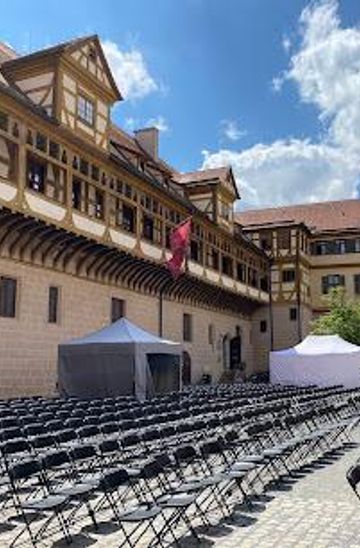
Hohentübingen Castle, a majestic structure overlooking the vibrant town of Tübingen in Baden-Württemberg, Germany, stands as a powerful testament to the region's rich and complex history. Its story spans nearly a millennium, from its humble beginnings as a medieval fortress to its current role as a dynamic part of the University of Tübingen. A visit to this iconic landmark offers a unique opportunity to step back in time and experience the evolution of architecture, culture, and knowledge. The castle's origins can be traced back to around 1037 when it was first constructed as a defensive stronghold. Its strategic location on a hill provided a commanding view of the surrounding landscape, making it an ideal site for a fortress. The first documented mention of the castle dates back to 1078, during the Investiture Controversy, a significant conflict between the papacy and the Holy Roman Emperor. Over the centuries, the castle underwent numerous expansions and renovations, reflecting the changing needs and tastes of its occupants. In 1342, the castle and the town of Tübingen were sold to the Counts of Württemberg, marking a new chapter in the castle's history. It became a residence for the Württemberg nobility and played an important role in the region's political and social life. During the Renaissance, the castle underwent a significant transformation, with the addition of new buildings and fortifications that reflected the architectural styles of the time. Duke Ulrich of Württemberg oversaw much of this work in the early 16th century, modernizing the castle into a formidable Renaissance fortress with artillery bastions. One of the most notable features of Hohentübingen Castle is its connection to the University of Tübingen, one of Germany's oldest and most prestigious universities. Founded in 1477, the university quickly established itself as a center of learning and research, and the castle played a vital role in its development. In the 16th century, Duke Ulrich donated the castle to the university, marking the beginning of its use as a center for academic and scientific pursuits. Over the centuries, the castle has housed various university departments, including the library and several museums. Today, Hohentübingen Castle is home to the Museum of Ancient Cultures, which houses an impressive collection of artifacts from around the world. Visitors can explore exhibits on ancient Egypt, Greece, Rome, and other cultures, gaining insights into the history and art of these civilizations. The museum's collection includes the famous Tübingen Hoplite, an ancient Greek bronze statue, and artifacts from two UNESCO World Heritage sites. The castle also houses the world's oldest surviving giant wine barrel, built in 1549, a testament to the region's winemaking traditions. In addition to its historical and cultural significance, Hohentübingen Castle offers stunning panoramic views of Tübingen and the surrounding area. From the castle's ramparts, visitors can admire the town's charming Altstadt (old town), the winding Neckar River, and the rolling hills of the Swabian Alb. The castle's courtyard, with its Renaissance arcades, provides a picturesque setting for events and gatherings. Visitors can explore the castle grounds, wander through the museums, and learn about the castle's fascinating history. Guided tours are available, providing in-depth information about the castle's architecture, art, and historical significance. The castle also hosts various cultural events throughout the year, including concerts, lectures, and historical reenactments. Hohentübingen Castle is easily accessible from Tübingen's city center. A pleasant walk up the Burgsteige (castle steps) leads to the castle entrance. Public transportation options are also available, with bus stops located near the castle. While there is no parking directly at the castle, parking garages are available in the Altstadt. A visit to Hohentübingen Castle is an unforgettable experience that combines history, culture, and natural beauty. Whether you are a history buff, an art enthusiast, or simply looking for a breathtaking view, Hohentübingen Castle has something to offer everyone. Immerse yourself in the rich heritage of this iconic landmark and discover the stories that have shaped Tübingen's past. Don't miss the Schlosslabor, the first biochemical laboratory worldwide, where Friedrich Miescher discovered DNA in 1869. The room with its Renaissance vaults has been set up since November 2015 as a small, freely accessible museum on biochemistry. Hohentübingen Castle is more than just a historical monument; it is a living, breathing part of Tübingen's identity. Its presence is felt throughout the town, and its story is woven into the fabric of the community. A visit to Hohentübingen Castle is an opportunity to connect with the past, to appreciate the present, and to imagine the future of this remarkable place.

Popular Experiences near Castle Hohentübingen

Popular Hotels near Castle Hohentübingen

Select Currency