
Gustav III:s Obelisk, Uppland Travel Guide
A restrained neoclassical shaft on Slottsbacken that marks Stockholm’s late‑18th‑century civic memory beside the Royal Palace.
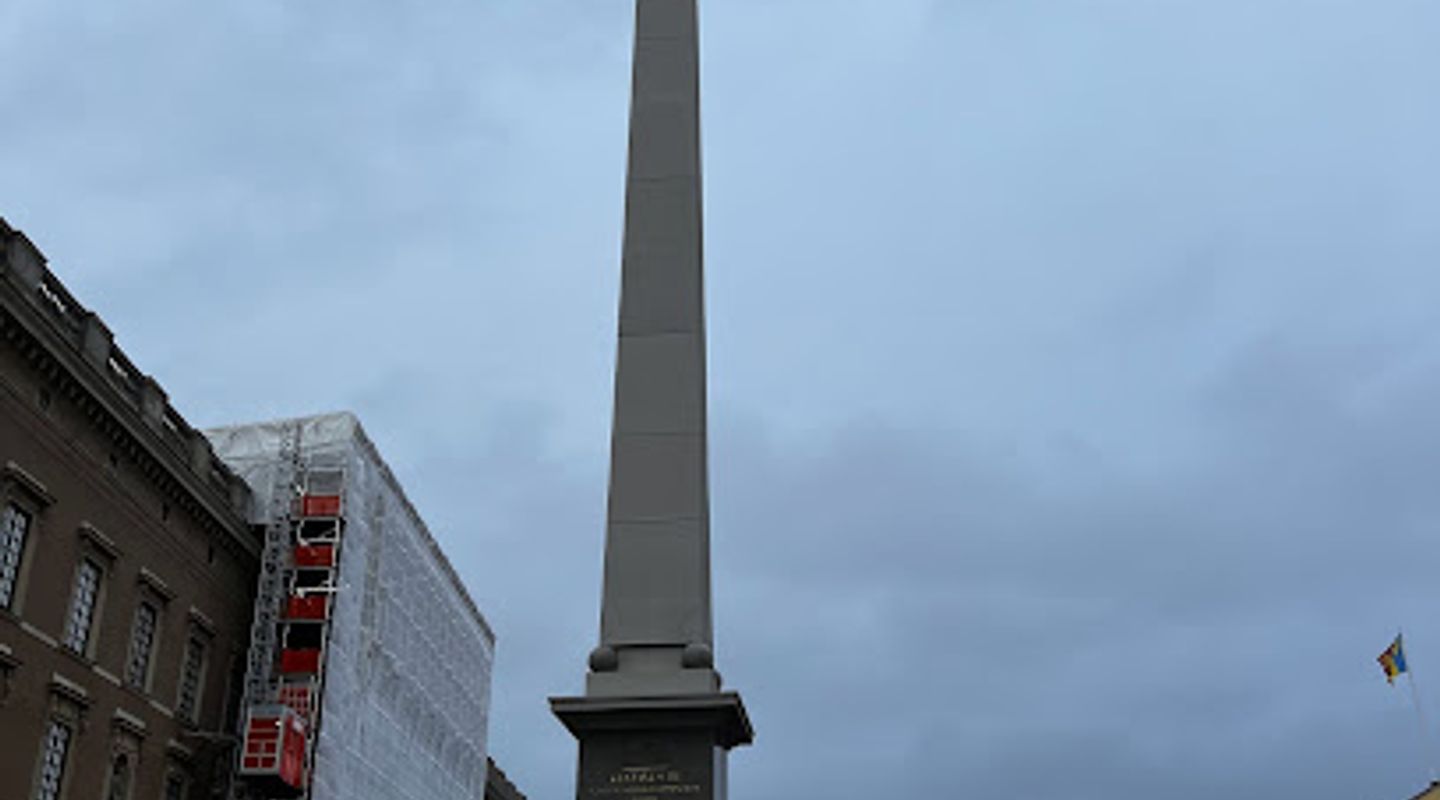
A slender neoclassical obelisk standing on Slottsbacken beside the Royal Palace in Stockholm, Gustav III’s Obelisk was commissioned in the late 18th century to honour the city’s steadfastness during wartime. Carved from Swedish granite and topped with a simple capital, the monument’s clean lines and Latin inscription give it a formal, commemorative presence amid palace lawns, cobbles and waterfront views, making it a quiet focal point in Gamla Stan.
A brief summary to Gustav III:s Obelisk
- Sweden, Slottsbacken 1, Stockholm, 111 30, SE
- Duration: 0.25 to 1 hours
- Free
-
 Outdoor
- Mobile reception: 4 out of 5

Know before you go
Hi, I'm Eve. Here are a few practical things to know before exploring Gustav III:s Obelisk.
- Visit at early morning or late afternoon for the best soft light on the granite and fewer passersby in photographs.
- Pause to read the inscription closely — the lettering and surface weathering tell as much about age and craft as the design itself.
- Combine a stop here with a stroll around the palace forecourt and nearby cathedral to appreciate how the obelisk sits within the historic ensemble.
Do you manage this location?
Take control to get all the benefits, like improved information, better appearance, and stronger visibility across AI-powered discovery. Learn more about listing your business on Evendo
Activate your presenceExplore Gustav III:s Obelisk on the Map
A handpicked selection of must-see spots near Gustav III:s Obelisk, mapped for you.
Unlock the Best of Gustav III:s Obelisk
Buy tickets
-
No tickets available
Book tours with entry


Getting There
-
Public transport
Metro plus short walk: From central Stockholm stations take the metro to Gamla Stan station (service frequency every 5–10 minutes), then walk across historic streets to Slottsbacken; total travel time from central hubs typically 10–20 minutes; no ticket surcharge beyond standard local fares and services operate day and evening with reduced frequency late at night.
-
Bus
City bus to central stops: Several city bus routes serve the palace area with journeys from central districts taking 15–30 minutes depending on boarding point; services run regularly during the day but can be slower in peak traffic; standard single-ride fares apply and real-time timetables are advised for planning.
-
Walking
On foot from nearby Inner City locations: expect walks of 10–30 minutes on mostly paved, sometimes cobbled streets with occasional steps; terrain is generally easy but cobbles can be uneven and less suitable for wheeled luggage or some mobility aids.
For the on-the-go comforts that matter to you
-
 Seating Areas
-
 Information Boards
-
 Trash Bins
Discover more about Gustav III:s Obelisk
Origins and royal intent
Gustav III’s Obelisk was conceived in the late 1700s as a public monument commissioned by King Gustav III to commemorate the civic spirit and support shown by Stockholm’s population during a period of military tension. Crafted in a neoclassical idiom that drew on ancient forms, the obelisk was intended as a timeless marker of national resolve: a tall, tapering shaft of Swedish stone set upright to read like a civic statement in the capital’s open air.Materials, scale and design details
The monument is executed in locally sourced granite with a measured restraint typical of late‑18th‑century classicism: an unadorned shaft rises to a modest capital rather than elaborate ornament, emphasising mass, durability and geometric clarity. A simple inscribed panel records the monument’s dedication; worn surfaces and subtle weathering now add a muted texture that catches winter light and summer sun differently.Relationship with the palace and city fabric
Placed on Slottsbacken beside the Royal Palace, the obelisk reads as part of the palace ensemble rather than as an isolated sculpture. Its verticality provides a counterpoint to the low, horizontal sweep of palace facades and the nearby cathedral spire, while the surrounding paving, lawns and mature trees create a measured setting where the monument can be viewed from multiple vantage points along Gamla Stan’s historic streets and quays.Atmosphere and visitor experience
Approach the obelisk and you notice its stillness: a formal, almost ceremonial object set in an everyday urban scene. Footsteps on cobbles, gull calls from the waterfront and distant voices from palace courtyards form the soundscape; in close light you can study the grain of the granite and the engraved lettering, and from a short distance the silhouette reads like a graphic puncture against sky. The site invites quiet contemplation rather than spectacle.Historical echoes and subtler stories
Beyond the primary dedication, the obelisk is embedded in late‑18th‑century currents—military ambition, royal commemoration and the adoption of classical motifs as civic language. Over two centuries it has become a fixed element of Stockholm’s historic core, its presence linking modern passersby to the city’s age of enlightened monarchy and the aesthetic choices of that era.Seasonal moods and photographic notes
Light and weather markedly change the obelisk’s character: frost and low winter sun sharpen edges and cast long shadows, while summer’s softer light reduces contrast and sets the stone against leafy greens. The monument is framed differently from each approach — against palace stonework, against sky, or with water in the background — offering a range of compositions for the observant visitor.












Your all‑in‑one travel companion app
Explore expert travel guides, compare and book tours, experiences, hotels, and more—all from the palm of your hand. Download now for seamless trip planning wherever your wanderlust takes you.


Explore More of Uppland
Looking beyond Gustav III:s Obelisk? Discover Uppland for broader travel guides, local hot-spots, and regional highlights.
Explore Uppland