Dunadd Fort Travel Guide
Free Guide: Explore Dunadd Fort, the ancient royal seat of the Gaelic kings of Dál Riata, where history, ritual, and panoramic views converge in Argyll’s Kilmartin Glen.


A brief summary of Dunadd Fort
Explore Dunadd Fort, the ancient royal seat of the Gaelic kings of Dál Riata, where history, ritual, and panoramic views converge in Argyll’s Kilmartin Glen.
Dunadd Fort, perched on a rocky outcrop near Lochgilphead in Argyll, Scotland, was the capital of the early medieval Gaelic kingdom of Dál Riata. This historic hillfort, dating from the Iron Age through the 9th century, served as a royal ceremonial center and military stronghold. Visitors can explore its terraces, ancient stone carvings—including a famous footprint used in kingly inaugurations—and enjoy panoramic views of the surrounding glen and historic landscape.
On-site amenities
 Restrooms
 Information boards
 Seating areas
 Trash bins
Opening hours
- Every dayOpen 24 hours
Opening hours as listed on the venue’s Google Business Profile. Hours can change for services and special events, so check with the venue before you go.
- Address
- A816, Lochgilphead PA31 8SU
- Website
Getting there
Car
Bus
Walking
Discover more about Dunadd Fort
Strategic Powerhouse of Early Scotland
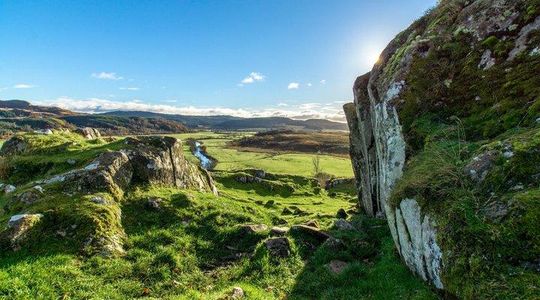
Dunadd Fort stands as a monumental symbol of early Scottish history, located in the heart of Kilmartin Glen. From the 6th to the 9th centuries, it was the political and cultural capital of the Gaelic kingdom of Dál Riata, a realm that spanned parts of western Scotland and northeast Ireland. Positioned atop a rocky hill rising from the Moine Mhor boggy basin, Dunadd’s natural defenses and commanding views made it an ideal stronghold for controlling the surrounding territory and waterways, including access to the River Add. This strategic location was crucial for trade, military defense, and communication across the kingdom.
Royal Ceremonial Site and Symbolism
Beyond its military function, Dunadd was a center of royal ceremony and ritual. The summit of the fort holds a carved footprint in stone, believed to be used during the inauguration of kings, symbolizing the monarch’s dominion over the land. Nearby, other rock carvings include a basin of unknown purpose, a Pictish-style boar, and an ogham inscription, all reflecting the site’s rich cultural tapestry. These features highlight Dunadd’s role not only as a fortress but as a sacred place where power was both displayed and consecrated.
Architectural and Archaeological Legacy
The fort’s structure evolved over centuries, with multiple terraces fortified by stone walls and ramparts forming a ‘nuclear’ hillfort layout. Excavations have revealed a monumental roundhouse at the summit, where leaders gathered for feasts and proclamations. Archaeological finds include weapons, tools, imported pottery, metalworking molds, and quernstones, underscoring Dunadd’s status as a bustling settlement of wealth and craftsmanship. The site’s defensive features, combined with its ceremonial importance, make it a unique glimpse into early medieval Scottish society.
Historical Conflicts and Decline
Dunadd’s prominence made it a focal point in regional conflicts, notably with the Picts and Northumbrians. Historical records mention sieges and battles, including a significant event in 736 AD when King Onuist of the Picts captured and burned the fort, imposing Pictish rule over Dál Riata. Despite these challenges, Dunadd remained occupied into the 9th century before the kingdom’s center shifted eastward. The site’s decline was influenced by changing political landscapes and Viking pressures, but its legacy as a formative seat of Scottish kingship endures.
Visiting Dunadd Today
Today, Dunadd Fort is a protected ancient monument managed by Historic Environment Scotland, open year-round with free access. Visitors can explore the rugged ascent through natural rock passages and terraces, touching remnants of original stone walls and the iconic footprint stone. The panoramic views from the summit offer sweeping vistas of Kilmartin Glen’s archaeological landscape, rich with prehistoric monuments. While no food or drink facilities exist on-site, dogs are welcome on leads. The site invites visitors to immerse themselves in Scotland’s early history and imagine the power struggles and ceremonies that shaped the nation.
Connection to the Wider Kilmartin Glen Heritage
Dunadd is part of the broader Kilmartin Glen area, renowned for its extraordinary concentration of ancient monuments, including burial cairns and standing stones. This landscape reveals layers of human history stretching back thousands of years, with Dunadd standing out as a pinnacle of early medieval Scottish identity. Exploring Dunadd alongside nearby sites provides a profound understanding of Scotland’s cultural and historical roots.
Evendo Review Centre
 Google
Guest reviews
Best time to go
Quietest: Jan, Feb & Dec · before 6am or at 9pm
Busy times are Evendo estimates for a typical year, to help you plan. Actual crowds vary with events, school holidays and the weather.
Explore Dunadd Fort on the map
A handpicked selection of must-see spots near Dunadd Fort, mapped for you.
Get your free copy of our complete guide to Dunadd Fort, delivered straight to you.
Everything on this page, from opening hours and how to get there to Eve’s tips and the best time to go, in one PDF you can read offline, print or share.
Already have an account? Sign in
Your Dunadd Fort guide is ready.
We'll send it to · Not you? Sign out

Getting your guide ready…
We are putting together a fresh copy of the Dunadd Fort guide. This can take up to a minute.
This can take a few moments. If your browser asks, choose Allow so the download can start. You'll find the guide in your Downloads folder.
Nothing happened? Download it again
Sorry, the guide is taking longer than usual. Please try again in a minute, or get it by email instead.
Unlock the best of Dunadd Fort
Skip-the-line tickets, guided tours with entry, and walking tours of the area, booked in a few clicks.



Other nearby places you may find interesting
The closest places of the same kind, if this one is not quite what you had in mind.
-
-
-
-
-


Swipe for more places
More to explore near Dunadd Fort

 Best experiences near Dunadd Fort
 Best hotels near Dunadd Fort
 Best landmarks near Dunadd Fort
 Best attractions near Dunadd Fort
 Best shops near Dunadd Fort
 Best restaurants near Dunadd Fort
 Best bars near Dunadd Fort
Do you manage this location?
Take control to get all the benefits, like improved information, better appearance, and stronger visibility across AI-powered discovery.
Explore more

Explore more of Bute
Discover the Isle of Bute in the United Kingdom, a serene island retreat offering stunning landscapes, historic landmarks, and a vibrant local culture.
Explore Bute
Explore more of United Kingdom
Discover the United Kingdom: A blend of rich history, stunning landscapes, and vibrant cities, offering a unique travel experience for every visitor.
Explore United Kingdom