Wolstenholme Square, Liverpool Travel Guide
Free Guide: A historic Georgian square reborn through art and regeneration, crowned by a vibrant public sculpture.


A brief summary of Wolstenholme Square
A historic Georgian square reborn through art and regeneration, crowned by a vibrant public sculpture.
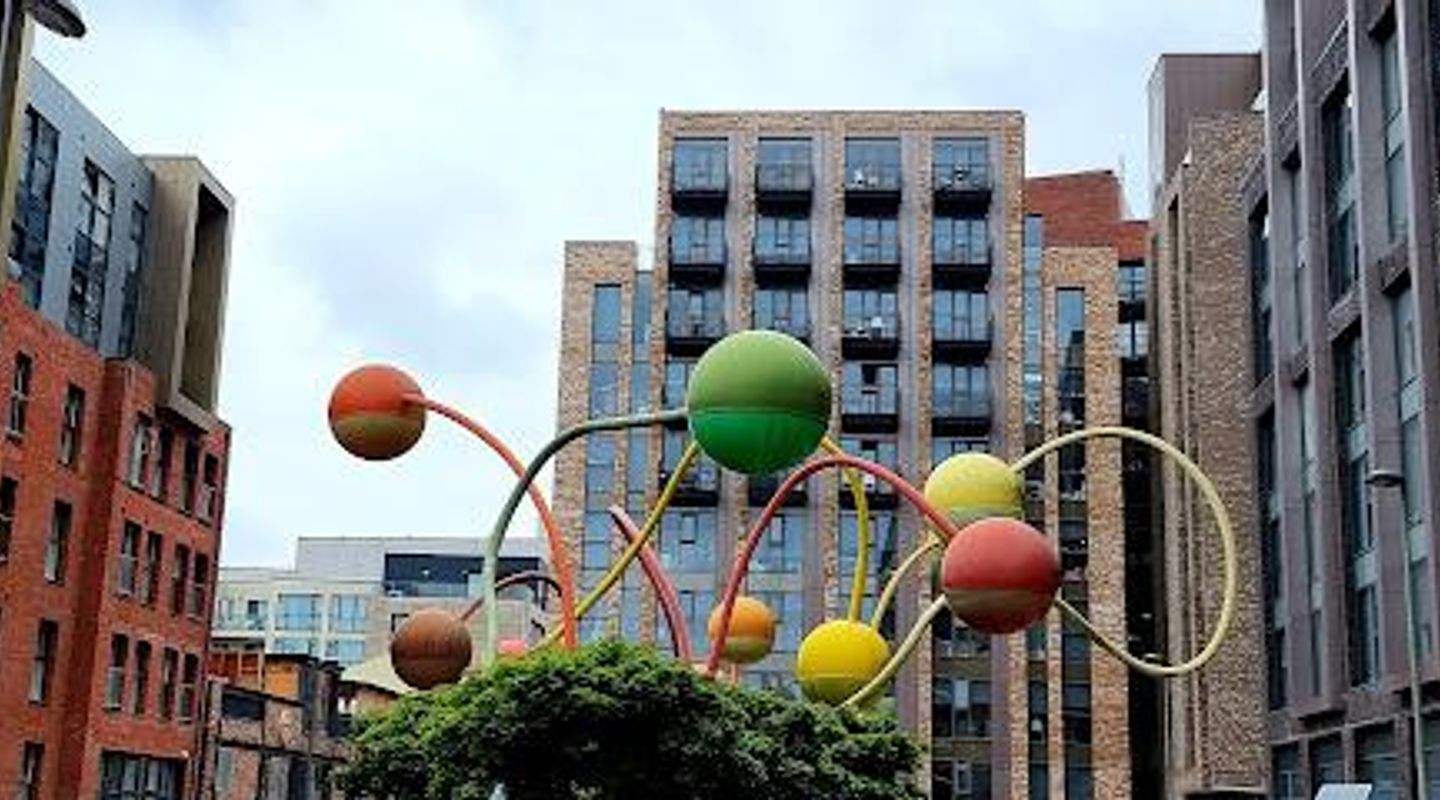
Wolstenholme Square is a historic public space in Liverpool's Ropewalks district, originally laid out around 1750 as an elegant tree-lined square on land owned by the Wolstenholme family. Once a fashionable Georgian address, the square evolved through Liverpool's industrial expansion before entering a phase of regeneration. Today, it is anchored by Jorge Pardo's striking sculptural installation Penelope, a vibrant public artwork commissioned by Liverpool Biennial that references both classical mythology and the area's maritime rope-making heritage.
On-site amenities
 Food options
 Drink options
 Restrooms
 Information boards
 Seating areas
- Address
- Liverpool
Getting there
Walking from Liverpool City Centre
Local Bus Service
Taxi or Ride-Share
Cycling
Discover more about Wolstenholme Square
Origins and Georgian Elegance
Wolstenholme Square emerged from the vision of Liverpool's expanding merchant class in the mid-18th century. Laid out around 1750 on land owned by the Wolstenholme family, the square was conceived as a tree-lined promenade and Ladies' Walk—a fashionable retreat for the city's elite. Development accelerated from 1756 onward, with elegant townhouses and refined architecture establishing the square as one of Liverpool's most desirable addresses. The square reflected the city's growing prosperity as an international port, attracting wealthy merchants and professionals seeking prestigious urban residences.
Industrial Transformation and Decline
As Liverpool's economy shifted during the 19th century, the character of Wolstenholme Square underwent dramatic change. The rise of commercial warehousing and industrial development swept across the surrounding area, transforming the elegant Georgian square into an urban landscape dominated by functional brick structures and working-class commerce. The rope-making industry, which had long been central to Liverpool's maritime economy, left its mark on the neighborhood. What had once been a symbol of refined urban living gradually faded into obscurity, its original grandeur obscured by the pragmatic demands of industrial expansion. For generations, the square remained a relic of a bygone era, its historical significance overshadowed by the commercial activity that surrounded it.
The Penelope Sculpture and Cultural Renewal
A turning point arrived with the commissioning of Penelope, a monumental public artwork by Cuban sculptor Jorge Pardo. Created in 2004 and installed in 2006 as part of Liverpool Biennial, this vibrant sculpture has become the square's defining feature. Rising prominently with brightly colored tentacles that evoke organic forms, Penelope ranks among the largest sculptures in the city. The work draws inspiration from Homer's Odyssey, specifically the figure of Penelope, who waited faithfully for her husband Ulysses to return from the Trojan War. According to legend, she rejected numerous suitors by claiming she must first complete weaving a rope—then unraveled her work each night to maintain her deception. The sculpture's stalks reference both Penelope's weaving and Liverpool's historical connection to rope manufacture, creating a layered dialogue between classical mythology and local industrial heritage.
Contemporary Regeneration and Urban Revival
Wolstenholme Square now stands at the center of Liverpool's broader urban regeneration efforts. Redevelopment is advancing on multiple sides of the square, signaling a renewed investment in the Ropewalks district and surrounding areas. This transformation reflects changing attitudes toward heritage preservation and adaptive reuse, as the city recognizes the cultural and historical value of its industrial past. The square's evolution from Georgian elegance through industrial decline to contemporary cultural renewal mirrors Liverpool's own journey as a global port city navigating economic change and urban reinvention. Today, Penelope serves as both an artistic anchor and a symbol of the square's rebirth, drawing visitors and residents to a space that bridges centuries of Liverpool's complex urban narrative.
Evendo Review Centre
 Google
Guest reviews
Best time to go
Quietest: Jan, Feb & Mar · before 6am or at 10pm
Busy times are Evendo estimates for a typical year, to help you plan. Actual crowds vary with events, school holidays and the weather.
Explore Wolstenholme Square on the map
A handpicked selection of must-see spots near Wolstenholme Square, mapped for you.
Get your free copy of our complete guide to Wolstenholme Square, delivered straight to you.
Everything on this page, from opening hours and how to get there to Eve’s tips and the best time to go, in one PDF you can read offline, print or share.
Already have an account? Sign in
Your Wolstenholme Square guide is ready.
We'll send it to · Not you? Sign out

Getting your guide ready…
We are putting together a fresh copy of the Wolstenholme Square guide. This can take up to a minute.
This can take a few moments. If your browser asks, choose Allow so the download can start. You'll find the guide in your Downloads folder.
Nothing happened? Download it again
Sorry, the guide is taking longer than usual. Please try again in a minute, or get it by email instead.
Unlock the best of Wolstenholme Square
Skip-the-line tickets, guided tours with entry, and walking tours of the area, booked in a few clicks.


Other nearby places you may find interesting
The closest places of the same kind, if this one is not quite what you had in mind.
-
Old Wall Arch Albert Dock UK Victorian stone engineering fragment preserving the pioneering spirit of 1846 dock innovation.
-
Sir Alfred Lewis Monument A distinguished bronze tribute at Liverpool’s Pier Head celebrating Sir Alfred Lewis Jones’s maritime legacy and global trade impact.
-
Queen Victoria Monument A grand Victorian monument celebrating empire, virtue, and industrial achievement in Liverpool's historic heart.
-
Viewing window to the Old Dock Step into Liverpool’s maritime origins through the preserved window revealing the world’s first commercial wet dock beneath Liverpool ONE.
-
Memorial to the Marine Engine Room Heroes Honoring the bravery of marine engineers, this 1916 memorial stands as a solemn tribute within Liverpool’s historic maritime heart.
Swipe for more places
More to explore near Wolstenholme Square

 Best experiences near Wolstenholme Square
 Best hotels near Wolstenholme Square
 Best landmarks near Wolstenholme Square
 Best attractions near Wolstenholme Square
 Best shops near Wolstenholme Square
 Best restaurants near Wolstenholme Square
 Best bars near Wolstenholme Square
Do you manage this location?
Take control to get all the benefits, like improved information, better appearance, and stronger visibility across AI-powered discovery.
Explore more

Explore more of Liverpool
Discover Liverpool: A city where maritime heritage meets modern culture, music legends, and sporting glory. An unforgettable destination in the heart of northwest England.
Explore Liverpool
Explore more of United Kingdom
Discover the United Kingdom: A blend of rich history, stunning landscapes, and vibrant cities, offering a unique travel experience for every visitor.
Explore United Kingdom