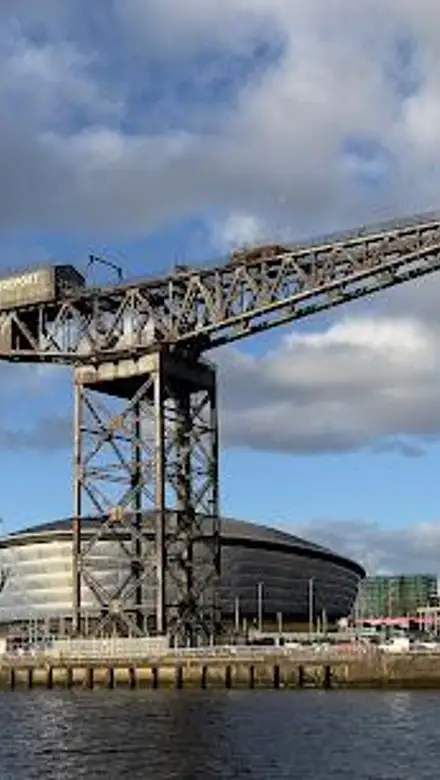
Finnieston Crane, Stirling Travel Guide
Free Guide: A towering symbol of Glasgow’s industrial heritage, the Finnieston Crane stands proudly on the Clyde as a testament to engineering prowess and maritime history.


A brief summary of Finnieston Crane
A towering symbol of Glasgow’s industrial heritage, the Finnieston Crane stands proudly on the Clyde as a testament to engineering prowess and maritime history.
The Finnieston Crane, a towering 175-ton cantilever crane on Glasgow’s River Clyde, stands as a powerful symbol of the city’s rich maritime and engineering heritage. Built in 1931 and operational from 1932, it was crucial for loading heavy machinery, especially steam locomotives, onto ships for global export. Though no longer in use, this landmark remains a striking reminder of Glasgow’s industrial past and its transformation into a modern riverside hub.
On-site amenities
 Information boards
 Seating areas
 Trash bins
Opening hours
- Every dayOpen 24 hours
Opening hours as listed on the venue’s Google Business Profile. Hours can change for services and special events, so check with the venue before you go.
- Address
- Finnieston Quay, Glasgow G3 8HN
- Website
Getting there
Bus
Train
Walking
Discover more about Finnieston Crane
A Monument to Glasgow’s Industrial Might
The Finnieston Crane, also known as the Stobcross Crane, is a giant cantilever crane located at Finnieston Quay on the River Clyde in Glasgow. Commissioned in 1928 and completed in 1931, it was built by Cowans, Sheldon & Company (tower) and the Cleveland Bridge & Engineering Company (cantilever arm). With a lifting capacity of 175 tons, it was designed to load heavy cargo such as steam locomotives, tanks, boilers, and engines onto ships for export worldwide. This crane played a vital role during Glasgow’s heyday as a global shipbuilding and engineering powerhouse, symbolizing the city’s industrial strength and innovation.
Engineering Marvel and Unique Features
The Finnieston Crane is notable for being the only British crane fitted with a personnel lift and a horizontal rail for a jigger hoist, allowing it to handle lighter loads efficiently. Its 152-foot-long jib could complete a full revolution in just three and a half minutes, showcasing advanced engineering for its time. Connected to a spur of the Stobcross Railway, it facilitated the movement of thousands of heavy locomotives from Springburn’s St Rollox works through Glasgow’s streets to the docks, where they were shipped across the British Empire. The crane’s imposing lattice steel girder structure remains one of only eleven giant cantilever cranes worldwide and one of four surviving on the Clyde.
From Industrial Workhorse to Cultural Icon
Although the crane ceased operation in 1988 following the closure of Queen’s Dock in 1969, it has since been preserved as a listed building and a totemic emblem of Glasgow’s engineering heritage. It has inspired artists and the public alike, having been used in art installations such as George Wyllie’s straw locomotive and paper boat, and transformed into a giant musical instrument by sound artist Bill Fontana. The crane’s silhouette is a familiar backdrop on Glasgow television and a poignant reminder of the city’s industrial past amid the modern developments along the river, including the SSE Hydro and the Clyde Auditorium.
The Crane’s Place in Glasgow’s Urban Landscape
Situated near Finnieston Quay, the crane overlooks the regenerated Clyde waterfront, juxtaposing the historic industrial structure with contemporary architecture. It stands close to landmarks like the Scottish Exhibition and Conference Centre and the BBC Scotland headquarters, linking Glasgow’s past and future. The surrounding area has evolved from dockyards to a vibrant cultural and entertainment district, with the crane serving as a landmark and symbol of resilience and transformation.
Preservation and Future Prospects
The Finnieston Crane is protected as a historic structure, with ongoing discussions about transforming it into a major visitor attraction featuring a museum and restaurant. Its preservation reflects Glasgow’s commitment to celebrating its industrial legacy while embracing regeneration and modernity. As one of the last remaining giants of its kind, the crane holds both historical significance and potential as a cultural destination.
Legacy of Glasgow’s Maritime Heritage
The crane embodies Glasgow’s global influence during the industrial age, particularly in shipbuilding and heavy engineering. It represents the thousands of workers, engineers, and industries that shaped the city’s identity and economy. Though silent now, the Finnieston Crane continues to tell the story of Glasgow’s maritime past and stands as a proud monument to the city’s enduring spirit and innovative legacy.
Evendo Review Centre
 Google
Guest reviews
Best time to go
Quietest: Jan, Feb & Dec · before 6am or from 11pm
Busy times are Evendo estimates for a typical year, to help you plan. Actual crowds vary with events, school holidays and the weather.
Explore Finnieston Crane on the map
A handpicked selection of must-see spots near Finnieston Crane, mapped for you.
Get your free copy of our complete guide to Finnieston Crane, delivered straight to you.
Everything on this page, from opening hours and how to get there to Eve’s tips and the best time to go, in one PDF you can read offline, print or share.
Already have an account? Sign in
Your Finnieston Crane guide is ready.
We'll send it to · Not you? Sign out

Getting your guide ready…
We are putting together a fresh copy of the Finnieston Crane guide. This can take up to a minute.
This can take a few moments. If your browser asks, choose Allow so the download can start. You'll find the guide in your Downloads folder.
Nothing happened? Download it again
Sorry, the guide is taking longer than usual. Please try again in a minute, or get it by email instead.
Unlock the best of Finnieston Crane
Skip-the-line tickets, guided tours with entry, and walking tours of the area, booked in a few clicks.


Other nearby places you may find interesting
The closest places of the same kind, if this one is not quite what you had in mind.
-
-
-
-
-


Swipe for more places
More to explore near Finnieston Crane

 Best experiences near Finnieston Crane
 Best hotels near Finnieston Crane
 Best landmarks near Finnieston Crane
 Best attractions near Finnieston Crane
 Best shops near Finnieston Crane
 Best restaurants near Finnieston Crane
 Best bars near Finnieston Crane
Do you manage this location?
Take control to get all the benefits, like improved information, better appearance, and stronger visibility across AI-powered discovery.
Explore more

Explore more of Stirling
Discover Stirling: A city where history comes alive amidst stunning landscapes and cultural richness in the heart of Scotland.
Explore Stirling
Explore more of United Kingdom
Discover the United Kingdom: A blend of rich history, stunning landscapes, and vibrant cities, offering a unique travel experience for every visitor.
Explore United Kingdom