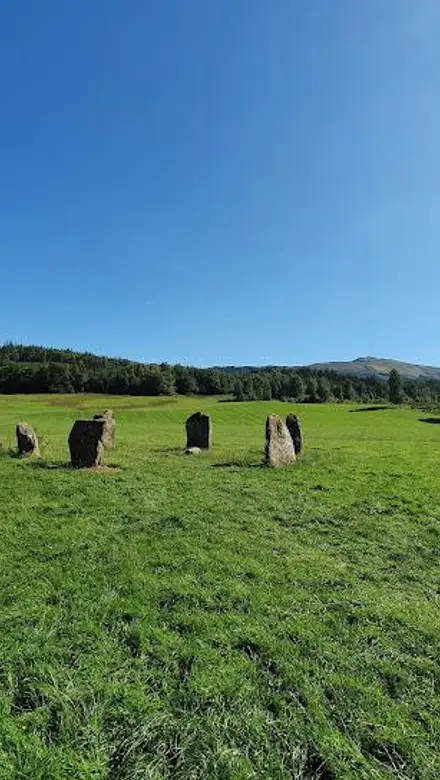
Kinnell Stone Circle, Stirling Travel Guide
Free Guide: A well-preserved Bronze Age stone circle near Killin, set in a peaceful Highland field with views over Loch Tay and the Trossachs.


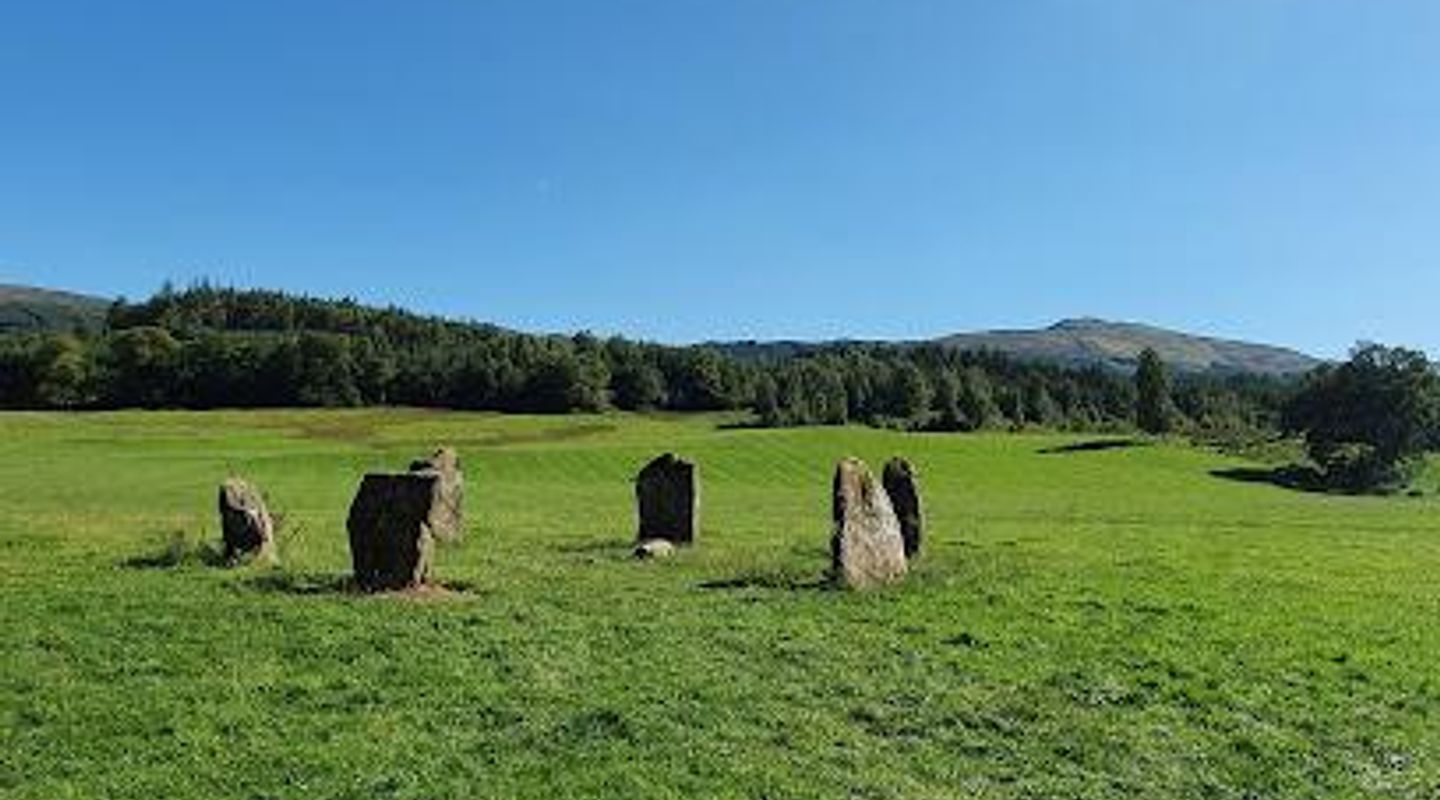
A brief summary of Kinnell Stone Circle
A well-preserved Bronze Age stone circle near Killin, set in a peaceful Highland field with views over Loch Tay and the Trossachs.
Tucked in a pasture near Killin at the western end of Loch Tay, the Killin Stone Circle is a well-preserved Bronze Age monument of six dark schist standing stones arranged in a flattened circle. Dating back over three thousand years, this atmospheric stone circle is thought to have served as a ceremonial or gathering place, with one stone bearing three ancient cupmarks. Surrounded by the dramatic scenery of the Trossachs and close to the Falls of Dochart, it offers a quiet, evocative glimpse into Scotland’s prehistoric past.
On-site amenities
 Seating areas
 Trash bins
 Information boards
- Address
- Loch Tay, Killin FK21 8SR
Getting there
On foot from Killin village
By car
By public transport
Discover more about Kinnell Stone Circle
Ancient Stones in the Trossachs
Standing in a grassy field just east of the village of Killin, at the western tip of Loch Tay, the Killin Stone Circle (also known as Kinnell Stone Circle) is a small but striking prehistoric monument. Six upright slabs of dark grey schist form a slightly flattened circle about ten metres across, their weathered surfaces softened by centuries of Highland rain and wind. The stones range from around 1.4 to 1.9 metres in height, with the two tallest standing side by side in the southwest quadrant. This arrangement gives the circle a subtle asymmetry, hinting at careful placement rather than random arrangement.
From Bronze Age Ritual to Clan Grounds
The circle dates from the Bronze Age, a time when communities across central Scotland were erecting stone circles, standing stones, and burial cairns. While its exact purpose remains unknown, it is widely believed to have been a place of ritual, gathering, or governance, possibly aligned with seasonal events or celestial markers. The northernmost stone is marked with three cupmarks – small, man-made depressions carved into the rock – which may have held symbolic or ceremonial significance. The circle’s good condition is likely due to its location within the grounds of Kinnell House, the historic seat of the MacNab clan, which may have helped protect it from disturbance and even prompted some restoration in the 18th or 19th century.
Setting and Surroundings
The stone circle sits in a pastoral landscape, surrounded by rolling fields and framed by the rugged hills of Breadalbane. To the west lies the broad expanse of Loch Tay, while the River Dochart rushes through the nearby Falls of Dochart in Killin village, just a short walk away. The area is rich in history: the MacNab clan’s ancient burial ground is on Inchbuie in the river, and the ruins of Finlarig Castle, stronghold of the Campbells of Breadalbane, lie to the north. The circle’s quiet, open setting makes it easy to imagine how it might have looked millennia ago, standing as a focal point in a landscape shaped by both nature and early human communities.
Visiting the Circle
Today, the Killin Stone Circle is a scheduled monument, protected for its archaeological importance. Visitors approach across a field, often via a stile or gate, and can walk freely around the stones, taking in their scale and the views across the valley. There are no modern structures immediately around the circle, so the atmosphere remains peaceful and timeless. Interpretive information is usually available nearby, explaining the site’s history and significance. Because it is in a working field, it is important to respect any livestock, close gates, and follow the countryside code.
Stories and Legacy
The circle is part of a wider network of prehistoric sites in central Scotland, many of which also consist of six stones, suggesting a shared tradition or belief system. Local tradition and early antiquarian accounts note the cupmarked stone and describe the circle as a compact, well-formed ring, admired even in the 19th century. Its survival in such good condition, combined with its dramatic Highland setting, makes it a powerful place to reflect on Scotland’s deep past. Nearby, the legacy of the MacNabs and Campbells, the healing stones of St Fillan, and the wild beauty of the Trossachs all contribute to a landscape layered with stories, where ancient and more recent history sit side by side.
Evendo Review Centre
 Google
Guest reviews
Best time to go
Quietest: Jan, Feb & Dec · before 3am
Busy times are Evendo estimates for a typical year, to help you plan. Actual crowds vary with events, school holidays and the weather.
Explore Kinnell Stone Circle on the map
A handpicked selection of must-see spots near Kinnell Stone Circle, mapped for you.
Get your free copy of our complete guide to Kinnell Stone Circle, delivered straight to you.
Everything on this page, from opening hours and how to get there to Eve’s tips and the best time to go, in one PDF you can read offline, print or share.
Already have an account? Sign in
Your Kinnell Stone Circle guide is ready.
We'll send it to · Not you? Sign out

Getting your guide ready…
We are putting together a fresh copy of the Kinnell Stone Circle guide. This can take up to a minute.
This can take a few moments. If your browser asks, choose Allow so the download can start. You'll find the guide in your Downloads folder.
Nothing happened? Download it again
Sorry, the guide is taking longer than usual. Please try again in a minute, or get it by email instead.
Other nearby places you may find interesting
The closest places of the same kind, if this one is not quite what you had in mind.
-
Martyrs' Memorial A solemn Victorian monument in Stirling honoring the courage and faith of the Presbyterian Wigtown Martyrs beneath a striking iron and glass canopy.
-
The King's Knot A 3-metre octagonal mound and geometric earthworks where Scottish kings once displayed their power and culture.
-
Robert the Bruce Statue A towering stone tribute to Scotland’s warrior-king, standing guard over Stirling Castle and gazing toward the battlefield where he secured Scottish independence.
-
Beheading Stone. A grim medieval execution block on Mote Hill, where traitors once lost their heads, now protected by a metal cage with sweeping views over Stirling and the Forth.
-
The Statues Discover Stirling’s iconic statues celebrating Scotland’s heroes and heritage in the city’s historic heart.
Swipe for more places
More to explore near Kinnell Stone Circle

 Best experiences near Kinnell Stone Circle
 Best hotels near Kinnell Stone Circle
 Best landmarks near Kinnell Stone Circle
 Best attractions near Kinnell Stone Circle
 Best shops near Kinnell Stone Circle
 Best restaurants near Kinnell Stone Circle
 Best bars near Kinnell Stone Circle
Do you manage this location?
Take control to get all the benefits, like improved information, better appearance, and stronger visibility across AI-powered discovery.
Explore more

Explore more of Stirling
Discover Stirling: A city where history comes alive amidst stunning landscapes and cultural richness in the heart of Scotland.
Explore Stirling
Explore more of United Kingdom
Discover the United Kingdom: A blend of rich history, stunning landscapes, and vibrant cities, offering a unique travel experience for every visitor.
Explore United Kingdom