

Stevns Klint Experience, Koge Travel Guide
Immersive gateway to the Stevns Klint UNESCO cliffs, where interactive exhibits, fossils and a quarry-side setting reveal how an ancient asteroid reshaped life on Earth.
Set on the edge of Boesdal Chalk Quarry in Rødvig, Stevns Klint Experience is the contemporary gateway to Denmark’s Stevns Klint UNESCO World Heritage Site. Inside this striking visitor centre, interactive exhibits, fossils, meteorites and a cinematic show on a sculpted limestone block bring to life the asteroid impact that wiped out the dinosaurs 66 million years ago. Outside, the drama continues in the surrounding quarry landscape and cliff-top paths overlooking the Baltic Sea.
A brief summary to Stevns Klint Experience
- Boesdalsvej 14, Rødvig, 4673, DK
- Click to display
- Click to display
- Duration: 1.5 to 4 hours
- Mid ranged
-
 Mixed
Mixed
- Mobile reception: 4 out of 5
- Tuesday 10 am-4 pm
- Wednesday 10 am-4 pm
- Thursday 10 am-4 pm
- Friday 10 am-4 pm
- Saturday 10 am-4 pm
- Sunday 10 am-4 pm

Know before you go
Hi, I'm Eve. Here are a few practical things to know before exploring Stevns Klint Experience.
- Allow at least two hours inside the centre, then add extra time to walk into Boesdal Chalk Quarry or along the nearby cliff-top path for views of the real rock layers.
- Check current opening hours in advance; the centre usually closes by late afternoon and may have reduced hours or close on Mondays outside peak season.
- Wear sturdy shoes and windproof layers if you plan to explore the quarry or coastal path, as chalk dust, uneven ground and strong sea breezes are common.
- Families can focus on the interactive zones and cinema first; older children interested in science will appreciate the more detailed fossil and geology sections.
- Combine your visit with the Stevnsfort Cold War museum or other viewpoints along Stevns Klint to experience both the deep-time geology and modern history of the area.
Do you manage this location?
Take control to get all the benefits, like improved information, better appearance, and stronger visibility across AI-powered discovery. Learn more about listing your business on Evendo
Activate your presenceOther nearby places you may find interesting
The closest places of the same kind, if this one is not quite what you had in mind.
Explore Stevns Klint Experience on the Map
A handpicked selection of must-see spots near Stevns Klint Experience, mapped for you.
Unlock the Best of Stevns Klint Experience
Buy tickets
-
No tickets available
Book tours with entry

Book tours without entry
-
No tours available
Getting There
-
Regional train and local walk from Copenhagen
From central Copenhagen, take a regional train towards Rødvig, usually with a change in Køge, with total travel times around 1.5–2 hours depending on connections. A standard adult single ticket typically costs about 120–150 DKK for the full journey. Trains run regularly during the day but less frequently in the evening. From Rødvig station, expect a 20–30 minute walk on level terrain through the town and towards Boesdal Chalk Quarry; pavements and paths are generally good, but weather and wind can make it feel exposed.
-
Car from Copenhagen via Køge and Stevns
Driving from Copenhagen city centre to Stevns Klint Experience usually takes 1–1.5 hours, depending on traffic, following main roads south via Køge and across the Stevns Peninsula. There is typically free or low-cost parking near Boesdal Chalk Quarry, but spaces can fill on sunny weekends and school holidays. Fuel costs for a return trip are modest, though you should budget around 150–250 DKK depending on vehicle and prices. Roads are paved and straightforward, but be prepared for narrow country stretches and occasional slow-moving farm traffic.
-
Bus from Køge or Store Heddinge to Rødvig
An alternative to the direct train is to travel by regional train to Køge or Store Heddinge and continue by local bus to Rødvig, with combined travel times generally between 1.5 and 2 hours from Copenhagen. A through ticket for train and bus is usually 120–150 DKK per adult. Bus services are less frequent outside weekday daytime and may run on reduced schedules on weekends and public holidays, so it is important to check departure times in advance. From Rødvig, the walk to the centre follows local roads and paths and takes roughly 20–30 minutes.
For the on-the-go comforts that matter to you
-
 Restrooms
-
 Drink Options
-
 Drinking Water
-
 Food Options
-
 Seating Areas
-
 Sheltered Areas
-
 Trash Bins
-
 Information Boards
-
 Visitor Center
Discover more about Stevns Klint Experience
A gateway to a world-changing moment
Stevns Klint Experience is the main visitor centre for the Stevns Klint UNESCO World Heritage Site, perched above the atmospheric Boesdal Chalk Quarry on the Stevns Peninsula in eastern Zealand. Here, a sleek, modern complex opens the door to one of Earth’s most dramatic turning points: the asteroid impact that ended the age of the dinosaurs and reshaped life on the planet roughly 66 million years ago.The centre sits where chalk and limestone have been quarried for centuries, tying today’s storytelling directly to the rock that preserves this deep-time history. From the moment you step inside, you are surrounded by reminders that this quiet corner of coastal Denmark holds clues that changed global scientific understanding of extinction and survival.Inside the story of the asteroid and the fish clay
At the heart of the exhibition is the thin, dark band of “fish clay” that made Stevns Klint world famous. This layer, sandwiched between bright chalk and harder limestone in the nearby cliffs, captures the ash and debris from the Chicxulub meteorite impact and marks the boundary between the Cretaceous and Paleogene periods.Displays explain how scientists decoded this line as evidence of mass extinction, using fossils, mineral traces and chemical signatures to reconstruct vanished ecosystems. Skeletons, fossil specimens and meteorite fragments are presented alongside clear, hands-on interactives, so complex geology and paleontology become tangible and accessible for both adults and children.Cinema on a carved block of cliff
One of the centre’s most striking features is its cinema, where the film “Genesis” is projected onto a monumental block of limestone hewn from Stevns Klint itself. This sculpted rock becomes a textured screen, immersing you in a visual journey through Earth’s evolution, the age of the dinosaurs, the moment of impact and the slow return of life in the seas.Seated in the dark, you watch the familiar chalk and clay transformed into living landscapes, while narration and sound design underscore just how precarious survival was for the small mammals that would ultimately lead to us. It is both science communication and theatrical experience, rooted in the very material that built the surrounding coastline and many of Denmark’s historic churches.Interactive exploration for curious minds
Beyond the cinema, galleries invite you to experiment, play and investigate. Interactive games simulate the spread of impact debris, changes in global climate and patterns of extinction and recovery. Young visitors are drawn to tactile exhibits and character-led storytelling, including the mascot-like “Lucky” mammal, symbolising the fragile line between disappearance and persistence.For more detail-oriented visitors, diagrams, models and carefully lit fossil displays map out the succession of marine communities before, during and after the impact. The design balances concise text with strong visuals, encouraging you to linger over individual specimens while still following a clear narrative thread.From chalk quarry floor to Baltic horizon
Stevns Klint Experience is not only an indoor museum; it is also a launchpad into the landscape. Large windows frame views of the stepped chalk quarry, where white walls and grassy terraces descend towards the sea. Outside, paths lead you across the former industrial site, now reimagined as an outdoor space for contemplation, play and occasional events.From the rim of the quarry, you can connect to the coastal path that follows Stevns Klint’s 15–17 km of cliffs. Here, the story told inside the exhibition continues in the real rock layers exposed along the Baltic shore, including vantage points where the fish clay can be seen in situ. The setting underlines how closely culture, geology and everyday life intertwine in this coastal community.Planning your visit around time and seasons
A visit to Stevns Klint Experience typically fills a couple of hours, but it often anchors a longer exploration of the peninsula. Many travellers combine time in the centre with walks along the cliff-top trail, stops at the lighthouse or churches, or excursions to the former Cold War fortress further along the coast.Most of the core exhibition is indoors, making it suitable in variable Danish weather, while the quarry and cliff-top surroundings are best appreciated in clear, mild conditions. Seasonal programmes, temporary activities and family-focused events make the centre a flexible stop on a day trip from Copenhagen or a deeper stay in South Zealand, with geology, history and dramatic scenery all converging in one compact site.More to explore near Stevns Klint Experience













Your all‑in‑one travel companion app
Explore expert travel guides, compare and book tours, experiences, hotels, and more—all from the palm of your hand. Download now for seamless trip planning wherever your wanderlust takes you.


Explore More of Koge
Looking beyond Stevns Klint Experience? Discover Koge for broader travel guides, local hot-spots, and regional highlights.
Explore Koge
Romantic former estate gardens turned community park, where canals, statues and audio stories meet dog forest, playgrounds and Køge Bay’s fresh sea air.
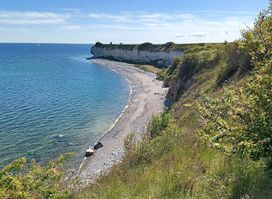
A striking quarry-side visitor centre where chalk cliffs, dinosaurs and asteroid impacts come to life through immersive exhibits at Denmark’s Stevns Klint.
