Vallø Castle Travel Guide
Free Guide: Historic red-brick Renaissance castle and landscaped parkland south of Køge, where royal patronage, noble tradition and tranquil protected countryside meet.


A brief summary of Vallø Castle
Historic red-brick Renaissance castle and landscaped parkland south of Køge, where royal patronage, noble tradition and tranquil protected countryside meet.
Rising above gentle parkland south of Køge, Vallø Castle is a striking red-brick Renaissance fortress with stout towers, encircling moats and a tranquil landscaped estate. Built in the late 1500s and later transformed into a charitable foundation for unmarried noblewomen, it blends aristocratic history with a peaceful country atmosphere. Visitors cannot tour the interior apartments, but can wander the scenic grounds, admire the imposing facades and explore the surrounding protected landscape.
On-site amenities
 Restrooms
 Drink options
 Food options
 Seating areas
 Trash bins
 Information boards
Opening hours
- Every dayOpen 24 hours
Opening hours as listed on the venue’s Google Business Profile. Hours can change for services and special events, so check with the venue before you go.
- Address
- Slotsgade 4, 4600 Køge
- Phone
- Website
Getting there
Regional train and local bus from Copenhagen
Car from Køge and greater Copenhagen area
Cycling from Køge
Discover more about Vallø Castle
Red-brick stronghold in the Køge countryside
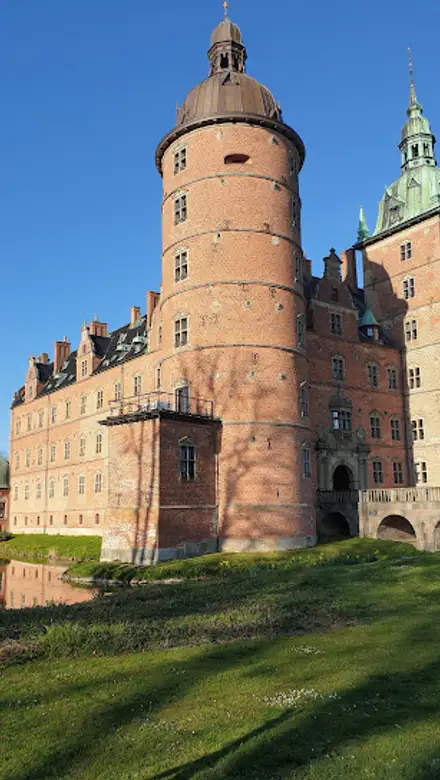
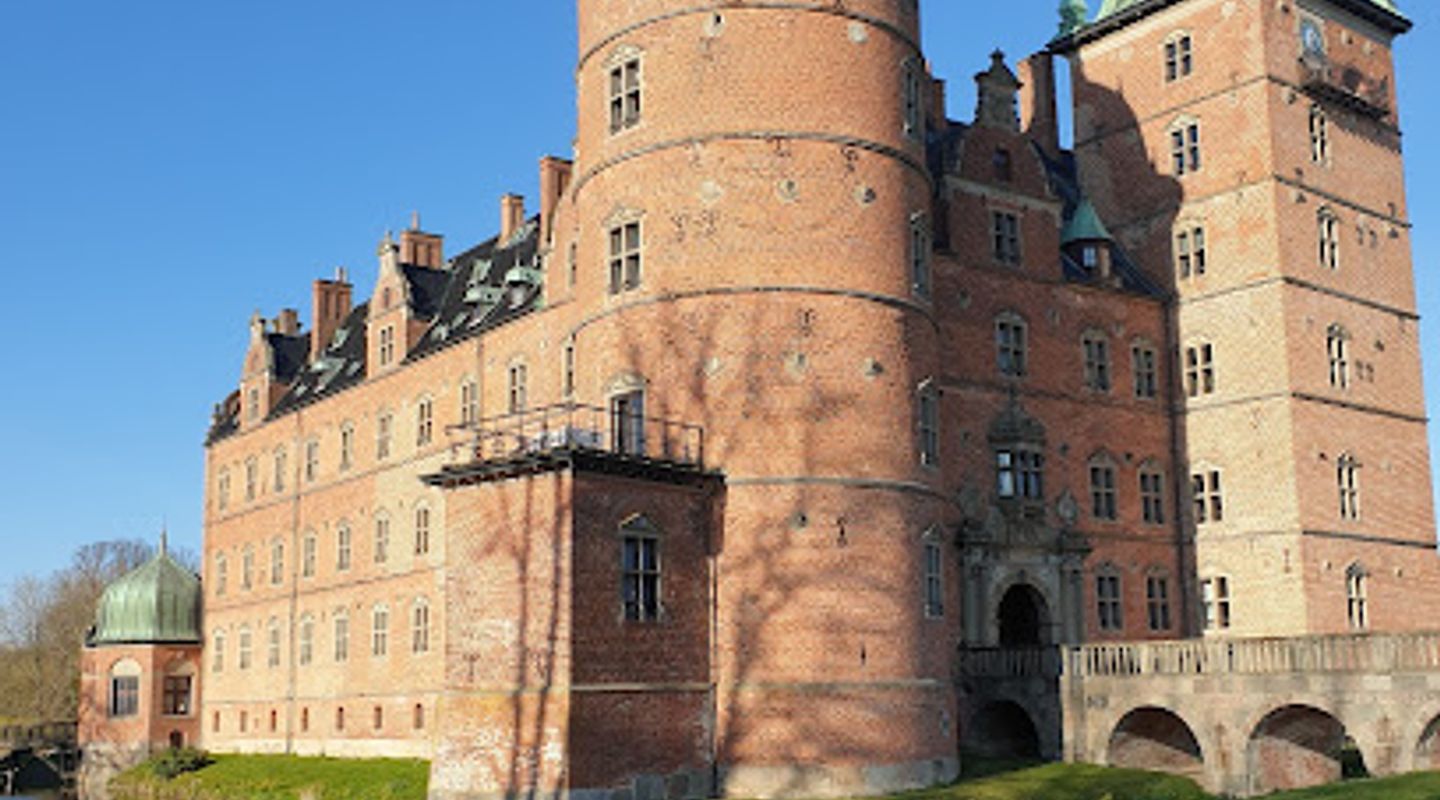
Vallø Castle stands just inland from the Køge coast, its deep red walls and twin towers rising above flat farmland and a cluster of 18th-century service buildings. The complex sits on a low island framed by water, recalling its origins as a fortified seat surrounded by moats. From a distance, the tall roofs, chimneys and contrasting towers – one cylindrical, one square – give it the silhouette of a classic Danish Renaissance stronghold.Close up, the brickwork reveals decorative details in sandstone: portals, medallions and cornices that survived later disasters and help date the building across several periods. Around the castle, the historic village street, the former inn, stift offices and clergy houses form a self-contained little enclave that still feels distinctly aristocratic and slightly removed from modern Køge.
From noble estate to royal foundation
The estate’s story reaches back to the Middle Ages, when Vallø was a fortified manor guarded by earthworks and water defenses. In the late 1500s, Mette Rosenkrantz, widow of statesman Peder Oxe, oversaw construction of the main Renaissance house with its southern and western wings flanked by the current towers. Over the following century and a half, successive owners expanded the complex with new wings on the north and east sides, gradually turning a defensive residence into a more comfortable aristocratic home.In 1708 the Danish king Frederik IV acquired Vallø and used it as a residence for his morganatic wife, Anna Sophie Reventlow. A generation later, in 1737, Queen Sophie Magdalene transformed the property into a royal foundation for unmarried daughters of the Danish nobility. This “frøkenstift” combined noble privilege with a social mission, granting housing and support to women of rank who might otherwise have had limited prospects.
Fire, reconstruction and the present-day exterior
In 1893 a devastating fire gutted the castle’s interior. Much of the roof and internal structure was destroyed, but the outer brick walls and towers largely withstood the blaze. Extensive surveys of the surviving masonry allowed architects Hans Jørgen Holm and Søren Lemche to plan a careful reconstruction. Over the following decade, the castle was rebuilt behind its historic facades, this time with modernized apartments rather than grand state rooms.By 1904 the renewed building was ready to house nine “stiftsdamer” in self-contained residences, a function it continues in adapted form. For visitors today, this means that while the outer appearance remains that of a Renaissance-Baroque castle, the interior is private residential space and not accessible for general touring. The experience focuses instead on admiring the architecture from the outside and understanding the layers of history contained within those preserved walls.
Gardens, landscape and protected grounds
The castle is framed by a broad park that reflects changing fashions in garden design. In the 1700s the grounds were laid out as a formal French baroque garden, with clipped hedges, straight avenues and geometric flower beds extending from the castle island. During the 1800s the park was reimagined in the softer English landscape style, introducing winding paths, open lawns, small pavilions and romantic viewpoints.Today, the wider Vallø estate is part of a large protected area valued for its cultural landscape, veteran trees and recreational paths. Lakes, streams and small woodland patches offer habitat to birdlife and give the grounds a quietly rural character. Walking here, you are always aware of the castle above the treeline, its towers reappearing between branches or across a meadow as you follow the paths.
Experiencing Vallø on a leisurely visit
A visit typically unfolds at a gentle pace. You arrive through the small historic settlement, then cross one of the bridges over the moat to stand in the main courtyard and take in the full height of the wings. From here, the contrasting forms of the square and round towers become especially striking, and the mix of Renaissance and later Baroque elements reveals itself in brick patterns and window details.Afterwards, paths lead out into the park, where benches invite a pause with views back to the water-encircled building. The setting lends itself to quiet photography, sketching or simply sitting under mature trees listening to birds and distant farm sounds. Even without access to the interior, the combination of architecture, story and landscape gives a satisfying sense of how Danish noble estates once shaped both society and countryside in this part of Zealand.
Evendo Review Centre
 Google
Guest reviews
Best time to go
Quietest: Jan, Feb & Mar · before 7am or from 8pm
Busy times are Evendo estimates for a typical year, to help you plan. Actual crowds vary with events, school holidays and the weather.
Explore Vallø Castle on the map
A handpicked selection of must-see spots near Vallø Castle, mapped for you.
Get your free copy of our complete guide to Vallø Castle, delivered straight to you.
Everything on this page, from opening hours and how to get there to Eve’s tips and the best time to go, in one PDF you can read offline, print or share.
Already have an account? Sign in
Your Vallø Castle guide is ready.
We'll send it to · Not you? Sign out

Getting your guide ready…
We are putting together a fresh copy of the Vallø Castle guide. This can take up to a minute.
This can take a few moments. If your browser asks, choose Allow so the download can start. You'll find the guide in your Downloads folder.
Nothing happened? Download it again
Sorry, the guide is taking longer than usual. Please try again in a minute, or get it by email instead.
Other nearby places you may find interesting
The closest places of the same kind, if this one is not quite what you had in mind.
-
Relic of the Castle Revshale Subtle castle earthworks on a lakeside island where medieval power, dramatic siege history and tranquil Maribo Nature Park scenery quietly meet.
-
Glentehøj Bronze Age burial chamber with panoramic views across ancient Lolland landscape
-
Ejegod Windmill Denmark's most complete windmill ensemble—a 1816 Dutch mill with original miller's house, barn, and toy museum.
-
Guldborgsund Zoo & Botanisk Have Formerly a vibrant zoo and botanical garden in Nykøbing Falster, now transitioning to Pangea Park Falster.
-
FEMERN BÆLT Fehmarnbelt HOLZPLATFORM Lang, skulpturel udsigtsrampe i stål og træ med fri panoramaudsigt til Femern Bælt-tunnelen og Lollands åbne kystlandskab – gratis og åben året rundt.
Swipe for more places
More to explore near Vallø Castle

 Best experiences near Vallø Castle
 Best hotels near Vallø Castle
 Best landmarks near Vallø Castle
 Best attractions near Vallø Castle
 Best shops near Vallø Castle
 Best restaurants near Vallø Castle
 Best bars near Vallø Castle
Do you manage this location?
Take control to get all the benefits, like improved information, better appearance, and stronger visibility across AI-powered discovery.
Explore more
Explore more of Lolland
Discover Lolland, Denmark's tranquil island retreat, offering lush landscapes, historic sites, and delightful local cuisine for an unforgettable escape.
Explore Lolland
Explore more of Denmark
Discover Denmark: A perfect blend of history, modern design, and the cozy concept of hygge. Explore vibrant cities, serene landscapes, and world-class cuisine.
Explore Denmark