Rügen Travel Guide
Free Guide: Germany’s largest Baltic island of chalk cliffs, beech forests, seaside resorts and Bodden lagoons, where national parks, piers and fishing villages create a varied coastal escape.


A brief summary of Rügen
Germany’s largest Baltic island of chalk cliffs, beech forests, seaside resorts and Bodden lagoons, where national parks, piers and fishing villages create a varied coastal escape.
Rügen is Germany’s largest island, a distinctive patchwork of chalk cliffs, long sandy beaches, Bodden lagoons and old beech forests in the Baltic Sea off the Pomeranian coast. Belonging to the state of Mecklenburg-Vorpommern, it combines classic seaside resorts such as Binz and Sellin with fishing villages, manor houses and wide-open countryside. Jasmund National Park’s famous white cliffs, the Southeast Rügen Biosphere Reserve and the nostalgic Rasender Roland steam railway make it a rich, varied destination for nature, culture and slow coastal escapes.
On-site amenities
 Restrooms
 Drinking water
 Seating areas
 Sheltered areas
 Picnic areas
 Trash bins
 Information boards
 Visitor centre
 Drink options
 Food options
- Address
- Germany
Getting there
Regional train and bus from Stralsund
Car via Rügen Bridge
Long-distance train to Stralsund plus local transfer
Cycling across the causeway from the mainland
Discover more about Rügen
Germany’s Baltic giant of chalk, sand and sea
Rügen is Germany’s largest island, a 926-square-kilometre sweep of land just off the Pomeranian coast in the Baltic Sea, connected to the mainland near Stralsund by bridge and causeway. Its shoreline is anything but regular: a tangle of peninsulas, headlands and narrow spits reaching into the water creates constantly shifting perspectives of bays, lagoons and open sea. No settlement lies more than a few kilometres from the coast, so the presence of the Baltic – salty air, seabirds, shifting light – is a constant backdrop wherever you stay.The island’s eastern edge is defined by dramatic chalk cliffs that rise sheer from the sea, most famously around the Königsstuhl in Jasmund National Park. Their white faces glow under changing skies and have long fascinated artists and writers. Inland, low hills such as Piekberg, at 161 metres the island’s highest point, offer wide views over forests, fields and the patchwork of water bodies that surround the main island core, known as Muttland.
Cliff forests, biosphere reserves and wild shores
Nature is one of Rügen’s greatest assets. Jasmund National Park protects ancient beech forests that, together with the chalk coast, form part of a UNESCO World Heritage listing. Walking paths lead through cool, cathedral-like woodland before emerging suddenly at cliff-edge viewpoints where the forest falls away to turquoise shallows and white stone beaches. The West Pomeranian Lagoon Area National Park and the Southeast Rügen Biosphere Reserve add a very different character, with shallow Bodden lagoons, salt meadows and reed-fringed shorelines important for migratory birds.Elsewhere, the island alternates between wide, fine-sand beaches and wilder stretches of natural and cliff coast. Long coastal hikes link sheltered coves, dune-backed strands and low, wind-shaped headlands. Offshore, smaller islands such as Hiddensee and Vilm extend the landscape, the latter hosting a nature conservation academy within a particularly untouched environment. Together, these protected areas make Rügen a stronghold for coastal flora and fauna and a rewarding place for quiet observation of nature.
Seaside resorts, spa architecture and fishing harbours
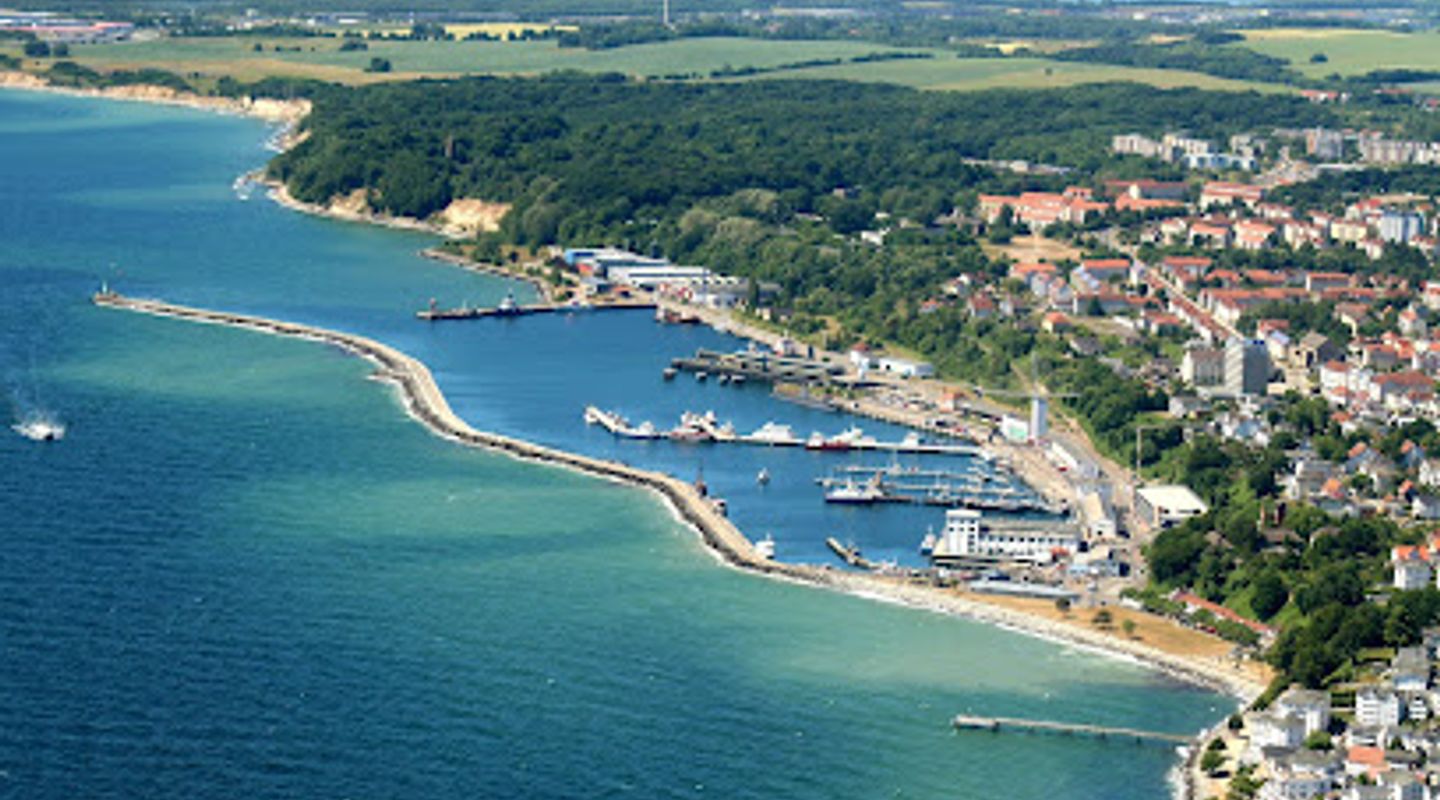
Rügen’s human landscape is just as distinctive. In the southeast, traditional Baltic seaside resorts like Binz, Sellin, Baabe and Göhren line up along sweeping beaches, their historic spa architecture characterized by bright-white villas, ornate balconies and long promenades. Wooden piers reach out into the water, some crowned with pavilions or unusual attractions such as diving gondolas. Evening strolls here combine sea views with the rhythm of cafés, ice-cream stands and concert pavilions.Beyond the resorts, the island’s towns show different faces. Bergen, in the centre, is the administrative heart with a hilltop church and viewing tower. Putbus, a former princely residence, is known for its neoclassical layout and parkland. On the northeast coast, the port town of Sassnitz serves as a gateway to Jasmund’s cliffs and offers a long harbour front, maritime museums and ferry connections to other Baltic ports. Smaller fishing villages, some with thatched cottages clustered near small harbours, preserve a quieter rhythm centred on the sea.
Layers of history from Slavic fortresses to seaside holidays
Rügen’s history runs deep. Archaeological finds trace human presence back to the Stone Age, and burial mounds and megaliths dot the countryside. Later, the island was home to Slavic tribes whose strongholds, such as the fortress at Cape Arkona, controlled regional trade and religious life until conquest and Christianisation in the 12th century. Over the centuries that followed, Rügen passed through the hands of Pomeranian, Swedish and Prussian rulers, each leaving their imprint on local administration, estates and architecture.In the 19th century, with the rise of seaside bathing culture, Rügen’s long beaches and mild Baltic climate transformed it into a coastal holiday destination. Manor houses became guesthouses, railways and piers were built, and the characteristic resort architecture developed along the island’s eastern shores. The 20th century added both grand projects and stark reminders of darker times, including monumental seaside complexes whose later re-use and reinterpretation form part of the island’s complex heritage narrative.
Island life today: slow travel, light and seasons
Modern Rügen blends everyday island life with tourism. Agriculture and fishing coexist with guesthouses, wellness hotels and outdoor activity providers. Around 2,000 hours of sunshine a year make the island one of Germany’s brighter regions, and the seasons each frame the landscape differently: summer brings busy beaches and warm, shallow bathing waters; spring and autumn highlight migratory birds over the lagoons; winter can mean quiet coastal walks under crisp skies and perhaps a dusting of snow on the chalk cliffs.Visitors can experience the island at many speeds. The narrow-gauge steam railway Rasender Roland chugs between seaside resorts at an unhurried pace, its historic locomotives threading through fields and villages. Cyclists follow signed routes across causeways and peninsulas, while walkers explore national park trails, cliff paths and village lanes. In the evenings, local fish specialities and smoked seafood, often enjoyed in simple harbourside venues, underline how closely daily life here still follows the rhythm of the Baltic Sea.
Evendo Review Centre
 Google
Guest reviews
Best time to go
Quietest: Jan, Feb & Mar · before 3am
Busy times are Evendo estimates for a typical year, to help you plan. Actual crowds vary with events, school holidays and the weather.
Explore Rügen on the map
A handpicked selection of must-see spots near Rügen, mapped for you.
Get your free copy of our complete guide to Rügen, delivered straight to you.
Everything on this page, from opening hours and how to get there to Eve’s tips and the best time to go, in one PDF you can read offline, print or share.
Already have an account? Sign in
Your Rügen guide is ready.
We'll send it to · Not you? Sign out

Getting your guide ready…
We are putting together a fresh copy of the Rügen guide. This can take up to a minute.
This can take a few moments. If your browser asks, choose Allow so the download can start. You'll find the guide in your Downloads folder.
Nothing happened? Download it again
Sorry, the guide is taking longer than usual. Please try again in a minute, or get it by email instead.
Other nearby places you may find interesting
The closest places of the same kind, if this one is not quite what you had in mind.
-
Rømø A wind-swept Wadden Sea island of endless sand, tidal flats and maritime heritage, where drivable beaches, kites and wild dunes meet North Sea light and migrating birds.
-
The North Sea Oceanarium Northern Europe’s largest North Sea–focused aquarium, blending giant tanks, playful seals, outdoor adventure zones, and hands‑on marine science in coastal Hirtshals.
-
Saltholm A low, wind-swept Øresund island of meadows, marsh and birdlife, Saltholm offers a rare taste of near-urban wilderness just off Copenhagen’s coastline.
-
Wadden Sea National Park Walk on the seabed, witness starling murmurations, and explore Europe's most dynamic tidal wilderness.
-
The Little Mermaid Copenhagen’s most famous mermaid sits quietly on a harbor rock, a small bronze figure whose fairy-tale melancholy and seaside setting have become a symbol of the city.
Swipe for more places
More to explore near Rügen

 Best experiences near Rügen
 Best hotels near Rügen
 Best landmarks near Rügen
 Best attractions near Rügen
 Best shops near Rügen
 Best restaurants near Rügen
 Best bars near Rügen
Do you manage this location?
Take control to get all the benefits, like improved information, better appearance, and stronger visibility across AI-powered discovery.
Explore more

Explore more of The North Sea Islands
Discover the North Sea Islands of Denmark: idyllic sandy beaches, vibrant local culture, and unique natural landscapes await you on Fanø, Rømø, and Mandø.
Explore The North Sea Islands
Explore more of Denmark
Discover Denmark: A perfect blend of history, modern design, and the cozy concept of hygge. Explore vibrant cities, serene landscapes, and world-class cuisine.
Explore Denmark