

The bell stone Travel Guide
Free Guide: A Neolithic dolmen on a hilltop above Lyø’s fields and sea, where ancient burial stone, island legend and sweeping South Funen views quietly meet.


A brief summary of The bell stone
A Neolithic dolmen on a hilltop above Lyø’s fields and sea, where ancient burial stone, island legend and sweeping South Funen views quietly meet.
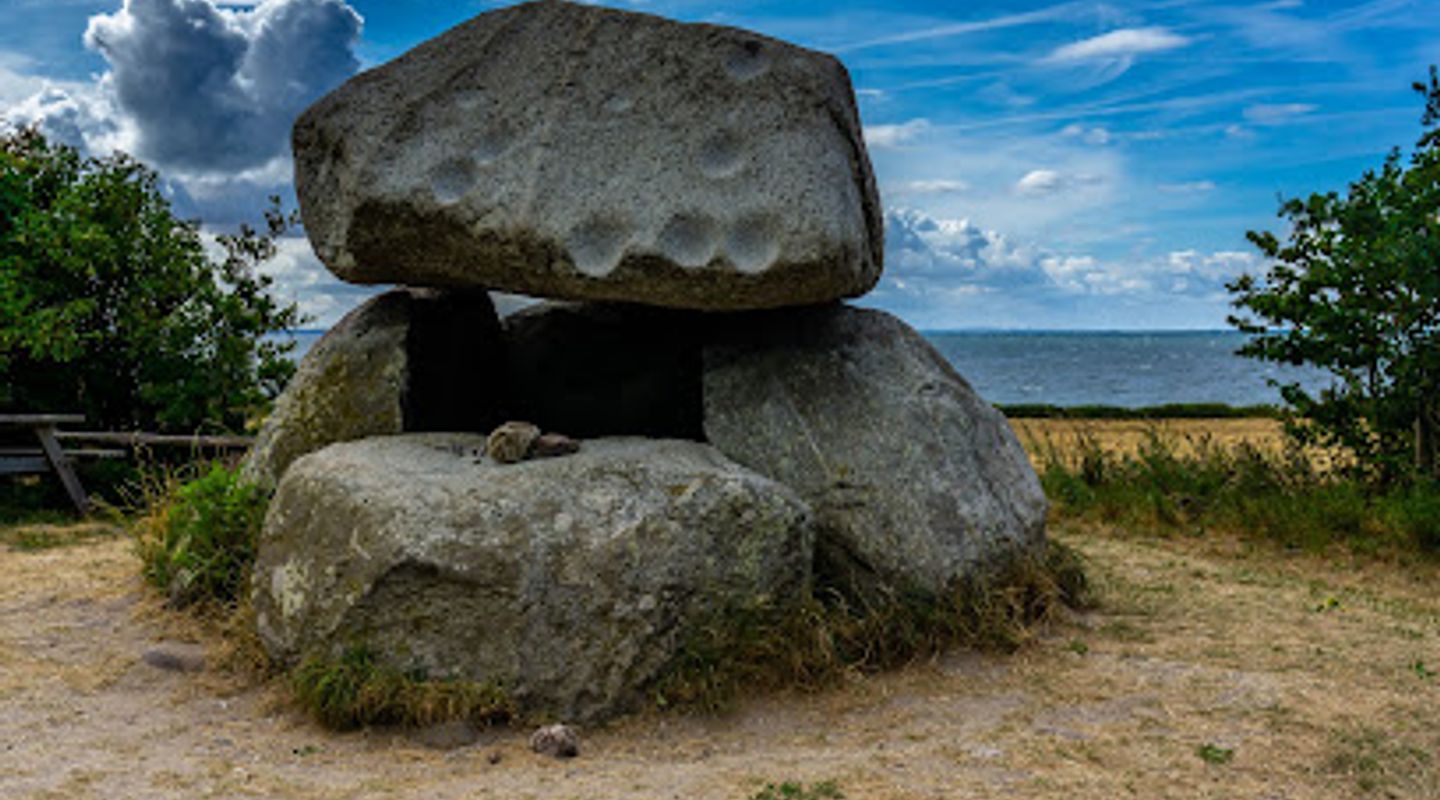
Set on a 20 m hill on the west side of tiny Lyø island near Faaborg, the Bell Stone is a remarkably well‑preserved Neolithic dolmen chamber dating back to around 3500–3100 BC. This atmospheric stone tomb crowns open fields with sweeping views over the South Funen Archipelago. Tap the capstone and, legend says, its clear ringing tone will grant you a wish, blending ancient burial site, island folklore and wide‑sky coastal scenery in one compact, evocative stop.
Opening hours
- Every dayOpen 24 hours
Opening hours as listed on the venue’s Google Business Profile. Hours can change for services and special events, so check with the venue before you go.
- Address
- Vestensvej 19, 5601 Faaborg
Getting there
Ferry and walking from Faaborg
Bicycle from Lyø harbour
Organised excursion from Faaborg region
Discover more about The bell stone
Ancient stones above the South Funen sea
The Bell Stone, or Klokkestenen, stands on a rounded hill on the western side of Lyø, one of the small islands scattered across the South Funen Archipelago. Dating to roughly 3500–3100 BC, this dolmen chamber comes from the early Neolithic farmers who shaped much of Denmark’s prehistoric landscape with megalithic tombs. Here, their legacy survives as a low stone chamber built from upright boulders and a massive capstone, set high above the surrounding fields with sea and islands shimmering on the horizon.Unlike many ruined or ploughed‑over monuments, the Bell Stone remains strikingly intact. The proportions of the chamber are still legible, and the elevated position on a 20 m hill makes the dolmen feel both exposed to the elements and curiously protected, as if time has folded around it. On a clear day, light skims across the weathered surfaces, picking out lichen, tool scars and the soft rounding of thousands of winters.
From burial place to island legend
Originally, the dolmen would most likely have been partly covered by an earthen mound, serving as a communal burial place where generations of the local farming community were laid to rest. Over millennia, soil slipped away and stones shifted, but the essential shape of the tomb endures. Standing beside it, it is easy to imagine ritual gatherings here, with views over both land and water connecting the living and their ancestors.The monument’s modern name comes from a local tale: when you strike the stone, it is said to ring like a bell, and whoever makes it sound clearly may claim a wish. The acoustic quirk probably stems from the capstone’s specific composition and the way it rests on the supporting stones, but the story gives the site a playful, almost intimate character. Visitors often test the superstition with a gentle tap, listening for that bright, bell‑like tone amid the soft sounds of wind and birds.
Landscape, light and the feel of a small island
Part of the Bell Stone’s appeal lies in its setting. Lyø is a compact, gently rolling island shaped by ice age forces, with valleys, low ridges and fertile fields stitched together by hedgerows and small lanes. From the hill, the view opens over patchwork farmland to the surrounding sea, where ferries and small boats mark the routes between the islands and the mainland at Faaborg.The atmosphere shifts with the weather. Under high summer sun, the dolmen seems almost benign, surrounded by wildflowers and buzzing insects. On overcast days, the stones darken and the site feels more solemn, its age more palpable. At sunset, warm light washes the hill and capstone, and the monument stands in silhouette against pastel skies, making it an evocative spot for quiet reflection and photography.
A quiet pause on an island wander
Visiting the Bell Stone is typically part of a wider ramble across Lyø. Paths and narrow country roads lead past old farms, field edges and grazing animals before you climb the final rise to the monument. The approach is not technically demanding but can involve uneven ground and grass, so sturdy footwear is helpful, especially after rain. There are no formal facilities right at the dolmen, and the experience remains pleasingly simple: just the stones, the wind and the view.Because the site is compact, most visitors spend only a short time here, yet the sense of connection it offers—to deep prehistory, to island folklore and to the broader seascape—is disproportionate to its size. It works well as a contemplative pause during a day trip from Faaborg, a highlight of a longer stay on Lyø, or a rewarding goal for anyone with an interest in Scandinavian prehistory.
Respecting a fragile prehistoric monument
Although robust in appearance, the Bell Stone is a vulnerable archaeological site. The capstone and uprights have withstood thousands of years of frost, salt air and human activity, but wear from climbing or scraping can accelerate damage. Treating the structure as a historic grave rather than a playground preserves both its physical integrity and its atmosphere.Simple care—keeping to existing access routes, avoiding pressure on the stones and carrying away any litter—helps ensure that future visitors will find the site as unspoiled and evocative as it feels today. In return, the dolmen offers something rare: a largely unmediated encounter with the distant past, framed by the gentle rhythms of a modern Danish island.
Evendo Review Centre
 Google
Guest reviews
Best time to go
Quietest: Jan, Feb & Dec · before 8am
Busy times are Evendo estimates for a typical year, to help you plan. Actual crowds vary with events, school holidays and the weather.
Explore The bell stone on the map
A handpicked selection of must-see spots near The bell stone, mapped for you.
Get your free copy of our complete guide to The bell stone, delivered straight to you.
Everything on this page, from opening hours and how to get there to Eve’s tips and the best time to go, in one PDF you can read offline, print or share.
Already have an account? Sign in
Your The bell stone guide is ready.
We'll send it to · Not you? Sign out

Getting your guide ready…
We are putting together a fresh copy of the The bell stone guide. This can take up to a minute.
This can take a few moments. If your browser asks, choose Allow so the download can start. You'll find the guide in your Downloads folder.
Nothing happened? Download it again
Sorry, the guide is taking longer than usual. Please try again in a minute, or get it by email instead.
Other nearby places you may find interesting
The closest places of the same kind, if this one is not quite what you had in mind.
-
Vornæs havn A tiny, tranquil harbour at the tip of a Funen peninsula, where forest meets shallow sea, anglers cast from quiet shores and small boats rest in sheltered waters.
-
Vejsnæs Nakke Fyr Small striped lighthouse, big Baltic horizons: Vejsnæs Nakke Fyr combines dramatic cliffs, Ice Age geology and wind-swept sea views on Ærø’s exposed south coast.
-
Skjoldnaes Lighthouse Granite beacon at Ærø’s northwestern tip, Skjoldnæs Lighthouse pairs sweeping sea views and Ice Age landscape with maritime heritage, night skies and seaside fairways.
-
Valdemars Slot Denmark's grandest private palace reimagined as a contemporary art destination in a historic landscape.
-
Cubo Nero Historic glass factory turned museum celebrating two centuries of Scandinavian design mastery and innovation.
Swipe for more places
More to explore near The bell stone

 Best experiences near The bell stone
 Best hotels near The bell stone
 Best landmarks near The bell stone
 Best attractions near The bell stone
 Best shops near The bell stone
 Best restaurants near The bell stone
 Best bars near The bell stone
Do you manage this location?
Take control to get all the benefits, like improved information, better appearance, and stronger visibility across AI-powered discovery.
Explore more

Explore more of The South Funen Archipelago
Discover the South Funen Archipelago: A tranquil haven of over 55 islands with lush landscapes, serene beaches, and rich cultural heritage in the Baltic Sea.
Explore The South Funen Archipelago
Explore more of Denmark
Discover Denmark: A perfect blend of history, modern design, and the cozy concept of hygge. Explore vibrant cities, serene landscapes, and world-class cuisine.
Explore Denmark
