

Herz-Jesu-Kirche, Koblenz Travel Guide
Free Guide: Discover the Herz-Jesu-Kirche in Koblenz: A stunning neo-Romanesque landmark with a rich history, resilient spirit, and central location, offering a peaceful retreat and architectural marvel.


A brief summary of Herz-Jesu-Kirche
Discover the Herz-Jesu-Kirche in Koblenz: A stunning neo-Romanesque landmark with a rich history, resilient spirit, and central location, offering a peaceful retreat and architectural marvel.
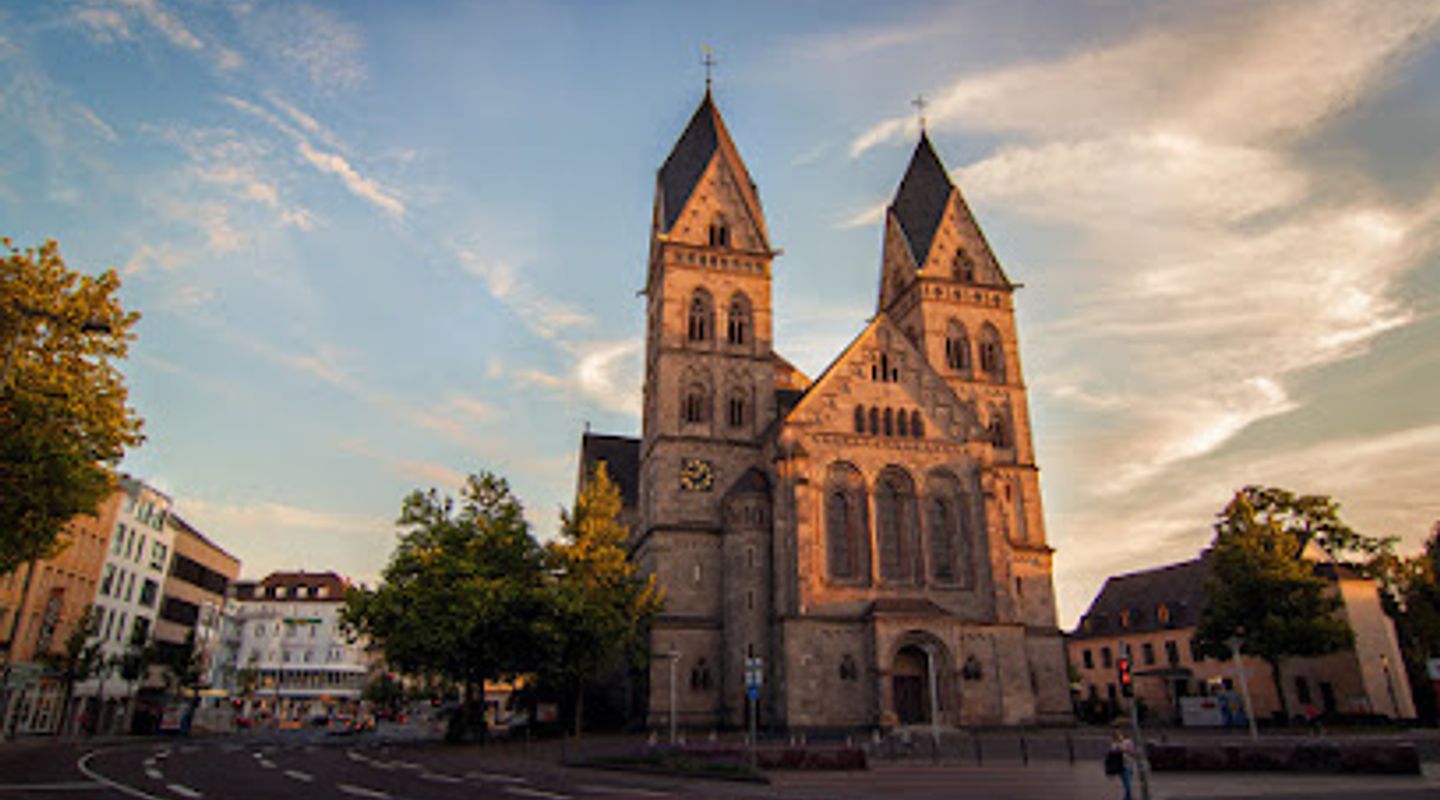
The Herz-Jesu-Kirche (Sacred Heart Church) in Koblenz is a stunning example of neo-Romanesque architecture, built between 1900 and 1903. Designed by Ludwig Becker, who later became the master builder of Mainz Cathedral, the church stands as a testament to the city's expansion at the turn of the 20th century. Severely damaged during World War II, it was lovingly rebuilt, reopening in 1953. Its imposing double-tower facade faces the city center, while the choir faces the Friedrich-Ebert-Ring. Inside, visitors are greeted by a spacious interior, ribbed vaults, and intricate details. The church's location makes it a convenient stop while exploring Koblenz's old town and nearby attractions like the Deutsches Eck. Open daily, Herz-Jesu-Kirche offers a peaceful retreat and a chance to admire its architectural beauty.
- Address
- Löhrrondell 1A, 56068 Koblenz
- Phone
- Website
Getting there
Walking
Public Transport
Taxi/Ride-Share
Driving
Discover more about Herz-Jesu-Kirche
Overview
Herz-Jesu-Kirche, or the Church of the Sacred Heart, is a prominent Catholic church located in Koblenz, Germany. Standing as one of the most important neo-Romanesque sacral buildings in the country, it marks the transition from the historic city center to the southern suburbs. Its construction from 1900 to 1903 was part of a broader urban expansion, addressing the needs of a rapidly growing population. The church's design is the work of Ludwig Becker, who later became the master builder of Mainz Cathedral, in collaboration with Anton Falkowski. Consecrated on May 19, 1904, the Herz-Jesu-Kirche became the second major church in the expanding southern district, erected on the site of the former Löhrtor gate. The need for the church arose from the limited capacity of the existing Liebfrauen and St. Kastor churches, which served over 30,000 residents. Architecturally, the Herz-Jesu-Kirche is notable for its neo-Romanesque style, drawing inspiration from late Rhenish Romanesque forms. The imposing double-tower facade faces the inner city, while the choir is oriented towards the Friedrich-Ebert-Ring. This orientation was chosen for urban planning reasons, making the church a visual anchor in the cityscape. The north facade and towers evoke the Maria Himmelfahrt church in Andernach, while the choir resembles the ruins of Heisterbach. The church suffered severe damage during an air raid in 1944, resulting in a complete burnout. Reconstruction took place between 1950 and 1953, led by Koblenz architects Hermann Meyer and Martin Ufer. In 2011, a fire in the sacristy caused extensive soot damage, rendering the church unusable for several months. The interior of the Herz-Jesu-Kirche is characterized by its spaciousness, designed to provide an unobstructed view of the altar for all worshippers, reflecting the liturgical movement of the 19th century. Ribbed vaults and a gallery add to the architectural richness. The sculptural work was created by Wenzel Jina of Koblenz, based on designs by Alexander Iven of Cologne. The interior was repainted in 1979, in accordance with historical findings. Today, Herz-Jesu-Kirche is part of the parish community of Koblenz-Innenstadt Dreifaltigkeit in the Koblenz deanery of the diocese of Trier. It stands as a symbol of steadfastness, having overcome war damage and fires. The church is not only a place of worship but also a cultural landmark, hosting concerts and community gatherings. Visitors can appreciate the detailed craftsmanship, from the woodwork to the stained glass windows. The surrounding area is ideal for leisurely walks, with attractions like the Deutsches Eck and the old town nearby. Visiting the Herz-Jesu-Kirche offers a peaceful retreat and a chance to reflect amidst travels. The church's location makes it convenient for exploring other attractions in Koblenz. Whether one is a history enthusiast, an architecture lover, or simply seeking a quiet space, Herz-Jesu-Kirche provides an enriching experience. The church's exterior is particularly striking during the golden hours of dawn or dusk, when the setting sun casts a warm glow upon its facade. Beyond its architectural and historical significance, Herz-Jesu-Kirche continues to serve as an active parish. Mass services are held regularly, providing spiritual solace to the local community. The church also participates in events like the Night of Open Churches, offering special programs and musical performances. The Herz-Jesu-Kirche stands as a testament to Koblenz's rich history and architectural heritage. Its neo-Romanesque design, resilient spirit, and central location make it a must-see destination for anyone visiting the city. Whether admiring its imposing facade, exploring its spacious interior, or attending a service, the Herz-Jesu-Kirche offers a memorable and enriching experience. Opening hours are Monday, Wednesday and Saturday from 9 AM to 6 PM, Tuesday, Thursday and Friday from 9 AM to 7:15 PM and Sunday from 10 AM to 7:15 PM. The church welcomes visitors seeking a moment of peace, an architectural marvel, or a connection to the local community.
Evendo Review Centre
 Google
Guest reviews
Explore Herz-Jesu-Kirche on the map
A handpicked selection of must-see spots near Herz-Jesu-Kirche, mapped for you.
Get your free copy of our complete guide to Herz-Jesu-Kirche, delivered straight to you.
Everything on this page, from opening hours and how to get there to Eve’s tips and the best time to go, in one PDF you can read offline, print or share.
Already have an account? Sign in
Your Herz-Jesu-Kirche guide is ready.
We'll send it to · Not you? Sign out

Getting your guide ready…
We are putting together a fresh copy of the Herz-Jesu-Kirche guide. This can take up to a minute.
This can take a few moments. If your browser asks, choose Allow so the download can start. You'll find the guide in your Downloads folder.
Nothing happened? Download it again
Sorry, the guide is taking longer than usual. Please try again in a minute, or get it by email instead.
Unlock the best of Herz-Jesu-Kirche
Skip-the-line tickets, guided tours with entry, and walking tours of the area, booked in a few clicks.

Other nearby places you may find interesting
The closest places of the same kind, if this one is not quite what you had in mind.
-
Deutsches Eck Witness the confluence of history and nature at Deutsches Eck in Koblenz, where the Rhine and Moselle meet beneath the gaze of Kaiser Wilhelm I's monument, a symbol of German unity.
-
History Column Discover Koblenz's captivating history etched in stone at the History Column on Josef-Görres-Platz, a vibrant square in the heart of the Old Town, surrounded by cafes and shops.
-
Ehrenbreitstein Fortress Explore a majestic fortress overlooking the Rhine and Moselle, offering panoramic views, historical insights, and cultural experiences in the heart of the UNESCO World Heritage Upper Middle Rhine Valley.
-
Memorial of German Unity A historic monument at the confluence of the Rhine and Moselle rivers, symbolizing German unity and offering panoramic views of Koblenz and the Upper Middle Rhine Valley.
-
Joseph-Görres-Denkmal Honoring Joseph Görres, a champion of freedom and influential figure in German history, this Koblenz monument offers a reflective experience within the beautiful Kaiserin-Augusta-Anlagen.
Swipe for more places
More to explore near Herz-Jesu-Kirche

 Best experiences near Herz-Jesu-Kirche
 Best hotels near Herz-Jesu-Kirche
 Best landmarks near Herz-Jesu-Kirche
 Best attractions near Herz-Jesu-Kirche
 Best shops near Herz-Jesu-Kirche
 Best restaurants near Herz-Jesu-Kirche
 Best bars near Herz-Jesu-Kirche
Do you manage this location?
Take control to get all the benefits, like improved information, better appearance, and stronger visibility across AI-powered discovery.
Explore more

Explore more of Koblenz
Discover Koblenz: A Historic City at the Confluence of the Rhine and Moselle, Offering Stunning Views, Rich Culture, and Scenic River Cruises.
Explore Koblenz
Explore more of Germany
Experience Germany: where history meets innovation, and urban energy blends with natural beauty. Discover diverse cultures, delicious cuisine, and stunning landscapes.
Explore Germany
