

Free Rothenburg ob der Tauber Travel Guide & Mobile App
Plan your Rothenburg ob der Tauber trip with Evendo. Get free guides to top attractions, restaurants, hotels, and bars. Web access or download the mobile app.


Rothenburg ob der Tauber reveals medieval walls, timber-framed streets, historic towers, Franconian cuisine and evocative sightseeing in Germany.
Within the Medieval Walls
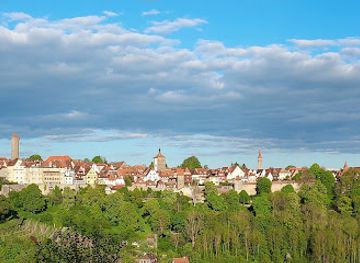
Rothenburg ob der Tauber stands above the Tauber valley in northern Bavaria, its historic centre enclosed by a largely preserved medieval town wall. Timber-framed houses, steeply pitched roofs, narrow lanes and fortified towers give the town an unusually coherent appearance, while the surrounding countryside adds wooded slopes and vineyard landscapes to the setting. The compact old town is best understood as a living historic environment rather than a collection of isolated monuments: everyday streets, workshops, restaurants and residences occupy buildings shaped by centuries of urban development.Read more about Rothenburg ob der Tauber
History in Stone and Timber
Life Beyond the Postcard
When is the best time to visit Rothenburg ob der Tauber?
Best: June–August · 23–24°C| Month | High (°C) | Rainfall (mm) |
|---|---|---|
| January | 4 | 25 |
| February | 5 | 25 |
| March | 8 | 25 |
| April | 14 | 35 |
| May | 20 | 40 |
| June (best) | 23 | 45 |
| July (best) | 24 | 45 |
| August (best) | 24 | 45 |
| September | 20 | 35 |
| October | 15 | 30 |
| November | 9 | 25 |
| December | 5 | 25 |
Getting to and around Rothenburg ob der Tauber
How to get there
Transportation
Best attractions in Rothenburg ob der Tauber
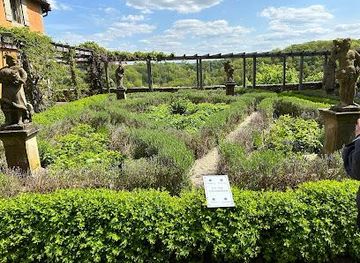
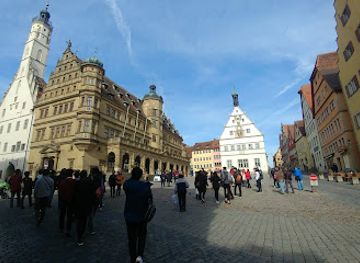
Rothenburg’s principal attractions unfold across its enclosed medieval centre. The Market Square brings together the Town Hall, the white Renaissance façade of the civic building and the route to the Town Hall Tower, whose elevated view explains the town’s compact plan. St James’s Church is essential for its late Gothic interior and Tilman Riemenschneider’s Holy Blood altarpiece. The Medieval Crime and Justice Museum presents historical approaches to law and punishment in a former convent setting, while the Imperial City Museum traces Rothenburg’s civic and artistic development. Walking sections of the town wall links gates, towers and roofline views, and the Castle Garden provides a quieter green space above the Tauber valley. The Plönlein is the most recognised streetscape, but the Burgtor, Spitalbastion and lanes around the southern wall offer equally revealing encounters with the town’s fortifications and urban history.
-
Historical landmark
Plönlein
Experience the enchanting beauty and historical charm of Plönlein, a must-see landmark in Rothenburg ob der Tauber, Germany.
10 min drive · 3.4 km from city centre
-
History museum
Medieval Crime Museum
Explore the chilling narratives of medieval justice at the Medieval Crime Museum in Rothenburg ob der Tauber, where history comes alive through intriguing exhibits.
10 min drive · 3.2 km from city centre
-
Park
Castle Garden
Discover the serene beauty of the Castle Garden in Rothenburg ob der Tauber, where history and nature blend seamlessly in a picturesque setting.
10 min drive · 3.3 km from city centre
-
Tourist attraction
Blade Gate
Explore Rothenburg ob der Tauber's Blade Gate, a captivating historical landmark that captures the essence of medieval Bavaria.
8 min drive · 2.8 km from city centre


Best landmarks in Rothenburg ob der Tauber
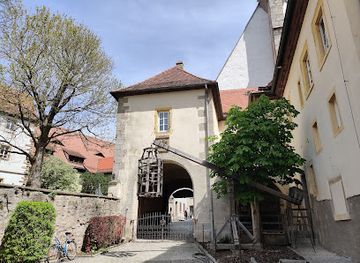
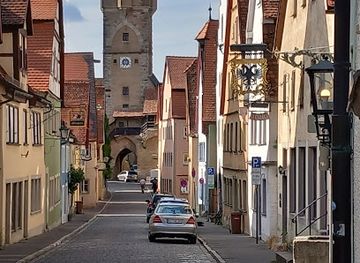
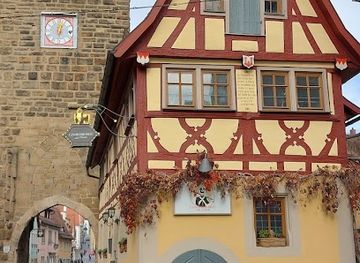
Rothenburg’s landmarks express the authority, faith and defensive needs of a former Free Imperial City. The Town Hall combines a Gothic rear section with a Renaissance façade and dominates the Market Square, where the Town Hall Tower rises above the surrounding roofs. St James’s Church is distinguished by its Gothic architecture and the carved Holy Blood altar by Tilman Riemenschneider. The Plönlein, framed by the Kobolzell Gate and a slender yellow timber-framed house, is the town’s most recognisable urban composition, while the Burgtor marks the western approach to the historic centre. At the southern edge, the Spitalbastion demonstrates the later development of Rothenburg’s fortifications, with multiple gateways and defensive passages. The town wall, towers and gates together form a continuous architectural record of medieval civic ambition, military preparedness and later preservation.
-
Historical landmark
Plönlein
Discover the breathtaking charm of Plönlein, a historical landmark in Rothenburg ob der Tauber, where medieval beauty meets vibrant local culture.
10 min drive · 3.4 km from city centre
-
History museum
Medieval Crime Museum
Discover the dark history of crime and punishment at the Medieval Crime Museum in Rothenburg ob der Tauber, a unique attraction that reveals the secrets of medieval justice.
10 min drive · 3.2 km from city centre
-
Historical landmark
Blade Gate
Explore the enchanting Blade Gate in Rothenburg ob der Tauber, a historic landmark that offers a glimpse into the medieval past of this charming German town.
8 min drive · 2.8 km from city centre
-
Park
Castle Garden
Discover the serene beauty and rich history of Castle Garden in Rothenburg ob der Tauber, a perfect blend of nature and culture for every traveler.
10 min drive · 3.3 km from city centre

Explore Rothenburg ob der Tauber on the map
Plan your Rothenburg ob der Tauber trip on one map. See where the top attractions, landmarks, restaurants, bars and hotels are, find what's near where you're staying, and book hotels and experiences in a few clicks.
Best hotels in Rothenburg ob der Tauber
Best restaurants in Rothenburg ob der Tauber
Rothenburg’s dining scene reflects Franconian and wider Bavarian traditions, with hearty regional cooking found in historic inns, contemporary restaurants, bakeries and cafés. Franconian specialities may include Schäufele, a roasted pork shoulder, sausages, potato-based dishes and seasonal preparations, while local menus often draw on produce from the surrounding countryside. Schneeballen, the town’s familiar pastry of fried strips of dough formed into a ball and dusted or coated in various ways, is widely associated with Rothenburg, though recipes and quality vary between bakeries. Traditional dining rooms around the old town offer regional beers and Franconian wines, particularly Silvaner and other wines from nearby vineyards. Restaurants and cafés range from atmospheric timber-framed interiors to simpler daytime establishments serving coffee, cakes and light meals, with the Market Square and streets near the main gates providing the greatest concentration.
-
Hotel
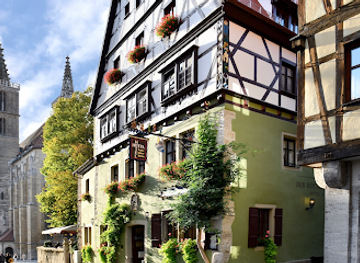
Hotel & Restaurant Reichsküchenmeister - Das Herz von Rothenburg
Discover the heart of Rothenburg at Hotel & Restaurant Reichsküchenmeister, where authentic German cuisine meets warm hospitality.
9 min drive · 3.0 km from city centre
-
Italian
Restaurant Michelangelo
Experience authentic Italian cuisine at Restaurant Michelangelo in Rothenburg ob der Tauber – where every dish tells a story.
9 min drive · 3.1 km from city centre
-
Restaurant
Zur Hoell
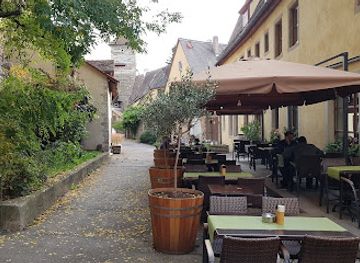
Experience authentic German cuisine in a historic setting at Zur Hoell in Rothenburg ob der Tauber.
10 min drive · 3.2 km from city centre
-
Restaurant
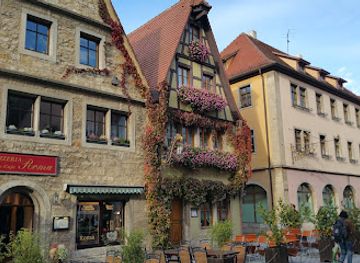
Eiscafé-Pizzeria Roma
Experience authentic Italian cuisine at Eiscafé-Pizzeria Roma in Rothenburg ob der Tauber – pizza perfection meets delicious gelato.
9 min drive · 2.9 km from city centre
Best bars in Rothenburg ob der Tauber
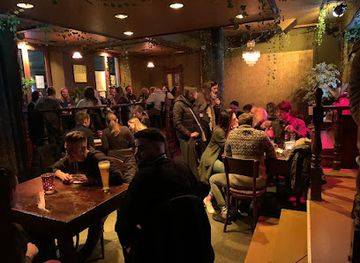
Rothenburg is an early-evening destination rather than a major clubbing centre. After day visitors depart, the historic centre becomes quieter, and evenings tend to centre on traditional inns, hotel bars, wine-focused establishments and cafés in or near the main streets. Franconian wines and regional beers provide a strong local connection, while some venues offer relaxed conversation in historic interiors rather than loud music. The town’s cultural calendar can add concerts, theatre, organ recitals and seasonal performances, especially in churches and civic venues, although programmes vary. Nightclubs are limited compared with larger Bavarian cities, and nightlife outside the central streets is subdued. The illuminated walls, towers and lanes create an atmospheric evening walk, but visitors should remember that Rothenburg is a residential town and keep noise low around homes and accommodation.
-
Beer Garden
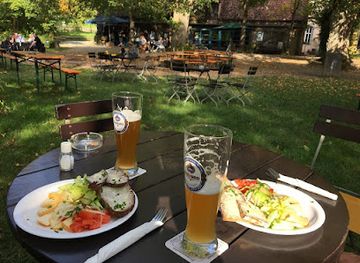
Unter den Linden
Discover Unter den Linden, a charming beer garden in Rothenburg ob der Tauber, where local brews meet rich cultural experiences.
9 min drive · 2.8 km from city centre
-
Bar
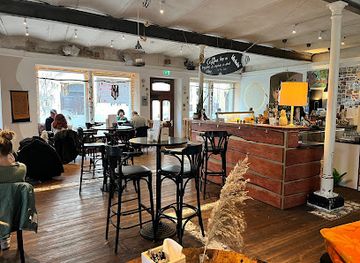
Café Lebenslust
Discover the delightful Café Lebenslust in Rothenburg ob der Tauber, where delicious pastries and cozy ambiance await every visitor.
9 min drive · 3.1 km from city centre
-
Restaurant
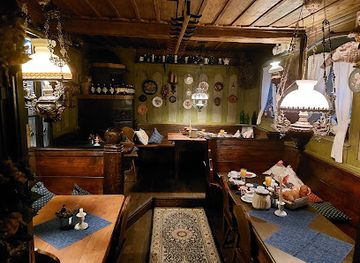
Altfraenkische Weinstube
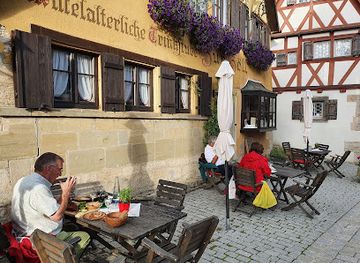
Savor authentic Franconian cuisine and exquisite local wines at Altfraenkische Weinstube, a must-visit dining spot in Rothenburg ob der Tauber.
9 min drive · 3.0 km from city centre
-
Brewpub
Landwehr-Bräu am Turm
Experience authentic Bavarian flavors and handcrafted beers at Landwehr-Bräu am Turm in the heart of Rothenburg ob der Tauber.
10 min drive · 3.4 km from city centre
Best nightclubs in Rothenburg ob der Tauber
Rothenburg is an early-evening destination rather than a major clubbing centre. After day visitors depart, the historic centre becomes quieter, and evenings tend to centre on traditional inns, hotel bars, wine-focused establishments and cafés in or near the main streets. Franconian wines and regional beers provide a strong local connection, while some venues offer relaxed conversation in historic interiors rather than loud music. The town’s cultural calendar can add concerts, theatre, organ recitals and seasonal performances, especially in churches and civic venues, although programmes vary. Nightclubs are limited compared with larger Bavarian cities, and nightlife outside the central streets is subdued. The illuminated walls, towers and lanes create an atmospheric evening walk, but visitors should remember that Rothenburg is a residential town and keep noise low around homes and accommodation.
-
Bar
Gela's Lounge und Bar
Discover the lively ambiance and diverse drink selections at Gela's Lounge und Bar, the perfect spot for relaxation and socializing in Rothenburg ob der Tauber.
9 min drive · 2.9 km from city centre
-
Cocktail bar
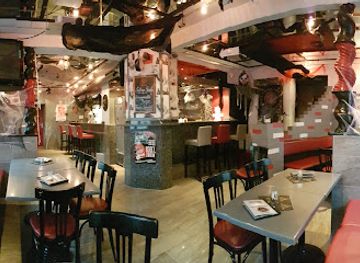
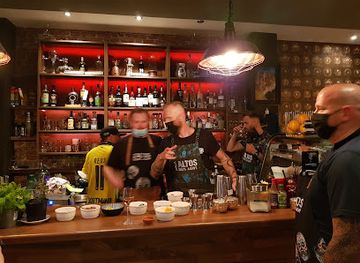
MUCHO AMOR Café & Bar
Discover the vibrant flavors and inviting ambiance at MUCHO AMOR Café & Bar in Rothenburg ob der Tauber, where every meal is a joyful celebration.
9 min drive · 3.0 km from city centre
-
Pub
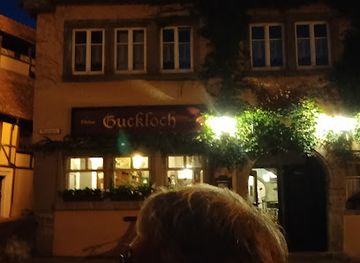
Guckloch 38
Experience the heart of Rothenburg ob der Tauber at Guckloch 38, where local brews and hearty meals await in a cozy pub atmosphere.
8 min drive · 2.8 km from city centre
-
Bar
Better Together
Discover Better Together, a cozy bar in Rothenburg ob der Tauber, perfect for enjoying drinks and mingling in a lively atmosphere.
9 min drive · 3.1 km from city centre
Best shops in Rothenburg ob der Tauber
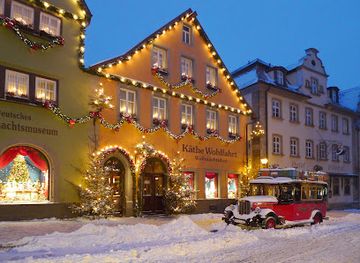
Shopping in Rothenburg centres on the streets within the walls, where specialist shops occupy historic houses alongside bakeries, cafés and galleries. Traditional craft goods, woodwork, ceramics, textiles and locally themed souvenirs reflect the town’s medieval image, while Christmas shops are prominent because of Rothenburg’s long association with festive decoration and Käthe Wohlfahrt’s retail presence. Bakeries sell Schneeballen and other regional sweets, and delicatessens may offer Franconian food products and wines from the surrounding region. The main shopping routes around Herrengasse, Schmiedgasse and the Market Square are convenient for browsing, while smaller side streets provide independent retailers and artisan-focused businesses. Visitors seeking authentic purchases should distinguish locally made craft and food products from generic souvenirs, and should expect some shops to follow traditional German opening patterns rather than extended evening hours.
-
Gift shop
Käthe Wohlfahrt - Weihnachtsdorf
Discover Käthe Wohlfahrt, the ultimate Christmas store in Rothenburg ob der Tauber, offering unique gifts and festive decorations all year round.
9 min drive · 3.1 km from city centre
-
Shopping mall
ZentRo Rothenburg
Explore ZentRo Rothenburg, an inviting shopping mall offering a diverse range of stores and dining options in the heart of medieval Rothenburg ob der Tauber.
9 min drive · 2.9 km from city centre
-
Store
Waffenkammer Rothenburg o.d.T.
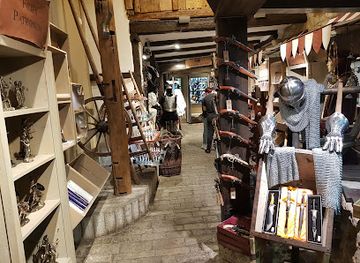
Explore the Waffenkammer in Rothenburg ob der Tauber for an unforgettable journey through medieval craftsmanship and history.
9 min drive · 3.2 km from city centre
-
Home goods store
TEDi
Discover affordable home goods and unique finds at TEDi in Rothenburg ob der Tauber, a charming destination for all your shopping needs.
9 min drive · 3.0 km from city centre


Get your free copy of our complete guide to Rothenburg ob der Tauber, delivered straight to you.
Everything on this page, from attractions and restaurants to essentials and local phrases, in one PDF you can read offline, print or share.
Already have an account? Sign in
Your Rothenburg ob der Tauber guide is ready.
We'll send it to · Not you? Sign out

Getting your guide ready…
We are putting together a fresh copy of the Rothenburg ob der Tauber guide. This can take up to a minute.
This can take a few moments. If your browser asks, choose Allow so the download can start. You'll find the guide in your Downloads folder.
Nothing happened? Download it again
Sorry, the guide is taking longer than usual. Please try again in a minute, or get it by email instead.
Rothenburg ob der Tauber essentials
Currency and Payment
Safety
Emergency Situations
Do's and Don'ts
Local Tips
From Eve
Local phrases worth knowing
You don't need to get them perfect. A few words go a long way, and locals appreciate the effort.
Basics
| English | Local | Say it |
|---|---|---|
| Hello | Hallo | [ha-lo] |
| Goodbye | Auf Wiedersehen | [ouf vee-der-zay-en] |
| Yes | Ja | [ya] |
| No | Nein | [nine] |
| Please/You're welcome | Bitte | [bi-te] |
| Thank you | Danke | [dan-ke] |
| Excuse me/Sorry | Entschuldigung | [ent-shool-di-gung] |
| How are you? | Wie geht es dir? | [vee gate es deer] |
| Fine. And you? | Gut. Und dir? | [goot oont deer] |
| Do you speak English? | Sprechen Sie Englisch? | [shprek-en zee eng-lish] |
| I don't understand | Ich verstehe nicht | [ikh fer-shtay-e neekt] |
Eating & Drinking
| English | Local | Say it |
|---|---|---|
| I'd like to see the menu, please | Ich hätte gerne die Speisekarte, bitte | [ikh heh-te gern dee shpy-ze-kar-te, bi-te] |
| I don't eat meat | Ich esse kein Fleisch | [ikh es-se kine fli-sh] |
| Cheers! | Prost! | [prost] |
| I would like to pay, please | Ich möchte bitte bezahlen | [ikh mosh-te bi-te be-tsal-en] |
Emergencies
| English | Local | Say it |
|---|---|---|
| Help! | Hilfe! | [hil-fe] |
| Go away! | Gehen Sie weg! | [ge-en zee veg] |
| Call the Police! | Rufen Sie die Polizei! | [roo-fen zee dee po-leet-sigh] |
| Call a doctor! | Rufen Sie einen Arzt! | [roo-fen zee i-nen artsht] |
| I'm lost | Ich habe mich verirrt | [ikh ha-be mish feh-rirt] |
| I'm ill | Ich bin krank | [ikh bin krank] |
Shopping
| English | Local | Say it |
|---|---|---|
| I'd like to buy... | Ich möchte kaufen... | [ikh mosh-te kow-fen] |
| I'm just looking | Ich schaue nur | [ikh shou-e noor] |
| How much is it? | Wie viel kostet das? | [vee feel kos-tet das] |
| That's too expensive | Das ist zu teuer | [das ist tso toy-er] |
| Can you lower the price? | Können Sie den Preis senken? | [koo-nen zee den prees sen-ken] |
Time & Numbers
| English | Local | Say it |
|---|---|---|
| What time is it? | Wie spät ist es? | [vee shpet ist es] |
| It's one o'clock | Es ist ein Uhr | [es ist iyn oor] |
| Half past (10) | Halb (10) Uhr | [halb (10) oor] |
| Morning | Morgen | [mor-gen] |
| Afternoon | Nachmittag | [nah-mit-tahg] |
| Evening | Abend | [ah-bent] |
| Yesterday | Gestern | [ges-tern] |
| Today | Heute | [hoi-te] |
| Tomorrow | Morgen | [mor-gen] |
| 1 | Eins | [iyns] |
| 2 | Zwei | [tsvai] |
| 3 | Drei | [dry] |
| 4 | Vier | [feer] |
| 5 | Fünf | [fuhnf] |
| 6 | Sechs | [zeks] |
| 7 | Sieben | [zee-ben] |
| 8 | Acht | [akht] |
| 9 | Neun | [noyn] |
| 10 | Zehn | [tsehn] |
Transport & Directions
| English | Local | Say it |
|---|---|---|
| Where's a/the...? | Wo ist ein/der...? | [vo ist iyn/deer] |
| What's the address? | Was ist die Adresse? | [vas ist dee ah-dre-suh] |
| Can you show me (on the map)? | Können Sie mir zeigen (auf der Karte)? | [koo-nen zee meer tsy-gen (ouf der kar-te)] |
| When's the next (bus)? | Wann kommt der nächste (Bus)? | [van komt deer nakh-ste (boos)] |
| A ticket (to ....) | Eine Fahrkarte (nach ....) | [i-ne fahr-kar-te (nakh)] |
History of Rothenburg ob der Tauber
Origins beside the Tauber
The area around Rothenburg was occupied before the medieval town emerged, and archaeological evidence indicates settlement in the wider region during earlier periods. The name Rothenburg is generally associated with a settlement on a red-coloured clearing or hill, while the addition ob der Tauber distinguishes it from other places called Rothenburg. A decisive stage came in the late tenth century, when a castle associated with the counts of Comburg-Rothenburg stood above the Tauber. The settlement developed around this elevated position and the routes crossing the region. Its location helped connect agricultural communities, local estates and emerging centres of trade, establishing the geographical foundations for the walled town visible today.
Imperial City and Urban Growth
Rothenburg gained increasing political importance during the later Middle Ages and became a Free Imperial City in 1274 under Rudolf I of Habsburg. This status placed the town directly under the authority of the Holy Roman Emperor rather than a territorial prince, giving its council considerable autonomy. Trade, craft production and agriculture supported expansion, while the town walls were extended and strengthened as the population grew. Churches, civic buildings and merchant houses reshaped the urban centre, and the principal gates controlled movement through the fortifications. The wealth and self-government associated with the imperial-city period laid much of the architectural and institutional groundwork for Rothenburg’s present historic character.
Religious Life and Civic Power
During the late medieval period, Rothenburg developed a substantial religious and civic infrastructure. St James’s Church became an important ecclesiastical building, and the town’s churches, foundations and charitable institutions reflected the influence of Christianity on urban life. Trade and craft guilds operated alongside a powerful municipal government, while the council managed taxation, defence and public order. The town’s prosperity is represented in surviving buildings such as the Town Hall and in the sophisticated religious art commissioned for its churches. Tilman Riemenschneider’s Holy Blood altarpiece in St James’s Church belongs to this period of artistic and devotional activity, when Rothenburg participated in wider cultural currents across Franconia.
Reformation and the Thirty Years’ War
Rothenburg adopted the Reformation in the sixteenth century, ending the established Catholic order in the city and transforming religious practice and institutions. The town retained its political independence as a Free Imperial City, but its position became more precarious during the conflicts that shook the Holy Roman Empire. In 1631, during the Thirty Years’ War, imperial troops under Johann Tserclaes, Count of Tilly, occupied Rothenburg. Later stories about the councilman Georg Nusch saving the town by drinking a large quantity of wine belong partly to local legend, and the celebrated Meistertrunk tradition should be read as cultural memory rather than straightforward military documentation. War and economic disruption weakened the city’s influence.
Loss of Independence and Economic Decline
Rothenburg’s status as a Free Imperial City ended in 1802, when it was incorporated into the Electorate of Bavaria during the territorial reorganisations associated with the Napoleonic era. The change removed the political autonomy that had shaped municipal life for centuries. Unlike rapidly industrialising centres, Rothenburg experienced limited economic expansion during the nineteenth century, and this relative stagnation helped preserve much of its medieval street plan and building stock. The town became increasingly valued for its historical appearance, attracting artists, writers and travellers. Romantic interest in medieval architecture encouraged conservation and gradually turned Rothenburg’s past into a central part of its modern identity.
Preservation and Reconstruction
Rothenburg’s historic centre survived the Second World War with significant but localised damage, particularly during fighting in 1945. Parts of the town were damaged by fire and bombing, yet substantial sections of the walls and old buildings remained. Reconstruction followed traditional forms, supported in part by international donations, and the restored town continued its role as a major heritage destination. Preservation has since shaped planning throughout the walled centre, where historic façades, gates, towers and public spaces are maintained alongside homes, businesses and museums. Modern Rothenburg therefore reflects both genuine medieval and early modern fabric and carefully executed post-war restoration, a distinction important to understanding its appearance.
Rothenburg ob der Tauber in Photos
Browse through our photo collection highlighting the charm and character of the destination.
Cities near Rothenburg ob der Tauber
The closest cities to Rothenburg ob der Tauber, if you have time for more than one stop.
-

-

-

-

-


Swipe for more cities
Explore more

Explore more of Germany
Experience Germany: where history meets innovation, and urban energy blends with natural beauty. Discover diverse cultures, delicious cuisine, and stunning landscapes.
Explore Germany