Rotunda, Thessaloniki Travel Guide
Free Guide: Explore Thessaloniki's ancient Rotunda: a Roman monument transformed into a church and mosque, showcasing stunning mosaics and rich history.


A brief summary of Rotunda
Explore Thessaloniki's ancient Rotunda: a Roman monument transformed into a church and mosque, showcasing stunning mosaics and rich history.
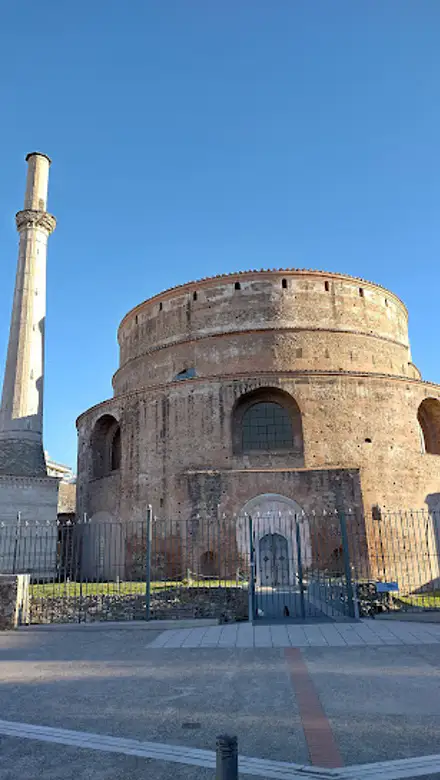
The Rotunda of Thessaloniki, also known as the Church of Agios Georgios, is a remarkably well-preserved ancient monument with a rich and varied history. Originally built in 306 AD by the Roman Emperor Galerius, it has served as a pagan temple, a Christian church, and an Ottoman mosque. Today, it stands as a museum and a testament to Thessaloniki's layered past, showcasing stunning mosaics and impressive Roman architecture.
Opening hours
- Mon8:30 am–3:30 pm
- TueClosed
- Wed8:30 am–3:30 pm
- Thu8:30 am–3:30 pm
- Fri8:30 am–3:30 pm
- Sat8:30 am–3:30 pm
- Sun8:30 am–3:30 pm
Opening hours as listed on the venue’s Google Business Profile. Hours can change for services and special events, so check with the venue before you go.
- Address
- Platia Agiou Georgiou Rotonta 5, Thessaloniki 546 35
- Phone
Getting there
Walking
Public Transport
Taxi
Discover more about Rotunda
Overview
The Rotunda is one of Thessaloniki's most iconic and historically significant monuments. Constructed around 306 AD during the reign of Roman Emperor Galerius, its original purpose remains debated, with theories suggesting it was intended as a temple to Zeus, a sanctuary for the Cabeiri gods, or even Galerius's own mausoleum. Regardless, its massive structure was designed as a symbol of imperial power.Architecturally, the Rotunda is a marvel. Its circular design features walls over 6 meters thick and a towering dome reaching nearly 30 meters in height. The building's design is comparable to that of the Pantheon in Rome. Over the centuries, the Rotunda has undergone several transformations, reflecting the city's changing cultural and religious landscape. In the late 4th century AD, it was converted into a Christian church, dedicated to Agios Georgios (Saint George). During this period, significant architectural changes were made, including the addition of a sanctuary, a perimetric aisle, and the opening of a western gate to serve as the main entrance. The interior was adorned with stunning mosaics, showcasing a variety of colors and depicting Christ, angels, martyrs, and early Christian saints.During the Ottoman occupation in 1591, the Rotunda was converted into a mosque, named the Mosque of Hortatz Effendi. A minaret was added, which is the only one remaining in the city. After Thessaloniki's liberation in 1912, the Rotunda was reclaimed as a Christian site before becoming a museum. Today, the Rotunda stands as a unique blend of church and archaeological monument, attracting tourists, hosting religious services, and serving as a venue for cultural events. The mosaics, which date back to the early Christian era, are particularly noteworthy, showcasing scenes from the lives of martyrs and intricate geometrical and floral motifs.
Evendo Review Centre
 Google
Guest reviews
Explore Rotunda on the map
A handpicked selection of must-see spots near Rotunda, mapped for you.
Get your free copy of our complete guide to Rotunda, delivered straight to you.
Everything on this page, from opening hours and how to get there to Eve’s tips and the best time to go, in one PDF you can read offline, print or share.
Already have an account? Sign in
Your Rotunda guide is ready.
We'll send it to · Not you? Sign out

Getting your guide ready…
We are putting together a fresh copy of the Rotunda guide. This can take up to a minute.
This can take a few moments. If your browser asks, choose Allow so the download can start. You'll find the guide in your Downloads folder.
Nothing happened? Download it again
Sorry, the guide is taking longer than usual. Please try again in a minute, or get it by email instead.
Unlock the best of Rotunda
Skip-the-line tickets, guided tours with entry, and walking tours of the area, booked in a few clicks.


 Tour
TourThessaloniki Self Guided Audio Tour Roman to Ottoman with Quiz
from $7.46 Tour
TourThessaloniki Scavenger Hunt & Highlights Self-Guided Walking Tour
from $7.48 Tour
TourThessaloniki Bike Tour, the best way to explore the city
from $44.86 Tour
TourThessaloniki Byzantine Wonders Guided Walk and Museum Visit
from $52.33
Other nearby places you may find interesting
The closest places of the same kind, if this one is not quite what you had in mind.
-
-
-
-
-


Swipe for more places
More to explore near Rotunda

 Best experiences near Rotunda
 Best hotels near Rotunda
 Best landmarks near Rotunda
 Best attractions near Rotunda
 Best shops near Rotunda
 Best restaurants near Rotunda
 Best bars near Rotunda
Do you manage this location?
Take control to get all the benefits, like improved information, better appearance, and stronger visibility across AI-powered discovery.
Explore more

Explore more of Thessaloniki
Discover Thessaloniki, Greece's vibrant northern gem, where ancient history meets modern allure. Enjoy rich culture, delicious cuisine, stunning views, and lively nightlife.
Explore Thessaloniki
Explore more of Greece
Discover Greece: A land where ancient history meets modern vibrancy, offering stunning islands, crystal-clear seas, and unforgettable cultural experiences.
Explore Greece