

Dom ter (Szeged) Travel Guide - Free
Explore Dom ter in Szeged with Evendo's free guide. Find the best shops, historic streets, restaurants, and gems on web or mobile.


Dom ter in Szeged reveals Hungary's Votive Church, brick arcades, the National Pantheon and the celebrated Open-Air Festival beside the Tisza.
A Civic Square Built After Disaster
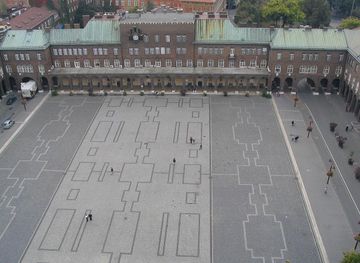
Dom ter, officially Dóm tér, is one of Szeged’s most distinctive urban spaces: a broad, enclosed square shaped by red-brick university buildings and dominated by the twin towers of the Votive Church. It lies at the historic centre of the city, close to the Tisza and within easy walking distance of Klauzál tér, Széchenyi tér and the pedestrian streets leading towards the river. The square’s appearance is inseparable from the rebuilding of Szeged after the catastrophic flood of 1879, when the city’s renewal brought monumental public architecture alongside practical urban reconstruction.Read more about Dom ter
Architecture, Memory and Study
The Square as Open-Air Stage
Best attractions in Dom ter
The principal attraction is the Votive Church, whose Romanesque Revival interior, large organ and colourful stained glass give the square a monumental focus, although visiting arrangements may vary with services and events. Around it, the arcaded university buildings create a rare, coherent brick ensemble that rewards a slow circuit rather than a single photograph. The National Pantheon, displayed in the arcades, introduces visitors to figures from Hungarian cultural, scientific and political life. In summer, the Szeged Open-Air Festival changes the square into a major performance setting with a temporary auditorium facing the cathedral. Nearby Somogyi utca offers a natural continuation towards the riverside and central museums, while Aradi vértanúk tere provides another perspective on the cathedral complex. The square is particularly atmospheric at the edges of the day, when the open space contrasts with the deep shadows beneath the arcades.
-
Tourist attraction
Szeged Open-air Festival
Explore the Szeged Open-air Festival, a cultural landmark that offers a spectacular blend of music, art, and local gastronomy in a stunning outdoor setting.
1 min walk · 0.1 km from neighbourhood centre

Best landmarks in Dom ter
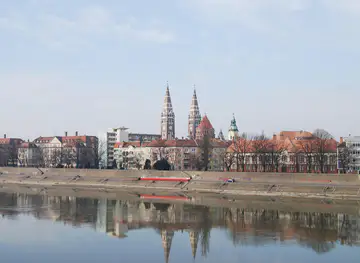
The Votive Church, or Cathedral of Our Lady of Hungary, is the defining landmark of Dom ter and one of Szeged’s most recognisable buildings. Its twin towers, patterned brickwork and monumental entrance embody the city’s post-flood rebuilding and its early twentieth-century religious ambitions. The surrounding arcades are equally important: they form a carefully planned architectural frame for the square and house university functions as well as the National Pantheon, whose commemorative sculptures connect the site with Hungarian public and cultural history. The square’s generous proportions and repeated brick details make the ensemble legible from several approaches, particularly along Somogyi utca. Rather than functioning as isolated monuments, cathedral, arcades and open space operate as one civic composition, combining religious memory, higher education and performance culture.
-
Catholic church
Votive Church of Szeged
Discover the Votive Church of Szeged, an architectural masterpiece and a symbol of the city’s rich cultural and historical heritage.
1 min walk · 0.1 km from neighbourhood centre
-
Tourist attraction
Musical Clock
Discover the enchanting Musical Clock in Szeged, where time and music harmoniously blend in a captivating display of artistry and culture.
1 min walk · 0.1 km from neighbourhood centre
-
Event venue
Dóm tér
Discover the vibrant Dóm tér in Szeged, Hungary—a cultural hub of events, stunning architecture, and local charm waiting to be explored.
1 min walk · 0.1 km from neighbourhood centre
-
Historical landmark
Dömötör Tower
Explore Szeged's Dömötör Tower, a stunning Romanesque landmark steeped in history and architectural beauty, perfect for every traveler.
1 min walk · 0.1 km from neighbourhood centre


Explore Dom ter on the map
A handpicked selection of must-see spots in Dom ter, mapped for you.
Best hotels in Dom ter
Best restaurants in Dom ter
Dining directly on Dom ter is more limited than in Szeged’s main pedestrian streets, but the square sits within easy reach of cafés, restaurants and casual eateries around Somogyi utca, Kárász utca and the adjacent central streets. Visitors can combine a cathedral visit with coffee, pastries or a full meal in the wider historic centre, where Hungarian dishes appear alongside contemporary European cooking and international options. The university presence contributes to a generally informal, mixed dining culture, while summer performances bring additional demand around the square. The nearby market and central food businesses are useful for encountering everyday Hungarian ingredients, although Dom ter itself is better understood as an architectural and cultural setting than as a dedicated restaurant quarter. Opening patterns and menus change, particularly during festival periods, so current local information is advisable.
-
Restaurant
Katedrális étterem és kávézó
Experience authentic Hungarian cuisine with stunning views at Katedrális Étterem és Kávézó in Szeged's picturesque Dóm tér.
1 min walk · 0.1 km from neighbourhood centre

Best bars in Dom ter
Dom ter is not primarily a nightclub district, but it becomes lively after dark during the Szeged Open-Air Festival, when theatre audiences fill the square and nearby central venues. Outside the festival season, evening activity is shaped more by university life, cafés and bars in the surrounding pedestrian centre than by establishments located on the square itself. Kárász utca and the streets around Klauzál tér offer a broader choice of informal drinking places, while the walk towards the Tisza provides a quieter change of mood. Performance nights can make the area feel theatrical rather than club-oriented, with people gathering before and after shows. Visitors should be considerate when leaving late events because residential and academic buildings stand immediately around the square.
-
Bar
Vitrin Szeged
Discover Vitrin Szeged, a vibrant bar and café offering exquisite drinks, a dog-friendly environment, and a delightful atmosphere in the heart of Szeged.
1 min walk · 0.1 km from neighbourhood centre

Best shops in Dom ter
Shopping on Dom ter itself is secondary to its cathedral, university and festival functions. The most useful retail streets lie a short walk away in Szeged’s central pedestrian area, particularly around Kárász utca and the adjoining lanes, where visitors find cafés, everyday shops, bookshops and locally oriented businesses rather than a specialised market concentrated on the square. The wider centre is also a practical place to look for Hungarian food gifts and regional products, while the nearby market offers a more everyday view of local commerce when open. Because the square is an institutional and cultural space, its retail character is quieter and less commercial than Szeged’s main shopping streets. Festival periods may bring temporary stalls or event-related vendors, but these should be treated as changing arrangements rather than permanent features.
-
Christian book store
KEFE
Explore KEFE in Szeged for a unique selection of Christian literature and gifts, nestled in a serene and inviting atmosphere.
1 min walk · 0.1 km from neighbourhood centre

Dom ter essentials
Getting There
Getting Around
Safety
Emergency Situations
Do's and Don'ts
Local Tips

From Eve
Local phrases worth knowing
You don't need to get them perfect. A few words go a long way, and locals appreciate the effort.
Basics
| English | Local | Say it |
|---|---|---|
| Hello | Helló | [heh-loh] |
| Goodbye | Viszlát | [vee-slaht] |
| Yes | Igen | [ee-gen] |
| No | Nem | [nem] |
| Please/You're welcome | Kérem | [keh-rem] |
| Thank you | Köszönöm | [kuh-zuh-nuhm] |
| Excuse me/Sorry | Elnézést | [el-nay-zayst] |
| How are you? | Hogy vagy? | [hohdj vahdj] |
| Fine. And you? | Jól vagyok. És te? | [yohl vahdj-ohk. ays teh] |
| Do you speak English? | Beszélsz angolul? | [bes-ayls ahn-goh-lool] |
| I don't understand | Nem értem | [nem ayr-tem] |
Eating & Drinking
| English | Local | Say it |
|---|---|---|
| I'd like to see the menu, please | Szeretnék látni az étlapot, kérem | [seh-reh-tnek laht-nee ahs ayt-loh-pot, keh-rem] |
| I don't eat meat | Nem eszek húst | [nem eh-sek hoo-st] |
| Cheers! | Egészségedre! | [ay-gays-shay-gehd-reh] |
| I would like to pay, please | Szeretnék fizetni, kérem | [seh-reh-tnek fee-zeht-nee, keh-rem] |
Emergencies
| English | Local | Say it |
|---|---|---|
| Help! | Segítség! | [sheh-geet-shayg] |
| Go away! | Menj el! | [men yehl] |
| Call the Police! | Hívd a rendőrséget! | [heed ah rehn-dur-shay-get] |
| Call a doctor! | Hívd az orvost! | [heed ahz or-vosht] |
| I'm lost | El vagyok tévedve | [el vahdj-ohk tay-ved-veh] |
| I'm ill | Beteg vagyok | [beh-tehg vahdj-ohk] |
Shopping
| English | Local | Say it |
|---|---|---|
| I'd like to buy... | Szeretnék vásárolni... | [seh-reh-tnek vah-shah-rohl-nee] |
| I'm just looking | Csak nézelődöm | [chahk nay-zeh-loh-dohm] |
| How much is it? | Mennyibe kerül? | [men-nyee-beh keh-rool] |
| That's too expensive | Ez túl drága | [ez tool drah-gah] |
| Can you lower the price? | Le tudnád engedni az árat? | [leh too-dnahd eng-ehd-nee ahs ah-raht] |
Time & Numbers
| English | Local | Say it |
|---|---|---|
| What time is it? | Mennyi az idő? | [men-yee ahz e-doh] |
| It's one o'clock | Egy óra van | [ehdj oh-rah vahn] |
| Half past (10) | Fél tizenegy | [fayl tee-zen-eh-y] |
| Morning | Reggel | [rehg-gehhl] |
| Afternoon | Délután | [deyl-oo-tahn] |
| Evening | Este | [ehs-teh] |
| Yesterday | Tegnap | [teg-nahp] |
| Today | Ma | [mah] |
| Tomorrow | Holnap | [hohl-nahp] |
| 1 | Egy | [ehdj] |
| 2 | Kettő | [ket-toh] |
| 3 | Három | [hah-rom] |
| 4 | Négy | [naydj] |
| 5 | Öt | [oht] |
| 6 | Hat | [haht] |
| 7 | Hét | [hayt] |
| 8 | Nyolc | [nyolts] |
| 9 | Kilenc | [keelents] |
| 10 | Tíz | [teehz] |
Transport & Directions
| English | Local | Say it |
|---|---|---|
| Where's a/the...? | Hol van a...? | [hohl vahn ah] |
| What's the address? | Mi a cím? | [mee ah cheem] |
| Can you show me (on the map)? | Megmutatnád (a térképen)? | [mehg-moo-taht-naad ah tayr-kay-pen] |
| When's the next (bus)? | Mikor megy a következő (busz)? | [mee-kor mehj ah kuh-veht-keh-zoh boos] |
| A ticket (to ....) | Egy jegyet (....-ra) | [ehdj yeh-gy-et ra] |
History of Dom ter
The Flood and Urban Renewal
The modern identity of Dom ter emerged from the rebuilding of Szeged after the great flood of 1879, which destroyed much of the low-lying city. Reconstruction introduced a more formal street plan and a number of monumental public spaces, creating the framework for a ceremonial square near the cathedral site. The area was not simply restored as it had been before the disaster: it became part of a deliberate effort to give Szeged a more durable civic core, with substantial public buildings and a clearer architectural relationship between streets, institutions and open space.
The Votive Church Begins
The idea of building a votive church developed after the flood, when city leaders and residents pledged a major religious monument in gratitude for Szeged’s survival and reconstruction. Construction of the present cathedral began in 1913, following plans associated with Frigyes Schulek, but the First World War and its economic consequences delayed completion. The church was finally consecrated in 1930. Its twin-towered brick façade established the visual focus of the square and linked local memory of the flood with a permanent religious and civic landmark.
A Planned Brick Ensemble
The square’s surrounding buildings were developed as a coordinated architectural ensemble rather than as unrelated façades. The red-brick arcades and institutional buildings reflect the interwar ambition to create a dignified centre for education, religion and public life. Architect Béla Rerrich played an important role in shaping the square’s finished appearance, while the arrangement of arcades, towers and open space gave Dom ter a distinctive enclosed character. This unity is one reason the square remains recognisable as a single urban composition rather than merely a forecourt to the cathedral.
University and Cultural Life
Dom ter became increasingly associated with higher education after the University of Kolozsvár, displaced from Cluj after the First World War, was relocated to Szeged in 1921. University institutions occupied buildings around and near the square, bringing students, scholars and academic activity into its daily life. In 1931, the Szeged Open-Air Festival began on Dom ter, establishing a cultural tradition that transformed the space seasonally into a large performance venue. The university and festival together helped define the square as both an intellectual centre and a major stage for public culture.
Dom ter in Photos
Browse through our photo collection highlighting the charm and character of the destination.
Neighbourhoods near Dom ter
The closest neighbourhoods to Dom ter, if you have time for more than one stop.
-
-

-


Swipe for more neighbourhoods
Explore more
Explore more of Szeged
Szeged, Hungary blends Tisza riverside walks, grand Art Nouveau architecture, historic squares, university culture and famous paprika-rich cuisine.
Explore Szeged