

St. Brelade's Bay Travel Guide - Free Web & App
Your ultimate guide to St. Brelade's Bay. Discover top landmarks, proposed trips, and local tips. Free on the web or via the Evendo companion app.


St. Brelade’s Bay in Jersey combines a sandy beach, historic chapel, coastal walks, rock pools, sea views and easy access to the island’s southern shore.
A Sheltered Jersey Beach
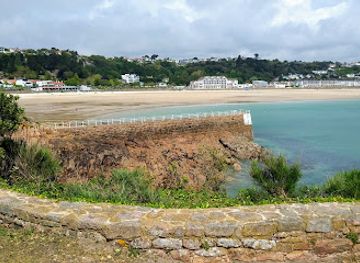
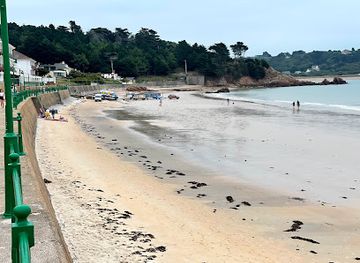
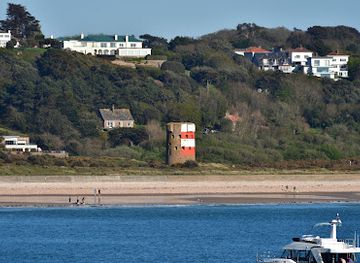
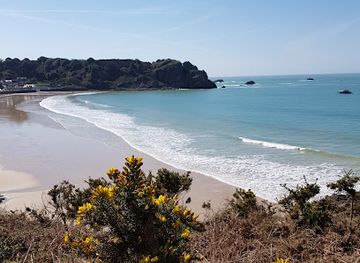
St. Brelade’s Bay curves along Jersey’s south-west coast, where a broad sweep of pale sand meets the clear waters of St. Aubin’s Bay and the English Channel. The beach is framed by rocky headlands, low coastal cliffs and the smaller sandy inlet of Ouaisné Bay at its western end. At low tide, the changing shoreline reveals rock pools and broad stretches of firm sand, while at high tide the beach takes on a more intimate, enclosed character. Conditions vary with the tide, wind and season, so the beach is best understood as a living coastal landscape rather than a fixed recreation ground.Read more about St. Brelade's Bay
Church, Chapel and Coastal Character
Beach Life and Nearby Bases
When is the best time to visit St. Brelade's Bay?
Best: June–August · 21–23°C| Month | High (°C) | Rainfall (mm) |
|---|---|---|
| January | 10 | 90 |
| February | 11 | 80 |
| March | 12 | 70 |
| April | 14 | 60 |
| May | 17 | 50 |
| June (best) | 21 | 40 |
| July (best) | 23 | 30 |
| August (best) | 23 | 30 |
| September | 21 | 50 |
| October | 17 | 60 |
| November | 15 | 70 |
| December | 12 | 80 |
Getting to and around St. Brelade's Bay
How to get there
Transportation
Best attractions in St. Brelade's Bay
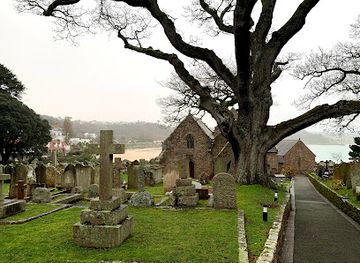
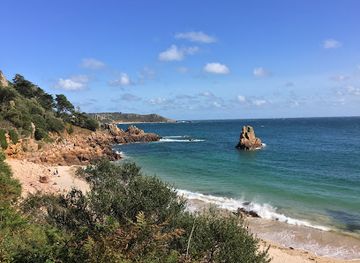
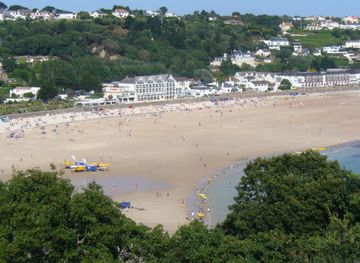
The main attraction is the wide sandy beach itself, whose sheltered south-western position makes it one of Jersey’s best-known coastal bathing and leisure areas when conditions permit. At the eastern end, St. Brelade’s Church and the Fisherman’s Chapel provide a historic counterpoint to the beachfront, with old stone buildings and a churchyard above the shore. Westwards, Ouaisné Bay offers a smaller coastal setting connected with the wider shoreline, while rocky platforms and tide pools become more visible as the sea retreats. Coastal paths and nearby lanes lead towards additional viewpoints and beaches in St. Brelade, although the walk can include slopes and exposed sections. St. Aubin, just beyond the bay, adds a harbour, historic streets, cafés and galleries, and can be combined with the beach as part of a broader south-west Jersey itinerary. The bay is also a useful starting point for exploring the island’s southern and western coastal landscapes by bus, bicycle or car.
-
Tourist attraction
St Brelade's Parish Church
Explore the historic St Brelade's Parish Church, a serene haven on Jersey Island, showcasing stunning architecture and rich cultural heritage.
-
Tourist attraction
Fishermen's Chapel
Discover Fishermen's Chapel - a serene Anglican church by the coast, rich in history, art, and stunning views, perfect for reflection and exploration.
Best landmarks in St. Brelade's Bay
St. Brelade’s Church is the bay’s most important historic landmark, standing above the eastern shore and representing the long religious history of the parish. Beside it, the Fisherman’s Chapel is a small medieval seaside chapel whose position close to the beach creates an unusually direct connection between Jersey’s ecclesiastical heritage and its maritime landscape. The bay itself is a defining natural landmark: a broad arc of sand set between rocky coastal edges, with Ouaisné Bay forming a smaller adjacent inlet. Tidal rock platforms, shallow pools and the surrounding headlands illustrate the continuing influence of the sea on Jersey’s shoreline. The historic harbour of nearby St. Aubin is outside the immediate beach but forms an important companion landmark for visitors exploring this part of the island, linking the bay with Jersey’s coastal settlement and maritime character.
-
Beach
St Brelade's Bay
Discover the enchanting St Brelade's Bay, a picturesque beach in Jersey known for its golden sands, crystal-clear waters, and vibrant coastal atmosphere.
-
Beach
Beauport Beach
Discover the serene beauty of Beauport Beach in Jersey, a perfect destination for relaxation, family fun, and stunning coastal views.
-
Protestant church
St Brelade's Parish Church
Explore the historical charm and serene beauty of St Brelade's Parish Church, a must-visit destination in Jersey for every traveler.
-
Bay
Ouaisné Bay
Experience the tranquility of Ouaisné Bay, a hidden gem on Jersey’s coastline, perfect for relaxation, adventure, and stunning natural beauty.
Explore St. Brelade's Bay on the map
Plan your trip on one map. See where the top attractions, landmarks, restaurants and hotels are, and book hotels and experiences in a few clicks.
Best hotels in St. Brelade's Bay
Get your free copy of our complete guide to St. Brelade's Bay, delivered straight to you.
Everything on this page, from attractions and restaurants to essentials and local phrases, in one PDF you can read offline, print or share.
Already have an account? Sign in
Your St. Brelade's Bay guide is ready.
We'll send it to · Not you? Sign out

Getting your guide ready…
We are putting together a fresh copy of the St. Brelade's Bay guide. This can take up to a minute.
This can take a few moments. If your browser asks, choose Allow so the download can start. You'll find the guide in your Downloads folder.
Nothing happened? Download it again
Sorry, the guide is taking longer than usual. Please try again in a minute, or get it by email instead.
St. Brelade's Bay essentials
Currency and Payment
Safety
Emergency Situations
Do's and Don'ts
Local Tips
From Eve
Local phrases worth knowing
You don't need to get them perfect. A few words go a long way, and locals appreciate the effort.
Basics
| English | Local | Say it |
|---|---|---|
| Hello | Bonjour | [bon-zhoor] |
| Goodbye | Au revoir | [oh re-vwar] |
| Yes | Oui | [wee] |
| No | Non | [nohn] |
| Please/You're welcome | S'il vous plaît / De rien | [seel voo pleh / deh ryen] |
| Thank you | Merci | [mehr-see] |
| Excuse me/Sorry | Excusez-moi / Désolé | [ex-kew-zay mwah / deh-zo-lay] |
| How are you? | Comment ça va? | [koh-mohn sah vah] |
| Fine. And you? | Bien. Et vous? | [byen. eh voo] |
| Do you speak English? | Parlez-vous anglais? | [par-lay voo ahn-glay] |
| I don't understand | Je ne comprends pas | [zhuh nuh kohm-prahnd pah] |
Eating & Drinking
| English | Local | Say it |
|---|---|---|
| I'd like to see the menu, please | Je voudrais voir le menu, s'il vous plaît | [zhuh voo-dray vwahr luh muh-nyuh, seel voo pleh] |
| I don't eat meat | Je ne mange pas de viande | [zhuh nuh mahnj pah duh vee-yahnd] |
| Cheers! | Santé! | [san-tay] |
| I would like to pay, please | Je voudrais payer, s'il vous plaît | [zhuh voo-dray peh-yay, seel voo pleh] |
Emergencies
| English | Local | Say it |
|---|---|---|
| Help! | Au secours! | [oh seh-koor] |
| Go away! | Allez-vous en! | [ah-leh voo zahn] |
| Call the Police! | Appelez la police! | [ah-peh-lay lah poh-lees] |
| Call a doctor! | Appelez un médecin! | [ah-peh-lay uh may-deh-sahn] |
| I'm lost | Je suis perdu | [zhuh swee pehr-doo] |
| I'm ill | Je suis malade | [zhuh swee mah-lahd] |
Shopping
| English | Local | Say it |
|---|---|---|
| I'd like to buy... | Je voudrais acheter... | [zhuh voo-dray zheh-tey...] |
| I'm just looking | Je regarde juste | [zhuh ruh-gahrd zheuhst] |
| How much is it? | Combien ça coûte? | [kohm-byen sah koot] |
| That's too expensive | C'est trop cher | [seh troh sher] |
| Can you lower the price? | Pouvez-vous baisser le prix? | [poo-veh voo beh-say luh pree] |
Time & Numbers
| English | Local | Say it |
|---|---|---|
| What time is it? | Quelle heure est-il? | [kell uhr eh-teel] |
| It's one o'clock | Il est une heure | [eel ehz uhnuhr] |
| Half past (10) | Dix heures et demie | [dees uhr eht duh-mee] |
| Morning | Matin | [ma-tahn] |
| Afternoon | Après-midi | [ah-pray mee-dee] |
| Evening | Soir | [swahr] |
| Yesterday | Hier | [ee-ehr] |
| Today | Aujourd'hui | [oh-zhoor-dwee] |
| Tomorrow | Demain | [duh-mahn] |
| 1 | Un | [uhn] |
| 2 | Deux | [duh] |
| 3 | Trois | [twah] |
| 4 | Quatre | [kah-truh] |
| 5 | Cinq | [sank] |
| 6 | Six | [sees] |
| 7 | Sept | [sept] |
| 8 | Huit | [weet] |
| 9 | Neuf | [nuff] |
| 10 | Dix | [dees] |
Transport & Directions
| English | Local | Say it |
|---|---|---|
| Where's a/the...? | Où est...? | [oo eh...] |
| What's the address? | Quelle est l'adresse? | [kell eh la-dress] |
| Can you show me (on the map)? | Pouvez-vous me montrer (sur la carte)? | [poo-veh voo muh mohn-tray (soor lah kart)] |
| When's the next (bus)? | Quand est le prochain (bus)? | [kahnd eh luh proh-shahn (boos)] |
| A ticket (to ....) | Un billet (pour ....) | [uhn bee-yay (poor)] |
History of St. Brelade's Bay
A Coast Shaped by Sea and Ice
The landscape around St. Brelade’s Bay reflects the long geological history of Jersey and the action of the sea on resistant coastal rock. Successive changes in sea level, together with erosion and the movement of water around the island’s southern headlands, helped form the coves, rocky platforms and sandy shore visible today. The beach’s shape is continually modified by tides, storms and sediment movement. These natural processes explain the contrast between the wide central sands, rocky edges and smaller neighbouring inlets such as Ouaisné Bay.
Medieval Religious Heritage
St. Brelade’s Church and the adjoining Fisherman’s Chapel are the principal historical reminders of the parish’s medieval past. The church occupies a prominent position above the bay, while the small chapel close to the shore reflects the importance of Christianity and coastal communities in Jersey’s earlier history. The surviving buildings were altered over time, as was common with island churches, but their setting preserves a direct relationship between parish life, the sea and the settlement of the surrounding countryside. The churchyard also contributes to the historic character of the bay’s eastern side.
From Working Coast to Seaside Resort
For centuries, Jersey’s south-western coast supported fishing, small-scale agriculture and movement between coastal communities, while the beach and coves provided practical access to the sea. From the nineteenth century onwards, improved travel links and the growth of seaside tourism changed the character of St. Brelade’s Bay. The broad sand, relatively sheltered aspect and proximity to St. Helier made it increasingly attractive for bathing and leisure. Hotels, seasonal facilities and roads gradually developed around the shore, while the historic church and chapel remained as reminders of the older parish landscape.
A Managed Coastal Landscape
Modern St. Brelade’s Bay is both a popular recreational beach and a sensitive coastal environment. Its sands, foreshore and surrounding paths are influenced by tides, weather, erosion and the pressure of seasonal visits. Management of access, beach facilities and public safety has therefore become part of the bay’s contemporary history, alongside the protection of Jersey’s historic buildings and coastal character. The area now belongs to a wider network of beaches, cliffs, harbours and footpaths through which visitors encounter the island’s natural and cultural heritage.
St. Brelade's Bay in Photos
Browse through our photo collection highlighting the charm and character of the destination.
Neighbouring destination travel guides
The closest destinations to St. Brelade's Bay, if you have time for more than one.
-

-

-

-

-


Swipe for more destinations
Explore more
Explore more of Saint Brélade
Discover Saint Brélade in Jersey: A seaside paradise with golden beaches, rich history, and outdoor adventures, perfect for a relaxing and enriching holiday.
Explore Saint Brélade
Explore more of Jersey
Discover the charm of Jersey, the largest Channel Island, with its stunning landscapes, rich history, and a delightful blend of British and French cultures.
Explore Jersey