

Free Tinian Travel Guide & Mobile App
Explore Tinian with free travel guides. Discover regional history, expert tips, proposed trips, and audio guides on web or mobile app.


Explore Tinian in the Northern Mariana Islands for Chamorro heritage, Second World War history, limestone coastlines and uncrowded island roads.
Read more about Tinian
When is the best time to visit Tinian?
Best: January–March · 30°C| Month | High (°C) | Rainfall (mm) |
|---|---|---|
| January (best) | 30 | 100 |
| February (best) | 30 | 80 |
| March (best) | 30 | 95 |
| April | 31 | 105 |
| May | 31 | 125 |
| June | 31 | 175 |
| July | 31 | 200 |
| August | 31 | 215 |
| September | 31 | 205 |
| October | 31 | 185 |
| November | 30 | 135 |
| December | 30 | 115 |
Getting to and around Tinian
How to get there
Transportation
Destinations in Tinian
Resorts, valleys and scenic spots worth a trip of their own.
-
-


Swipe for more destinations
Best attractions in Tinian
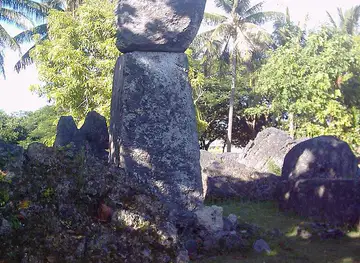
Tinian's attractions are spread across a compact but largely open island, with history and landscape closely connected. The House of Taga is the principal archaeological site, presenting monumental latte stones associated with ancestral Chamorro settlement and chiefly authority. In the north, North Field offers an extensive Second World War landscape of runways, airfield remains and the atomic-bomb loading pits used before the 1945 missions. Coastal exploration adds a different dimension: Taga Beach, Long Beach and other reef-fringed areas offer opportunities for swimming, snorkelling, fishing and picnicking when sea conditions are favourable. The Tinian Blowhole is a natural limestone feature whose spray depends on swell and tide. Roads through the interior pass through scrub, woodland and former agricultural or military land, allowing visitors to see how plantation and wartime development altered the island. Tinian is not a resort island with a dense programme of ticketed attractions; its appeal lies in combining Indigenous heritage, globally significant war history and quiet Pacific shorelines at a manageable scale.
-
Tourist attraction
Bird Island Observatory
Explore the stunning Bird Island Observatory in Saipan, a paradise for birdwatching and nature appreciation in the Northern Mariana Islands.
-
Tourist attraction
Taga Beach
Discover the tranquil beauty of Taga Beach, a pristine public beach in Tinian, where golden sands meet crystal-clear waters in a serene tropical paradise.
-
Observation deck
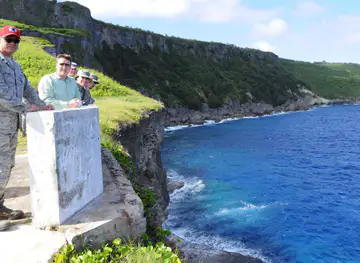
Forbidden Island Lookout
Discover stunning vistas and natural beauty at Forbidden Island Lookout, the premier observation deck in Saipan's tropical paradise.
-
Tourist attraction
House of Taga
Discover the House of Taga in Tinian, a historical gem showcasing ancient Chamorro culture through its stunning latte stone structures.


Best landmarks in Tinian
The House of Taga is Tinian's defining archaeological landmark, with tall latte stones that express the engineering, social organisation and ceremonial traditions of the ancient Chamorro world. North Field is the island's most consequential modern landmark: its runways and surviving structures reveal the extraordinary scale of the 1944–45 American air base, while the atomic-bomb loading pits mark the point from which the weapons used at Hiroshima and Nagasaki were prepared for departure. The Tinian Blowhole provides a natural counterpoint to these human histories, showing the force of the Pacific against the island's raised limestone coast. Taga Beach is also visually significant, combining a broad shore with reef-fringed water and associations with the island's traditional landscape. Around San Jose Village, churches and civic buildings reflect the continuing life of a small Chamorro community, although the island's most powerful landmarks remain the archaeological, military and coastal features encountered beyond the settled centre.
-
Public beach
Taga Beach
Discover Taga Beach, a serene public beach in Tinian known for its stunning views, clear waters, and rich cultural heritage, perfect for sunbathing and snorkeling.
-
Historical place
House of Taga
Explore the House of Taga, a historical treasure in Tinian that showcases the iconic remnants of ancient Chamorro culture and architecture.
-
Public beach
Chulu Beach
Discover tranquility at Chulu Beach on Tinian Island, a stunning public beach perfect for relaxation, water activities, and breathtaking coastal views.
-
Historical landmark
No 1 Bomb Loading Pit
Explore the No 1 Bomb Loading Pit on Tinian Island, a vital historical landmark that reveals the untold stories of World War II.


Explore Tinian on the map
Plan your trip on one map. See where the top cities, national parks and sights are, and book hotels and experiences in a few clicks.
Best hotels in Tinian
Best restaurants in Tinian
Dining on Tinian is small-scale and practical rather than restaurant-led, with the main choice concentrated around San Jose Village and local accommodation. Visitors can expect Chamorro and broader Pacific-influenced food, rice-based meals, grilled meat or seafood, noodles, soups and simple family-style cooking, alongside familiar American options. Fresh seafood may appear according to local supply and weather, while imported provisions shape much of everyday island dining. Small eateries and takeaways are useful for informal meals, but opening arrangements and menus can change, so accommodation staff are often the best source of current information. There are no extensive food quarters or supermarket choices comparable with a large mainland town. Travellers exploring North Field or remote beaches should carry water and snacks, and those with dietary requirements should bring suitable supplies or confirm options in advance. Eating locally is less about a formal gastronomic scene than about understanding the limited logistics and community scale of life on a remote Northern Mariana island.
-
Restaurant
Surf Club Saipan Restaurant
Experience fresh seafood and local flavors at Surf Club Saipan Restaurant with stunning ocean views in Northern Mariana Islands.
-
Cafe
The Shack, Saipan
Discover The Shack in Saipan - where delicious meals meet stunning views in a cozy café atmosphere perfect for tourists.
-
Restaurant
Yewon Restaurant
Discover authentic flavors at Yewon Restaurant in Saipan, where fresh ingredients meet exquisite culinary traditions.
-
Italian
The Angry Penne
Experience authentic Italian cuisine at The Angry Penne in Saipan – where each dish tells a delicious story.


Best bars in Tinian
Tinian does not have a substantial nightclub circuit, and evening life is centred on small local bars, casual restaurants, hotel-based social spaces and private gatherings rather than late-night entertainment districts. San Jose Village is the most practical area for finding an evening meal or a drink, although venues and opening arrangements can change and should be checked locally. The atmosphere is generally low-key; visitors may encounter local conversation, televised sport or occasional music rather than a programmed nightlife scene. Because the island is quiet and roads beyond the village are dark, arranging a safe return to accommodation is important. A more active choice of bars, restaurants and entertainment is available on neighbouring Saipan, but it is outside Tinian and requires separate transport planning. Tinian's evenings are better suited to unhurried dinners, stargazing and listening to the island's night sounds than to clubbing.
-
Restaurant
Surf Club Saipan Restaurant
Experience delicious local cuisine and stunning ocean views at Surf Club Saipan, the perfect dining spot for tourists in the Northern Mariana Islands.
-
Bar
Godfather's Bar
Discover the vibrant nightlife of Saipan at Godfather's Bar, where live music and refreshing drinks create unforgettable memories.
-
Grill
AB Wild Bill's Bar & Grill
Discover a culinary haven at AB Wild Bill's Bar & Grill, where American, Asian, and Mexican flavors meet in a vibrant atmosphere in Saipan.
-
Grill
Oleai Beach Bar & Grill
Experience the best of Saipan at Oleai Beach Bar & Grill, where delicious grilled cuisine meets stunning ocean views and a vibrant island atmosphere.


Best nightclubs in Tinian
Tinian does not have a substantial nightclub circuit, and evening life is centred on small local bars, casual restaurants, hotel-based social spaces and private gatherings rather than late-night entertainment districts. San Jose Village is the most practical area for finding an evening meal or a drink, although venues and opening arrangements can change and should be checked locally. The atmosphere is generally low-key; visitors may encounter local conversation, televised sport or occasional music rather than a programmed nightlife scene. Because the island is quiet and roads beyond the village are dark, arranging a safe return to accommodation is important. A more active choice of bars, restaurants and entertainment is available on neighbouring Saipan, but it is outside Tinian and requires separate transport planning. Tinian's evenings are better suited to unhurried dinners, stargazing and listening to the island's night sounds than to clubbing.
-
Restaurant
Surf Club Saipan Restaurant
Experience the flavors of Saipan at Surf Club Saipan, where fresh ingredients meet stunning ocean views in a vibrant dining atmosphere.
-
Bar
Godfather's Bar
Experience the vibrant nightlife at Godfather's Bar in Saipan, a hotspot for live music, delicious drinks, and unforgettable social gatherings.
-
Grill
True North Bar And Grill
Discover the vibrant flavors of Saipan at True North Bar And Grill, where local cuisine meets a lively atmosphere in the heart of Garapan.
-
Western
Bar-K Diner & Dine-In
Experience delightful Western cuisine at Bar-K Diner & Dine-In in Tinian, where great flavors meet a warm, inviting atmosphere.


Best shops in Tinian
Shopping on Tinian is limited and functional, with small stores and locally oriented outlets concentrated around San Jose Village rather than a dedicated retail district. Visitors may find basic provisions, drinks, toiletries and everyday necessities, but should not expect the range of specialist shops available on Saipan. Local products, snacks and small souvenirs may be available through individual businesses or accommodation providers, while crafts and artworks should be purchased respectfully and with attention to their materials and provenance. The island's most meaningful souvenirs are often connected to its landscape and history, such as locally produced food items or modest commemorative goods, rather than luxury retail. Bring specialist equipment, substantial outdoor supplies and prescription medicines from a larger centre whenever possible. Saipan is the practical neighbouring destination for broader shopping, but it is outside Tinian and requires separate travel arrangements.
-
Souvenir store
I Love Saipan
Discover the essence of Saipan at I Love Saipan, your ultimate destination for unique souvenirs and local treasures.
-
Grocery store
JOETEN HAFA ADAI SHOPPING CENTER
Experience the vibrant JOETEN HAFA ADAI SHOPPING CENTER in Saipan for local products, delicious dining, and a taste of the island's culture.
-
Warehouse store
Joeten Superstore
Discover a diverse selection of goods at Joeten Superstore in Saipan, from local delicacies to household essentials, all at competitive prices.
-
Outlet store
I Love Saipan Outlet Store, Middle Road
Explore unbeatable deals on clothing, furniture, and home goods at I Love Saipan Outlet Store, your ultimate shopping destination in Saipan.


Get your free copy of our complete guide to Tinian, delivered straight to you.
Everything on this page, from attractions and restaurants to essentials and local phrases, in one PDF you can read offline, print or share.
Already have an account? Sign in
Your Tinian guide is ready.
We'll send it to · Not you? Sign out

Getting your guide ready…
We are putting together a fresh copy of the Tinian guide. This can take up to a minute.
This can take a few moments. If your browser asks, choose Allow so the download can start. You'll find the guide in your Downloads folder.
Nothing happened? Download it again
Sorry, the guide is taking longer than usual. Please try again in a minute, or get it by email instead.
Tinian essentials
Currency and Payment
Safety
Emergency Situations
Do's and Don'ts
Local Tips
From Eve
Local phrases worth knowing
You don't need to get them perfect. A few words go a long way, and locals appreciate the effort.
Basics
| English | Local | Say it |
|---|---|---|
| Hello | Hafa adai | [Hah-fah ah-dah-ee] |
| Goodbye | Adios | [Ah-dee-os] |
| Yes | Si | [See] |
| No | Ahe | [Ah-heh] |
| Please/You're welcome | Si yu'us ma'ase | [See yoo-us mah-ah-seh] |
| Thank you | Si yu'us ma'ase | [See yoo-us mah-ah-seh] |
| Excuse me/Sorry | Dispensa | [Dees-pen-sah] |
| How are you? | Kumusta? | [Koo-moos-tah] |
| Fine. And you? | Maulek. Hafa hao? | [Mau-lek. Hah-fah how?] |
| Do you speak English? | Hu guahu na' tiningo English? | [Hoo goo-ah-hoo nah tee-ning-o English?] |
| I don't understand | Ti hu na' fan maolek | [Tee hoo nah fan mah-oh-lek] |
Eating & Drinking
| English | Local | Say it |
|---|---|---|
| I'd like to see the menu, please | Hu guaiya na' ufan gi menu, si yu'us | [Hoo gwai-yah nah oo-fan gee meh-noo, see yoo-us] |
| I don't eat meat | Ti hu na' chi' na' tiningo | [Tee hoo nah chee nah tee-ning-o] |
| Cheers! | Salud! | [Sah-lud] |
| I would like to pay, please | Hu guaiya na' ufan gi chumo', si yu'us | [Hoo gwai-yah nah oo-fan gee cho-mo', see yoo-us] |
Emergencies
| English | Local | Say it |
|---|---|---|
| Help! | Help! | [Help!] |
| Go away! | Dai todo! | [Dai toh-doh!] |
| Call the Police! | Fana' i Police! | [Fah-nah ee Poh-lees!] |
| Call a doctor! | Fana' i doktor! | [Fah-nah ee dok-tor!] |
| I'm lost | Hu na' fan maolek | [Hoo nah fan mah-oh-lek] |
| I'm ill | Hu na' fan maolek | [Hoo nah fan mah-oh-lek] |
Shopping
| English | Local | Say it |
|---|---|---|
| I'd like to buy... | Hu guaiya na' ma' para... | [Hoo gwai-yah nah mah pah-rah...] |
| I'm just looking | Hu na' guaiya na' fan | [Hoo nah gwai-yah nah fan] |
| How much is it? | Hafa ginen? | [Hah-fah gee-nen?] |
| That's too expensive | Sao' ni' manmaolek | [Sow nee man-mah-oh-lek] |
| Can you lower the price? | Hu na' siha na' fan ginen? | [Hoo nah see-hah nah fan gee-nen?] |
Time & Numbers
| English | Local | Say it |
|---|---|---|
| What time is it? | Hafa tiempo? | [Hah-fah tee-em-poh?] |
| It's one o'clock | Uno na tiempo | [Oo-no nah tee-em-poh] |
| Half past (10) | Medio na (10) | [Meh-dee-oh nah (10)] |
| Morning | Mañana | [Mah-nyah-nah] |
| Afternoon | Pausa | [Pah-oo-sah] |
| Evening | Noche | [Noh-cheh] |
| Yesterday | I cha'lao | [Ee chah-lah-oh] |
| Today | I na' cha'lao | [Ee nah chah-lah-oh] |
| Tomorrow | I ma' cha'lao | [Ee mah chah-lah-oh] |
| 1 | Uno | [Oo-no] |
| 2 | Dos | [Dohs] |
| 3 | Tres | [Tress] |
| 4 | Cuatro | [Kwah-troh] |
| 5 | Cinco | [Seen-koh] |
| 6 | Seis | [Says] |
| 7 | Siete | [See-eh-teh] |
| 8 | Ocho | [Oh-cho] |
| 9 | Nueve | [Nweh-veh] |
| 10 | Diez | [Dyeh] |
Transport & Directions
| English | Local | Say it |
|---|---|---|
| Where's a/the...? | Hafa gi...? | [Hah-fah gee...?] |
| What's the address? | Hafa i direccion? | [Hah-fah ee dee-rek-syon?] |
| Can you show me (on the map)? | Hu na' siha na' fan i mapa? | [Hoo nah see-hah nah fan ee mah-pah?] |
| When's the next (bus)? | Hafa tiempo i mas kinu (bus)? | [Hah-fah tee-em-poh ee mahs kee-noo (bus)?] |
| A ticket (to ....) | Un billete (para....) | [Oon bee-yeh-teh (pah-rah....)] |
History of Tinian
Ancient Chamorro Settlement and Latte Culture
Tinian has been inhabited by the ancestral Chamorro people for many centuries. Traditional communities built homes and other structures on latte stones, paired pillars of coral limestone or volcanic stone supporting capstones. The House of Taga site preserves some of the most imposing examples on the island and is associated with chiefly authority in local tradition. Archaeological evidence across Tinian also reflects maritime exchange, farming and settlement patterns shared with other islands of the Marianas. These remains are not merely scenic ruins: they provide evidence of a complex Indigenous society adapted to a small tropical island before European colonisation.
Spanish Rule and Mission Influence
Spanish authority reached the Marianas in the seventeenth century, following earlier European voyages and the establishment of a permanent colonial presence on nearby Guam. Missionisation, introduced diseases, forced relocations and colonial administration profoundly affected Chamorro communities throughout the archipelago, including Tinian. Population decline and changes in settlement patterns altered the island's traditional social landscape. Catholic influence became an enduring part of Chamorro life, although Indigenous language, kinship and cultural practices continued to shape local identity through later political administrations.
German Administration and the Early Twentieth Century
After the Spanish-American War, Spain sold the remaining Northern Mariana Islands to Germany in 1899. German administration was relatively brief, ending when Japan occupied the islands during the First World War. The period forms part of Tinian's longer transition from Indigenous island society to a territory governed and economically organised by outside powers. Its importance is visible less through surviving German buildings than through the sequence of colonial changes that prepared the Marianas for the commercial and strategic transformations of the twentieth century.
Japanese Mandate and the Sugar Industry
Japan administered Tinian under a League of Nations mandate after the First World War. Japanese investment transformed the island through the Nan'yō Kōhatsu Kaisha and a large sugar-growing and processing operation. Workers and settlers arrived from other parts of the Japanese empire, while Chamorro residents experienced major changes in land use, employment and population. Roads, plantation infrastructure and settlement patterns developed around sugar production. Much of this industrial landscape was later destroyed or overlaid by wartime construction, but the plantation era remains an important chapter in Tinian's modern economic history.
The Battle of Tinian, 1944
United States forces invaded Tinian in July 1944 after securing nearby Saipan. Fighting continued for several weeks, with Japanese defenders using caves, ravines and fortified positions across the island. The battle caused extensive destruction and civilian suffering, and Japanese resistance ended in early August. Military engineers subsequently converted the island into a major air base. The wartime landscape that visitors see today therefore combines traces of the battle with the enormous construction programme that followed, rather than representing a single preserved historical period.
North Field and the Atomic Missions
North Field became one of the largest air bases of the Second World War and the operational centre for the 509th Composite Group's atomic missions. In August 1945, B-29 aircraft departed Tinian for the bombings of Hiroshima and Nagasaki; the weapons were assembled and loaded in specially constructed facilities on the island. The historic loading pits, runways and associated remains form a place of major global significance. They should be understood within the wider history of the war, the Pacific campaign and the human consequences of nuclear weapons.
Postwar Commonwealth Island
After the war, Tinian's military role diminished and the island became part of the United Nations Trust Territory of the Pacific Islands administered by the United States. The Northern Mariana Islands later entered into a political union with the United States through the Covenant, effective in 1986, becoming a US commonwealth. Tinian today combines Chamorro heritage, American political and infrastructural connections, a small local community and a landscape still marked by wartime remains. Its contemporary identity is therefore shaped by both island continuity and successive external administrations.
Tinian in Photos
Browse through our photo collection highlighting the charm and character of the destination.
Neighbouring regions of Tinian
The closest regions to Tinian, if you have time for more than one.
-

-


Swipe for more regions
Explore more

Explore more of Northern Mariana Islands
Uncover the beauty of Northern Mariana Islands, a tropical paradise with stunning beaches, rich history, and diverse cultures, perfect for a serene and adventurous getaway.
Explore Northern Mariana Islands