Apollo Fountain, Madrid Travel Guide
Free Guide: Apollo Fountain rises boldly in Paseo del Prado, where sun god battles darkness amid four seasons' stone embrace, channeling 18th-century Baroque power in Madrid's enlightened promenade.


A brief summary of Apollo Fountain
Apollo Fountain rises boldly in Paseo del Prado, where sun god battles darkness amid four seasons' stone embrace, channeling 18th-century Baroque power in Madrid's enlightened promenade.
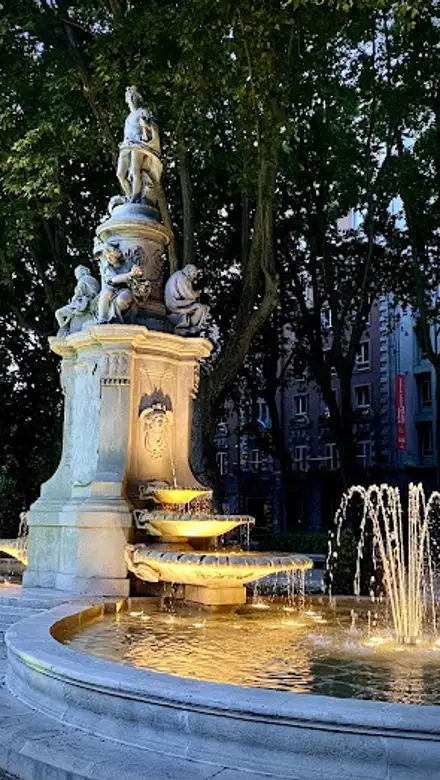
In the heart of Madrid's Paseo del Prado, the Apollo Fountain captivates with its dynamic sculpture of the sun god Apollo rising from the chariot, surrounded by the allegorical figures of Spring, Summer, Autumn, and Winter. This 17th-century Baroque masterpiece, designed by Pedro Calderón de la Barca and sculpted by Giovan Battista Maini, harmonizes water, stone, and mythology amid the city's grand cultural axis. A symbol of artistic ambition, it invites contemplation of time's eternal cycle beneath Madrid's vibrant skies.
On-site amenities
 Restrooms
 Seating areas
 Sheltered areas
 Trash bins
 Information boards
Opening hours
- Every day12 am–12 am
Opening hours as listed on the venue’s Google Business Profile. Hours can change for services and special events, so check with the venue before you go.
- Address
- P.º del Prado, s/n, Centro, 28014 Madrid
- Website
Getting there
Metro
Bus
Walking
Taxi
Discover more about Apollo Fountain
Historical Origins and Royal Vision
The Apollo Fountain, also known as the Fountain of the Four Seasons, emerged from the ambitious vision of Spain's Bourbon monarchs in the mid-18th century. Commissioned as part of King Ferdinand VI's urban renewal of Paseo del Prado, it was conceived by Italian architect Giovanni Battista Sacchetti in 1747. The fountain's literary inspiration traces to Pedro Calderón de la Barca's play 'Eco y Narciso,' where Apollo embodies the sun's triumphant ascent. Sculptor Giovan Battista Maini crafted the central bronze figure of Apollo, dynamically leaping from his chariot pulled by Dawn, symbolizing the dawn of a new era for Madrid's artistic landscape.
Artistic Elements and Symbolism
At its core, Apollo stands nude and vigorous, bow drawn against Python, the serpent of darkness, flanked by allegories of the seasons on the pedestal. Spring appears as a blooming maiden with flowers, Summer as a mature woman with wheat sheaves, Autumn with grapes and harvest tools, and Winter as an aged figure huddled against cold. Water jets from tritons and sea creatures enhance the motion, while the granite basin reflects intricate carvings of marine motifs. This Baroque composition masterfully blends movement, mythology, and natural cycles, reflecting Enlightenment ideals of harmony between art and nature.
Architectural Integration and Surroundings
Perfectly positioned opposite the Prado Museum and Neptune Fountain, Apollo anchors the Paseo del Prado's monumental axis, declared a UNESCO World Heritage site in 2021 as 'Paisaje de la Luz' (Landscape of Light). The fountain's tiered design escalates the visual drama, drawing the eye upward to Apollo's poised triumph. Flanked by manicured gardens and neoclassical facades, it forms a theatrical stage where water's murmur complements the promenade's lively rhythm, connecting Retiro Park to Plaza de Cibeles.
Cultural Significance and Artistic Legacy
As one of Madrid's oldest fountains, Apollo exemplifies the Italianate influence on Spanish Baroque sculpture, bridging Renaissance humanism with Rococo exuberance. Restored multiple times, including major interventions in the 20th century, it endures as a testament to craftsmanship amid urban evolution. Its presence elevates everyday strolls into encounters with classical mythology, inspiring poets, painters, and photographers who capture its interplay of light and spray.
Visitor Experience and Atmosphere
Visitors encounter a timeless scene: sunlight gilding Apollo's bronze form, seasonal figures evoking life's progression, and cascading water creating rainbows on breezy days. The fountain's open accessibility fosters spontaneous gatherings, from tourists photographing its grandeur to locals pausing in reflection. Evenings transform it into a luminous beacon, its waters shimmering under streetlamps, blending serenity with the pulse of Madrid's cultural heart.
Evendo Review Centre
 Google
Guest reviews
Best time to go
Quietest: Jan, Feb & Mar · at 1am or at 2am or at 3am
Busy times are Evendo estimates for a typical year, to help you plan. Actual crowds vary with events, school holidays and the weather.
Explore Apollo Fountain on the map
A handpicked selection of must-see spots near Apollo Fountain, mapped for you.
Get your free copy of our complete guide to Apollo Fountain, delivered straight to you.
Everything on this page, from opening hours and how to get there to Eve’s tips and the best time to go, in one PDF you can read offline, print or share.
Already have an account? Sign in
Your Apollo Fountain guide is ready.
We'll send it to · Not you? Sign out

Getting your guide ready…
We are putting together a fresh copy of the Apollo Fountain guide. This can take up to a minute.
This can take a few moments. If your browser asks, choose Allow so the download can start. You'll find the guide in your Downloads folder.
Nothing happened? Download it again
Sorry, the guide is taking longer than usual. Please try again in a minute, or get it by email instead.
Unlock the best of Apollo Fountain
Skip-the-line tickets, guided tours with entry, and walking tours of the area, booked in a few clicks.

Other nearby places you may find interesting
The closest places of the same kind, if this one is not quite what you had in mind.
-
-
-
-
-


Swipe for more places
More to explore near Apollo Fountain

 Best experiences near Apollo Fountain

 Best hotels near Apollo Fountain

 Best landmarks near Apollo Fountain

 Best attractions near Apollo Fountain

 Best shops near Apollo Fountain

 Best restaurants near Apollo Fountain

 Best bars near Apollo Fountain
Do you manage this location?
Take control to get all the benefits, like improved information, better appearance, and stronger visibility across AI-powered discovery.
Explore more

Explore more of Madrid
Discover Madrid: A city of art, culture, and culinary delights, where history and modern vibrancy meet in the heart of Spain.
Explore Madrid
Explore more of Spain
Discover Spain: A vibrant tapestry of culture, history, and breathtaking landscapes, where every city offers a unique adventure and unforgettable experiences.
Explore Spain