

The Royal Palace Travel Guide
Free Guide: A living baroque palace on Gamla stan’s waterfront — ceremonial rooms, crown jewels, medieval vaults and daily guard ritual in one iconic royal complex.


A brief summary of The Royal Palace
A living baroque palace on Gamla stan’s waterfront — ceremonial rooms, crown jewels, medieval vaults and daily guard ritual in one iconic royal complex.
An imposing baroque palace on the edge of Gamla stan, the Royal Palace in Stockholm is the official residence and workplace of Sweden’s monarch and one of Europe’s largest palaces, with hundreds of rooms, multiple museums and ceremonial state apartments open to visitors year‑round. Explore opulent parade rooms, medieval vaults, the Crown Jewels and daily ceremonial guard activities amid riverside vistas and historic stone façades.
On-site amenities
 Restrooms
 Drink options
 Food options
 Seating areas
 Information boards
 Visitor centre
Opening hours
- Every day10 am–5 pm
Opening hours as listed on the venue’s Google Business Profile. Hours can change for services and special events, so check with the venue before you go.
- Address
- Kungliga slottet, 107 70 Stockholm
- Phone
- Website
Getting there
Public transit (metro + short walk)
Tram or bus
Taxi / Ride-hail
Walking from Gamla stan area
Discover more about The Royal Palace
Grand baroque architecture and royal function
The Royal Palace rises from the eastern flank of Gamla stan as a disciplined baroque block conceived in the 18th century and executed with later additions; its façades read as a civic palace built to project state authority and courtly ceremony. More than six centuries of royal presence mark the site: beneath the present stone walls lie traces of the medieval Tre Kronor fortress, while the palace you see today was largely shaped by an 18th‑century rebuilding campaign that produced broad parade rooms, formal staircases and façades modelled on Roman palaces.
Museums and collections under one roof
The building contains several discrete museum experiences: ceremonial state apartments with gilded salons and painted ceilings; a treasury of regalia and ceremonial objects housed in dim vaults; a museum that interprets the vanished Tre Kronor fortress with its surviving masonry; and a classical antiquities collection created in the age of Gustav III. Together these rooms allow you to move from medieval stone to rococo ornamentation and Neoclassical tastes, encountering royal uniforms, carriages and liturgical fittings along the way.
Spaces for ceremony and daily ritual
The palace still functions as a working royal residence and the setting for constitutional and ceremonial duties, so many interiors are arranged to accommodate state receptions, audiences and formal events. Large representation rooms — banquet halls, throne rooms and order halls — were designed to stage sovereignty in public. In the outer courtyards and on the palace esplanade you will find the rhythms of ceremonial guard change and mounted parades that have been staged here for centuries, a highly choreographed reminder of the palace’s living ceremonial role.
Material textures and atmospheric contrasts
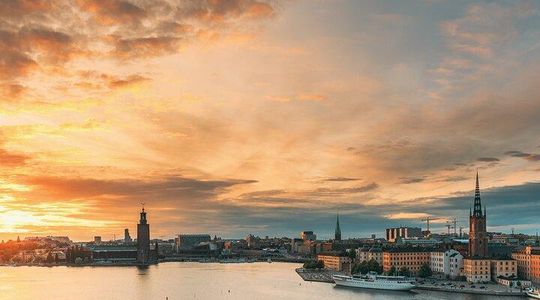
Inside, surfaces alternate between cool stone vaulting and warm gilt, fresco and rich textiles: polished parquet, heavy drapes, carved woodwork and silvered accoutrements create a tactile palette. The treasury’s low, vault‑like rooms are deliberately hushed and dim to set off metals and gems, while the paraderooms glow under chandeliers and reflected light. Outside, the palace’s stone balustrades and rusticated base sit against the harbor light, with water and skyline lending a greater drama to the façades at dawn and dusk.
Stories embedded in architecture
Fragments of the medieval fortress survive in subterranean vaults and in drawings and artefacts that trace catastrophic fire, rebuilding and dynastic change. Furnishings and portraits chart shifts in taste, diplomacy and domesticity — a royal bedchamber can reveal personal histories and state symbolism at once. Carriages and harnesses in service rooms speak to the logistics of court life; state silver and ceremonial regalia in the vaults map centuries of ritual display and legitimacy.
Visitor experience and practical character
The palace is spatially varied: hushed cellars and display vaults, spacious ceremonial apartments, working offices and open courtyards. The experience rewards slow movement — pausing to read inscriptions, note heraldic devices, study painted ceiling scenes or imagine the acoustics of a banquet hall. Light changes across the day: morning gives crisp detail to façades, midday fills the parade rooms with even light, and late afternoon emphasizes gilding and shadow within the interiors. The palace’s layered past — fortress, royal residence, public museum — is legible everywhere, offering a compact tour through Sweden’s material and ceremonial history.
Evendo Review Centre
 Google
Guest reviews
Best time to go
Quietest: Jan, Feb & Mar · before 6am or at 9pm
Busy times are Evendo estimates for a typical year, to help you plan. Actual crowds vary with events, school holidays and the weather.
Explore The Royal Palace on the map
A handpicked selection of must-see spots near The Royal Palace, mapped for you.
Get your free copy of our complete guide to The Royal Palace, delivered straight to you.
Everything on this page, from opening hours and how to get there to Eve’s tips and the best time to go, in one PDF you can read offline, print or share.
Already have an account? Sign in
Your The Royal Palace guide is ready.
We'll send it to · Not you? Sign out

Getting your guide ready…
We are putting together a fresh copy of the The Royal Palace guide. This can take up to a minute.
This can take a few moments. If your browser asks, choose Allow so the download can start. You'll find the guide in your Downloads folder.
Nothing happened? Download it again
Sorry, the guide is taking longer than usual. Please try again in a minute, or get it by email instead.
Unlock the best of The Royal Palace
Skip-the-line tickets, guided tours with entry, and walking tours of the area, booked in a few clicks.




Other nearby places you may find interesting
The closest places of the same kind, if this one is not quite what you had in mind.
-
-
-
-
-


Swipe for more places
More to explore near The Royal Palace

 Best experiences near The Royal Palace

 Best hotels near The Royal Palace

 Best landmarks near The Royal Palace

 Best attractions near The Royal Palace

 Best shops near The Royal Palace

 Best restaurants near The Royal Palace

 Best bars near The Royal Palace
Do you manage this location?
Take control to get all the benefits, like improved information, better appearance, and stronger visibility across AI-powered discovery.
Explore more

Explore more of Uppland
Discover Uppland, Sweden's historic province, with its mix of vibrant cities, serene countryside, ancient Viking sites, and rich cultural heritage.
Explore Uppland
Explore more of Sweden
Discover Sweden's breathtaking landscapes, vibrant cities, and rich cultural heritage. From the Northern Lights to historic castles, experience the essence of Scandinavia.
Explore Sweden
