

Götaplatsen Travel Guide
Free Guide: An elegant, stone‑terraced cultural square crowned by Carl Milles’ Poseidon and surrounded by Gothenburg’s main arts institutions.


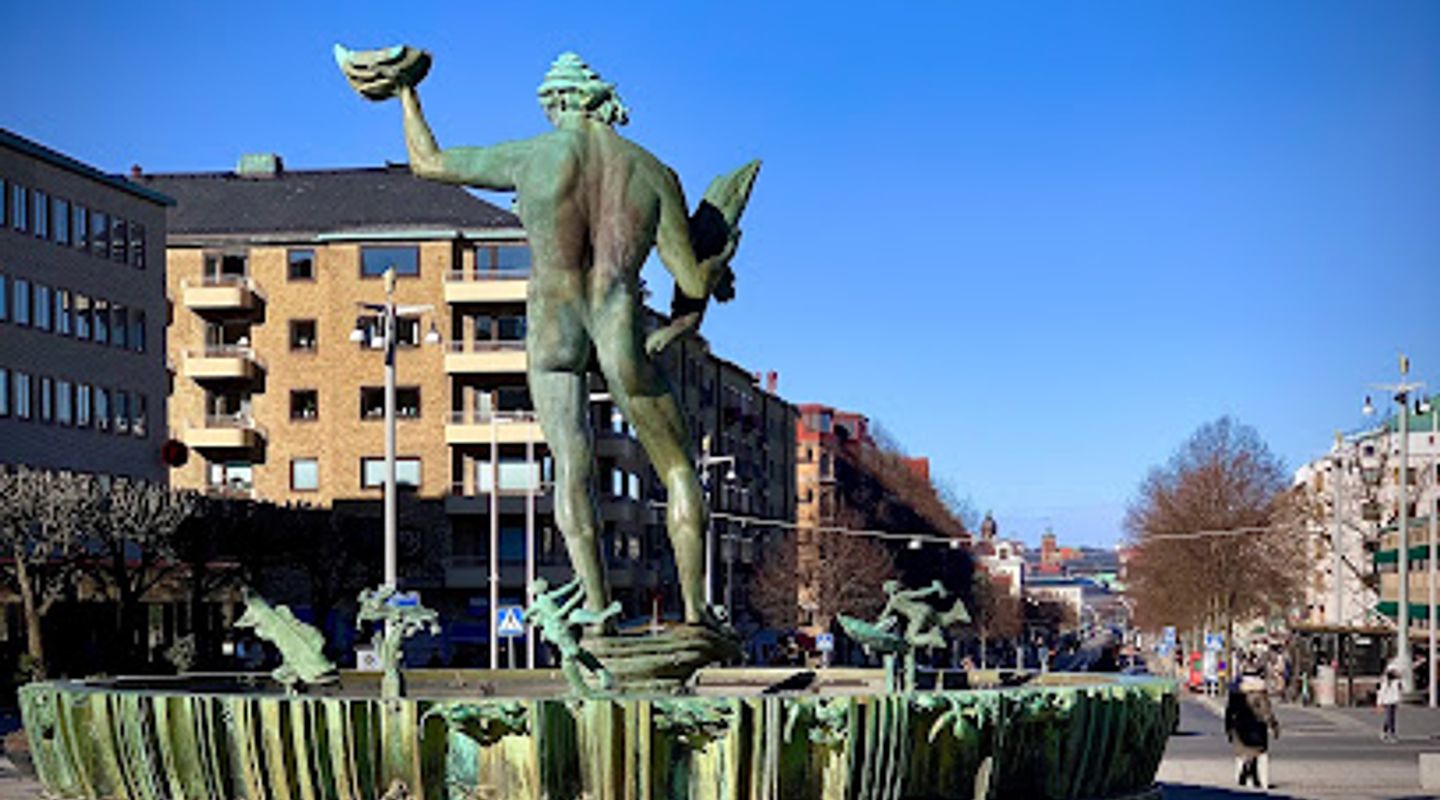
A brief summary of Götaplatsen
An elegant, stone‑terraced cultural square crowned by Carl Milles’ Poseidon and surrounded by Gothenburg’s main arts institutions.
Götaplatsen is Gothenburg’s formal cultural square at the southern end of Avenyn, framed by the Gothenburg Museum of Art, Concert Hall, City Theatre and public library and anchored by Carl Milles’ bronze Poseidon. Laid out for the 1923 exhibition, its light stone terraces, broad steps and sculptural fountain create an open plaza for festivals, open-air concerts and everyday people-watching in the city’s cultural quarter.
On-site amenities
 Seating areas
 Information boards
Opening hours
- Every dayOpen 24 hours
Opening hours as listed on the venue’s Google Business Profile. Hours can change for services and special events, so check with the venue before you go.
- Address
- Götaplatsen, 412 56 Göteborg
Getting there
Tram
Walking
Taxi / Rideshare
Discover more about Götaplatsen
Origins shaped by a city anniversary
Götaplatsen was deliberately created in the early 1920s as part of Gothenburg’s large commemorative exhibition and the city’s 300th-anniversary works; its formal terraces, wide staircases and axial relationship to Avenyn reflect that civic-era planning. The Museum of Art, completed for the 1923 events, sits at the head of the square and gives the place a monumentality that was intended to signal culture and civic pride.
Poseidon and the square’s sculptural focus
At the geometric heart of the plaza is Poseidon, Carl Milles’ bronze god of the sea, whose trident and vertical silhouette become a visual fulcrum between the museum steps and the boulevard. The fountain and the statue act as both a meeting point and a photographic anchor; water, bronze patina and stone step surfaces compose a deliberate contrast with the yellow-brick and pale façades of the surrounding buildings.
Buildings that define a cultural district
Three main cultural institutions frame the open space: the Gothenburg Museum of Art with its high arches and formal steps, the Gothenburg Concert Hall where symphonic events take place, and the City Theatre with its stage-facing presence. The municipal library and smaller cultural venues cluster nearby, so the square reads as a compact cultural campus rather than an isolated plaza.
Public life, events and seasonal changes
The square functions as an adaptable public room: calm on foggy weekday mornings with muted footsteps on stone, busy and festive during summer cultural programmes when stages, audiences and performers spill across the paving. Lighting at night transforms the textures — the bronze, the water and the museum’s arches take on a different presence once the lamps come on — and seasonal events reshape the layout with temporary stages and seating.
Materiality, movement and sensory notes
Stone terraces and broad steps invite sitting; the soundscape mixes tram bells from Avenyn with orchestral echoes when concerts are being rehearsed. Underfoot the plaza’s pale stone holds warmth on sunny days and a slick stillness after rain. Visual lines are deliberately axial: your eye is drawn from Avenyn up to the museum and then to the verticality of Poseidon, a composition that works equally well in candid street photographs and quiet contemplation.
Why the square matters to the city’s identity
Götaplatsen is more than an arrangement of stone and institutions — it’s an urban hinge that links the cultural institutions to the city’s primary boulevard and the everyday life of Gothenburg. Its layered history, sculptural centerpiece and the ensemble of civic buildings make it a concise expression of the city’s relationship with art, performance and public assembly.
Evendo Review Centre
 Google
Guest reviews
Best time to go
Quietest: Jan, Feb & Mar · before 7am
Busy times are Evendo estimates for a typical year, to help you plan. Actual crowds vary with events, school holidays and the weather.
Explore Götaplatsen on the map
A handpicked selection of must-see spots near Götaplatsen, mapped for you.
Get your free copy of our complete guide to Götaplatsen, delivered straight to you.
Everything on this page, from opening hours and how to get there to Eve’s tips and the best time to go, in one PDF you can read offline, print or share.
Already have an account? Sign in
Your Götaplatsen guide is ready.
We'll send it to · Not you? Sign out

Getting your guide ready…
We are putting together a fresh copy of the Götaplatsen guide. This can take up to a minute.
This can take a few moments. If your browser asks, choose Allow so the download can start. You'll find the guide in your Downloads folder.
Nothing happened? Download it again
Sorry, the guide is taking longer than usual. Please try again in a minute, or get it by email instead.
Other nearby places you may find interesting
The closest places of the same kind, if this one is not quite what you had in mind.
-
-
-
-
-


Swipe for more places
More to explore near Götaplatsen

 Best experiences near Götaplatsen
 Best hotels near Götaplatsen
 Best landmarks near Götaplatsen
 Best attractions near Götaplatsen
 Best shops near Götaplatsen
 Best restaurants near Götaplatsen
 Best bars near Götaplatsen
Do you manage this location?
Take control to get all the benefits, like improved information, better appearance, and stronger visibility across AI-powered discovery.
Explore more

Explore more of Västergötland
Discover Västergötland: A blend of historical treasures, natural beauty, and cultural richness in the heart of Sweden.
Explore Västergötland
Explore more of Sweden
Discover Sweden's breathtaking landscapes, vibrant cities, and rich cultural heritage. From the Northern Lights to historic castles, experience the essence of Scandinavia.
Explore Sweden
