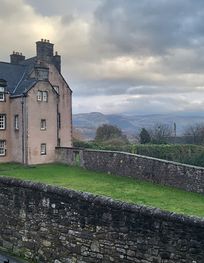
Mar's Wark, Scotland Travel Guide
Explore the majestic Renaissance façade of Mar's Wark, a 16th-century noble residence steeped in Scottish history and architectural grandeur.
Mar's Wark is a striking 16th-century Renaissance townhouse ruin in Stirling, Scotland, originally built by John Erskine, Earl of Mar, as a grand family residence. Its impressive façade, adorned with heraldic panels and decorative sculptures, stands beside the Holy Rude Churchyard on Broad Street. Once a symbol of aristocratic power and later used as barracks and a workhouse, Mar's Wark offers a free, evocative glimpse into Scotland's rich history and architectural heritage.
A brief summary to Mar's Wark
- Stirling, GB
- Click to display
- Duration: 0.5 to 1.5 hours
- Free
-
 Outdoor
- Mobile reception: 4 out of 5

Know before you go
Hi, I'm Eve. Here are a few practical things to know before exploring Mar's Wark.
- Visit at any time as Mar's Wark is freely accessible with no entrance fee.
- Take time to read the information boards on site to fully appreciate the historical and architectural details.
- Combine your visit with nearby attractions like Stirling Castle and the Holy Rude Church.
- Bring a camera to capture the intricate heraldic panels and unique stone carvings.
Do you manage this location?
Take control to get all the benefits, like improved information, better appearance, and stronger visibility across AI-powered discovery. Learn more about listing your business on Evendo
Activate your presenceOther nearby places you may find interesting
The closest places of the same kind, if this one is not quite what you had in mind.



Explore Mar's Wark on the Map
A handpicked selection of must-see spots near Mar's Wark, mapped for you.
Unlock the Best of Mar's Wark
Buy tickets
-
No tickets available
Book tours with entry


Getting There
-
Bus
Take the local Stirling bus service from the city center, which runs frequently with a travel time of approximately 10-15 minutes. The nearest stop is within a 5-minute walk of Mar's Wark. Tickets cost around £1.50–£3.00 GBP. Note that buses may be less frequent on weekends and holidays.
-
Train
From Stirling Railway Station, a 15-minute walk through Stirling’s Old Town brings you to Mar's Wark. The route is mostly flat and accessible. Train services connect Stirling with major Scottish cities, with fares starting at £5 GBP depending on origin.
-
Car
Driving to Mar's Wark is possible, with public parking available in Stirling city center about a 10-minute walk away. Parking fees range from £1.50 to £3.50 GBP per hour. Note that the immediate area is pedestrian-friendly and narrow, so parking nearby is advised.
For the on-the-go comforts that matter to you
-
 Information Boards
-
 Seating Areas
-
 Trash Bins
Discover more about Mar's Wark
A Noble Residence Born of Renaissance Ambition
Mar's Wark was constructed between 1570 and 1572 by John Erskine, the Regent of Scotland and Earl of Mar, who intended it as the principal residence for his family in Stirling. Positioned prominently on Broad Street, it fronts the churchyard of the historic Holy Rude Church and commands the processional route leading up to Stirling Castle. The building's design was inspired by the Renaissance style introduced to Scotland from France, reflecting the architectural trends of the time and royal influences, particularly the nearby Stirling Castle palace block.Architectural Grandeur and Heraldic Symbolism
Though now a ruin, Mar's Wark retains its imposing façade, notable for its near symmetry, polygonal gatehouse towers, and richly decorated heraldic panels bearing the royal arms of Scotland and Erskine family insignia. The façade also features decorative gargoyles, statuettes, and intriguing inscriptions in Middle Scots, inviting onlookers to appreciate the artistry and status embodied in the building. The basement vaults, with street-facing doors and windows, likely served commercial purposes such as shops, adding a functional dimension to the residence.Historical Layers of Power and Conflict
John Erskine, as hereditary keeper of Stirling Castle, was a significant political figure during a turbulent era in Scottish history. Mar's Wark witnessed key historical events, including its use as a barracks during the 1715 Jacobite Rising led by the 6th Earl of Mar. The building also suffered damage during various conflicts, contributing to its current ruined state. Despite these upheavals, the residence remained in use by Erskine's widow and later served civic functions, including as a workhouse leased by the town council in the 18th century.Legends and Artistic Details in Stone
Local lore suggests that some stones used in Mar's Wark were recycled from the nearby Cambuskenneth Abbey, a claim supported by the presence of a consecration cross in the masonry. Among the carvings is a figure of a woman bound by ropes, believed to represent Joan of Arc, known to Scottish soldiers as Jeanie Dark. These artistic details enrich the building's narrative, blending history, myth, and symbolism in its stonework.Present-Day Experience and Preservation
Today, Mar's Wark stands as a protected scheduled monument under the care of Historic Environment Scotland. Visitors can freely explore its exterior at any time, absorbing the atmosphere of a once-grand aristocratic townhouse through its surviving façade. Informative signage helps contextualize the site’s significance within Stirling’s Old Town and Scotland’s broader historical tapestry. Its proximity to Stirling Castle and the Holy Rude Church makes it a compelling stop for those interested in Renaissance architecture and Scottish heritage.Architectural Influence and Cultural Importance
Mar's Wark exemplifies the Renaissance architectural style adapted in Scotland during the 16th century, showcasing the influence of continental design filtered through royal and noble aspirations. The building's decorative elements and inscriptions reflect the status and power of the Earl of Mar, while its strategic location underscores its role in the social and political life of Stirling. As a ruin, it offers a tangible connection to Scotland’s past, inviting reflection on the layers of history embedded in its stones.












Your all‑in‑one travel companion app
Explore expert travel guides, compare and book tours, experiences, hotels, and more—all from the palm of your hand. Download now for seamless trip planning wherever your wanderlust takes you.


Explore More of Scotland

Looking beyond Mar's Wark? Discover Scotland for broader travel guides, local hot-spots, and regional highlights.
Explore Scotland