

Scalloway Castle Travel Guide
Free Guide: Explore the haunting ruins of Scalloway Castle, a formidable 1600 tower house symbolizing Shetland’s turbulent past and the legacy of ‘Black Patie’.


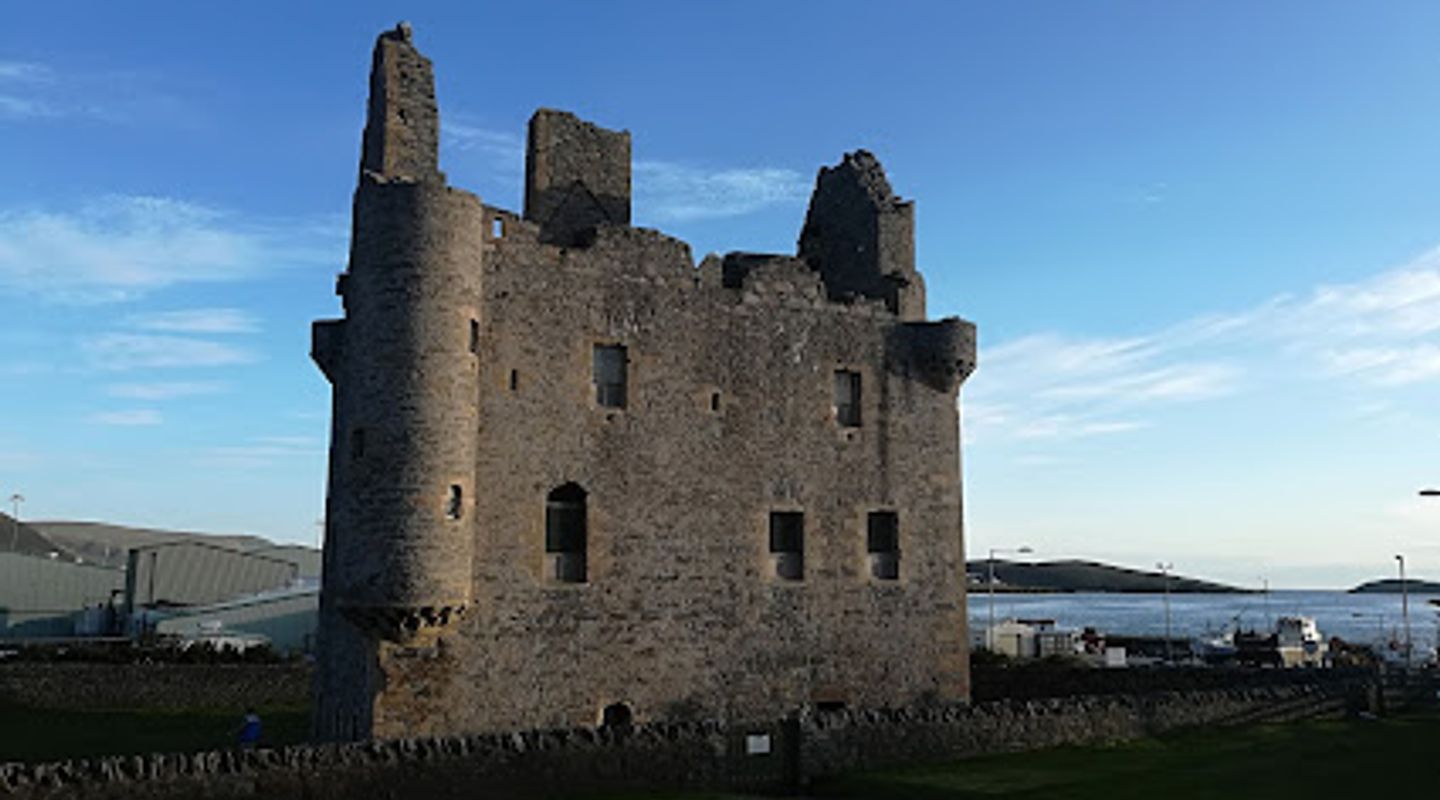
A brief summary of Scalloway Castle
Explore the haunting ruins of Scalloway Castle, a formidable 1600 tower house symbolizing Shetland’s turbulent past and the legacy of ‘Black Patie’.
Scalloway Castle, a striking late 16th-century tower house on Shetland Mainland, was built by Patrick Stewart, 2nd Earl of Orkney, as a symbol of his power and harsh rule. This L-shaped fortress once served as a residence, courthouse, and meeting place for Shetland’s parliament. Though now a roofless ruin, it remains a powerful reminder of Shetland’s turbulent history and the legacy of ‘Black Patie’. The castle is currently closed for conservation but can be explored by obtaining a key from the nearby museum.
On-site amenities
 Restrooms
 Drink options
 Food options
 Seating areas
 Information boards
 Visitor centre
- Address
- Castle St, Shetland ZE1 0TQ
- Website
Getting there
Bus
Car
Walking
Discover more about Scalloway Castle
Legacy of a Ruthless Ruler
Scalloway Castle was constructed around 1600 by Patrick Stewart, known locally as ‘Black Patie’, the 2nd Earl of Orkney and Lord of Shetland. His reign was marked by oppression and forced labour, with the castle itself built by unpaid workers summoned from Shetland’s parishes. Stewart’s iron-fisted rule ended with his imprisonment in 1609 and execution in 1615. The castle stands as a symbol of his harsh governance and the suffering endured by the Shetland people during this turbulent period.
Architectural Significance and Design
The castle is a fine example of a late 1500s tower house, built in an L-shaped plan with a projecting entrance jamb. It features a wide scale and platt staircase, an integral kitchen, and private suites on the upper floors. The great hall on the first floor served both as a place to entertain guests and administer justice. Constructed primarily from locally quarried limestone with sandstone detailing imported from Orkney, the castle’s robust design reflects its dual role as a fortified residence and courthouse.
A Center of Power and Justice
Beyond being a home, Scalloway Castle was the administrative heart of Shetland during Stewart’s rule. It hosted the Shetland ‘thing’ or parliament meetings, continuing its role in governance even after Stewart’s downfall. Notoriously, the castle housed a ‘maiden’, an early guillotine, highlighting the severe justice meted out here. English troops were stationed in the castle during the 1650s, and by the early 18th century, it had fallen into disrepair, with some stonework repurposed for local buildings.
Preservation and Visitor Experience
Scalloway Castle has been under state care since 1908 and is maintained by Historic Environment Scotland. Though currently closed for essential conservation work, visitors can access the castle by obtaining a key from the nearby Scalloway Museum during its opening hours. The museum itself offers insights into the castle’s history and the wider heritage of Scalloway, including its role as Shetland’s ancient capital and its connections to World War II’s Shetland Bus operations.
Surrounding Historical Context
The village of Scalloway, once the capital of Shetland until 1708, is steeped in history. The castle’s commanding position on a natural promontory overlooking the harbour underscores its strategic importance. Nearby sites include the Earl’s Palace in Orkney and Muness Castle on Unst, both linked to the Stewart family. The inscription once above the castle door, translating to “That house whose foundation is rock will stand, but will perish if it be shifting sand,” resonates as a poignant metaphor for the castle’s enduring presence despite its turbulent past.
Modern Significance and Cultural Heritage
Today, Scalloway Castle stands as a powerful emblem of Shetland’s complex history, reflecting both the architectural sophistication of its era and the harsh realities of feudal rule. It attracts history enthusiasts keen to explore the legacy of the Stewart Earls and the Norse and Scottish influences that shaped Shetland. The castle’s ruins, combined with the adjacent museum and the village’s rich heritage, offer a compelling narrative of resilience and transformation in the Northern Isles.
Evendo Review Centre
 Google
Guest reviews
Best time to go
Quietest: Jan, Feb & Dec · before 6am
Busy times are Evendo estimates for a typical year, to help you plan. Actual crowds vary with events, school holidays and the weather.
Explore Scalloway Castle on the map
A handpicked selection of must-see spots near Scalloway Castle, mapped for you.
Get your free copy of our complete guide to Scalloway Castle, delivered straight to you.
Everything on this page, from opening hours and how to get there to Eve’s tips and the best time to go, in one PDF you can read offline, print or share.
Already have an account? Sign in
Your Scalloway Castle guide is ready.
We'll send it to · Not you? Sign out

Getting your guide ready…
We are putting together a fresh copy of the Scalloway Castle guide. This can take up to a minute.
This can take a few moments. If your browser asks, choose Allow so the download can start. You'll find the guide in your Downloads folder.
Nothing happened? Download it again
Sorry, the guide is taking longer than usual. Please try again in a minute, or get it by email instead.
Unlock the best of Scalloway Castle
Skip-the-line tickets, guided tours with entry, and walking tours of the area, booked in a few clicks.

Other nearby places you may find interesting
The closest places of the same kind, if this one is not quite what you had in mind.
-
-
-
-
-


Swipe for more places
More to explore near Scalloway Castle

 Best experiences near Scalloway Castle
 Best hotels near Scalloway Castle
 Best landmarks near Scalloway Castle
 Best attractions near Scalloway Castle
 Best shops near Scalloway Castle
 Best restaurants near Scalloway Castle
 Best bars near Scalloway Castle
Do you manage this location?
Take control to get all the benefits, like improved information, better appearance, and stronger visibility across AI-powered discovery.
Explore more
Explore more of Shetland
Explore Shetland: A captivating blend of rugged landscapes, rich wildlife, and a unique cultural heritage between Scotland and Scandinavia.
Explore Shetland
Explore more of United Kingdom
Discover the United Kingdom: A blend of rich history, stunning landscapes, and vibrant cities, offering a unique travel experience for every visitor.
Explore United Kingdom
