

Buda Castle Tour: History and Architecture
 Budapest, HU
 100% of travellers recommend this
Highlights
- Expertly guided walking tour
- Deeper, immersive experience of Buda Castle District
- Exploration of iconic landmarks and hidden medieval remains
- Reveals rare historical details and dramatic stories
- Perfect for history lovers and architecture enthusiasts
-
Duration 2 hours 30 minutes
-
Expert Archaeologist Guide
-
Admission Ticket Included
-
Focus on history and architecture
-
Public transport nearby
Embark on a captivating journey through Budapest's rich history and stunning architecture with the Buda Castle Tour: History and Architecture. Led by an expert Archaeologist, this guided walking tour delves deep into the Buda Castle District, uncovering hidden medieval remains and sharing dramatic stories from the 1686 siege. Explore iconic landmarks like Matthias Church and Fisherman's Bastion, as well as rare details such as the 13th-century Dominican monastery ruins. Perfect for history buffs, architecture enthusiasts, and curious travelers alike, this tour offers a unique and immersive experience unlike any other. Don't miss the opportunity to discover the fascinating layers of Budapest's past on this unforgettable tour.
At a Glance
-
 Free cancellation
-
 3 hours 30 minutes
-
 Instant Confirmation
-
 Available in English
-
 Mobile voucher
-
 Small Group tour
-
 Guided
-
 Family friendly

Featured Reviews

Explore Buda Castle's rich history and architecture on a guided tour, revealing hidden treasures and stories of Budapest's past.
Included
-
 OtherOfficially licensed English-speaking tour guide
 -
OtherGuest pass with lanyard (provided for the tour, collected at the end)
Excluded
-
 OtherBuda Castle Garden Bazaar
 -
Entrance feesAdmission to the interior of Matthias Church is not included in the tour price. Guests may choose to visit independently after the tour ends.
-
Entrance feesAccess to the upper panoramic terrace of Fisherman’s Bastion is not included in the tour price. Visitors who wish to enter this area may purchase tickets on-site after the tour.
-
Entrance feesAdmission to the interior of the Royal Palace is not included in the tour price. Guests may choose to visit independently after the tour ends.
-
GratuitiesGratuities
Meeting Point
The meeting point will be at the equestrian statue of Prince Eugene of Savoy, in front of the Royal Palace.

Budapest, 1013 , Hungary

End Point
The tour concludes at Szentháromság Square, right beside Matthias Church. Guests are welcome to explore the area or visit the church interior independently after the tour.

Budapest, Szentháromság tér 2, 1014 , Hungary
What to expect

At this stop, we’ll take a closer look at the Royal Palace — one of the most iconic landmarks of Budapest. Over the centuries, it has been built, destroyed, and rebuilt multiple times. Originally a medieval stronghold, it was gradually transformed into a royal residence, reflecting the power struggles and architectural tastes of different eras. From Gothic to Baroque to Neoclassical elements, the palace’s layers tell the story of Hungary’s turbulent history.
20 minutes
Remains of the medieval Sigismund Church
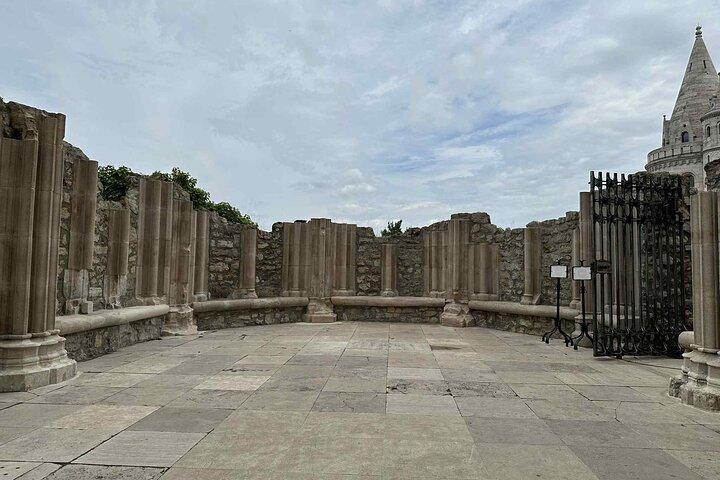
During the expansion of the Royal Palace under King Sigismund in the early 15th century, a Gothic-style royal chapel was constructed as part of the palace complex. Today, the foundations of this medieval church are still visible in the courtyards below. These remains mark one of the earliest monumental royal construction phases in Buda, initiated by Sigismund as part of his effort to turn the palace into a true imperial residence.
3 minutes
Tárnok u.
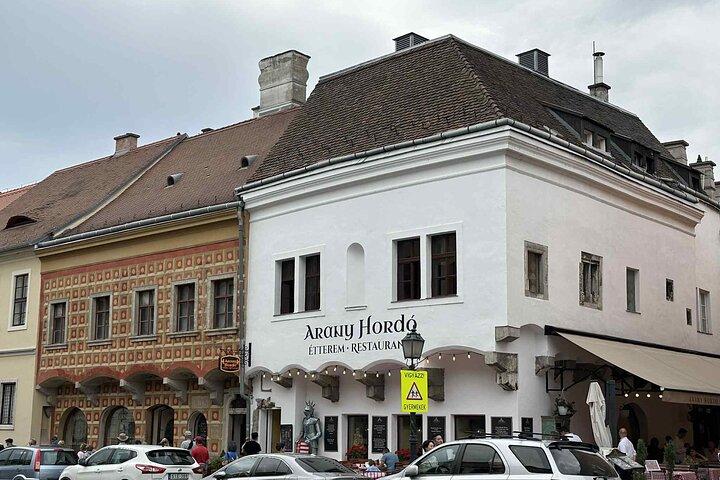
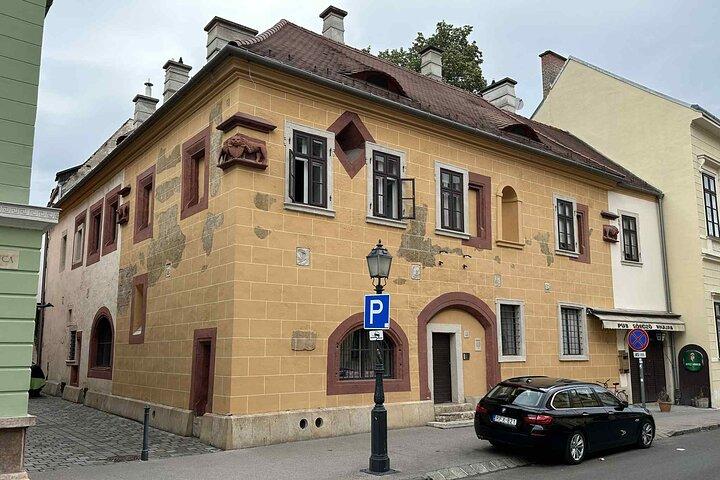
Step into the heart of medieval Buda as we explore Tárnok Street — the main commercial street of the former burgher town beneath the royal court. This charming cobbled lane hides some of the best-preserved medieval merchant houses in the Castle District. Behind the Gothic façades, you'll learn how goods were stored, traded, and displayed — and how everyday commerce shaped the life of Buda's burghers. We’ll visit three authentic buildings that withstood fire, siege, and centuries of urban change, each standing on original medieval foundations. Tárnok Street offers a rare, tangible glimpse into the practical world of medieval trade, domestic life, and architectural ingenuity — far beyond the walls of the palace above.
15 minutes
Hungarian Parliament Building

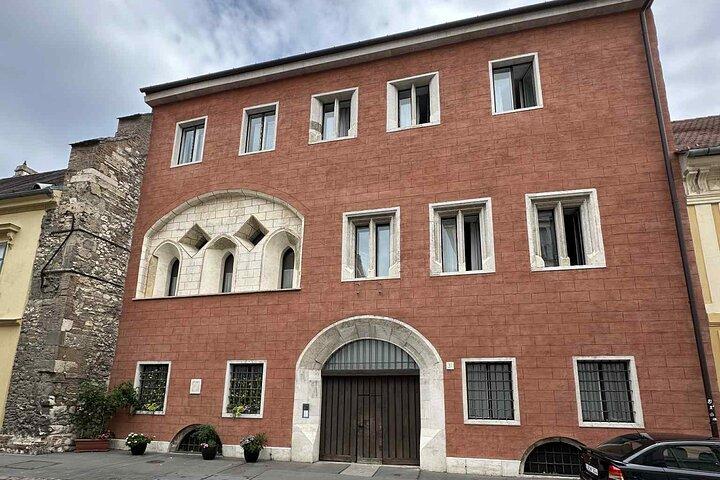
Our walk continues along Úri Street, once the noble residential quarter of medieval Buda. Here we uncover the remnants of aristocratic palaces and residential houses, many built on original 14th–15th century foundations. These structures whisper stories of status, power, and daily life behind their thick stone walls. The street is also home to the finest collection of medieval gateways in the Castle District ornate entrances that once welcomed merchants, craftsmen, and travelers from across the kingdom. As we stroll beneath their arches, we’ll trace the architectural evolution of Buda's noble class and step into a world of forgotten elegance and medieval refinement.
15 minutes
Church of Saint Mary Magdalene
Built on the site of the earliest church on Castle Hill, the Church of Saint Mary Magdalene once served as the main parish for the district’s Hungarian-speaking population in the area historically known as “Szombathely.” Its foundations date back to the 13th century. Though partially destroyed during the siege of Buda in 1686, it stood for centuries as a symbol of faith and identity. Its fate was sealed in the 1950s, when Hungary’s communist regime ordered the demolition of the ruined structure. Only the medieval tower survived saved by the determined efforts of archaeologists and preservationists. Today, the solitary tower stands as a powerful reminder of resilience, memory, and the layers of history buried beneath Buda Castle Hill.
8 minutes
 Admission Not Included
Hungarian Parliament Building
Our walk continues along Országház Street, once known as the “Italian Street” in medieval times. This elegant lane was home to a thriving community of Italian merchants who played a key role in Buda’s commercial and cultural life. Lined with grand medieval houses and noble residences, the street reflects the prosperity of the area during the 14th and 15th centuries. Among its many architectural treasures is the only surviving 16th-century sgraffito decoration in the entire Castle District a rare and delicate trace of Renaissance artistry amid Gothic walls. As we walk, we uncover the story of a multicultural Buda shaped by trade, diplomacy, and European exchange.
15 minutes
Volt Magyar Királyi Pénzügyminisztérium
This striking Neo-Gothic building, now home to Hungary’s Ministry of Finance, was originally constructed in the early 20th century. Its monumental design came at a cost: several medieval structures were demolished to make way for it. Severely damaged during World War II, the building's ornate façade was stripped down and simplified in the post-war years. In the past five years, its original façade has been carefully reconstructed—restoring much of its former grandeur. However, the project also sparked debate, as part of one of the original wings was demolished during the process.
10 minutes
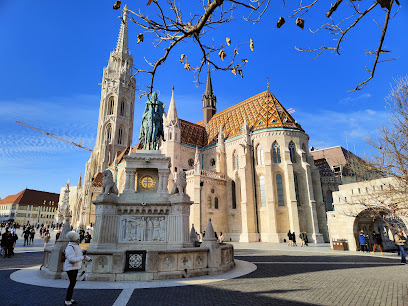
Church of the Assumption of the Buda Castle – commonly (and incorrectly) known as “Matthias Church” Often mistakenly referred to as “Matthias Church,” this iconic landmark is officially named the Church of the Assumption of the Buda Castle. Originally built to serve Buda’s German-speaking community, the church's history reflects centuries of religious and cultural change on Castle Hill.
5 minutes
Admission Not Included
Fortuna u. & Fortuna köz
Today, Fortuna Street is famed for its modern restaurants, but in the Middle Ages it was home to aristocratic palaces and grand townhouses. In the 1470s, this street witnessed a milestone in Hungarian history: Andreas Hess (Huss?), a German-born printer, produced Hungary’s first printed book here - the Chronica Hungarorum. Just a few steps away once stood the Red Hedgehog Inn (Vörös Sün), a legendary meeting point for travelers, merchants, and intellectuals for centuries. This street, quiet and refined today, was once a center of innovation and noble ambition - its past echoing with the hum of printing presses, while today the clink of wine glasses from nearby restaurants fills the air.
15 minutes
Becsi Kapu Square
This square once served as both a marketplace and a main entrance to medieval Buda. In its heyday, this square was a vibrant meeting point where Hungarian townsfolk and members of the local Jewish community came together to trade, talk, and worship. Today, the square retains its historic charm, offering a glimpse into the social and commercial life that once animated the heart of the medieval city.
5 minutes
National Archives of Hungary
Built in the early 20th century, the National Archives of Hungary was designed in the Neo-Romanesque style to echo and elevate the medieval character of the Buda Castle District. Its robust stonework, arched windows, and monumental presence make it appear centuries older than it truly is deliberately blending into the historical fabric of its surroundings. Far more than an architectural statement, the building symbolizes national memory, housing documents that span the full scope of Hungary’s written past. Standing before it, we see not just a modern construction, but a powerful nod to Buda’s medieval heritage.
5 minutes
Abdurrahman pasa síremléke
Walking along the outer castle walls, we uncover key moments from the dramatic Siege of Buda in 1686. Here, you can see where the walls were first breached by the Christian allied forces, and not far from this spot, the Ottoman Pasha of Buda fell in battle. Today, a solemn memorial stands nearby, honoring the multinational Christian soldiers who fought and died in the liberation of the city.
15 minutes
Mediaeval Jewish Chapel
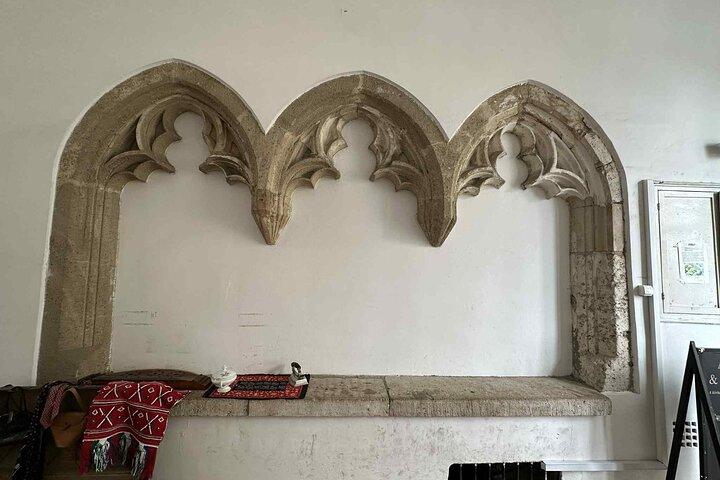
We now enter the medieval Jewish quarter of Buda, a once-thriving community within the Castle walls. Here, we’ll pause at the site of the former Gothic synagogue, which stood as a central place of worship until its destruction. Nearby, we’ll step inside the excavated medieval Jewish prayer house, one of the rare surviving examples of Jewish religious architecture from the Middle Ages in Hungary. Modest in size but rich in meaning, it offers a quiet and powerful glimpse into the everyday life, resilience, and faith of a long-silenced community.
15 minutes
 Admission Included
Holy Trinity Statue
As we walk along Táncsics Mihály Street, we encounter a few remarkable examples of how medieval ruins were reused and transformed during the 17th and 18th centuries. Here, old Gothic walls and cellars were not demolished but carefully incorporated into Baroque and later residential buildings. These layered façades and hidden structures silently reveal how post-Ottoman Buda rose from the ashesrebuilding itself atop its medieval foundations, both literally and symbolically.
5 minutes
Dominikánus Udvar
Here lie the evocative remains of the Dominican monastery of Saint Nicholas, once a vital center of medieval religious life in Buda. It was from this very order that Friar Julianus embarked on his now-legendary journey in the 13th century - one of many remarkable stories linked to this site. Centuries later, the ruins endured fire, siege, and neglect, only to be dramatically reinterpreted during the construction of the Hilton Hotel in the 20th century. The result is a striking and controversial blend of medieval stonework and modern architecture - capturing the ongoing tension between heritage and progress, faith and modernity.
12 minutes
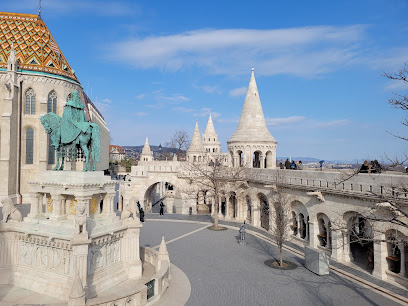
At this stop, we explore the Fishermen’s Bastion, one of Budapest’s most iconic landmarks. At its center stands the equestrian statue of King Saint Stephen, Hungary’s first Christian king, symbolizing the birth of the Hungarian state. Please note: While we will admire the monument and the structure from the main level, we will not enter the upper lookout terrace, as access requires a ticket and is not included in the tour price.
6 minutes
Admission Not Included
The experience can be subject to change due to bad weather or unforseen circumstances. We always endeavour to give you the best possible experience.
Additional Information
-
 Children under 10 years of age are not permitted, due to the physical and thematic nature of the tour.
 -
Not recommended for pregnant travelers
-
Not recommended for travelers with poor cardiovascular health
-
Not recommended for travelers with spinal injuries
-
Not suitable for guests with limited mobility
-
Public transportation options are available nearby
-
Travelers should have at least a moderate level of physical fitness
What our experts say
-
 Visit nearby Matthias Church
 -
Check out Fisherman’s Bastion views
-
Grab lunch at a local café nearby
-
Wear comfortable shoes for walking
-
Bring water to stay hydrated

More About this Experience
Introduction
Embark on a journey through time with the Buda Castle Tour: History and Architecture. This expertly guided walking tour offers a deeper, more immersive experience of the Buda Castle District in Budapest, taking you beyond the surface to uncover hidden stories and historical treasures.What to expect?
During this tour, travelers can expect to delve into the rich history of Budapest's Buda Castle District with an expert Archaeologist guide. From iconic landmarks like Matthias Church and Fisherman's Bastion to hidden medieval ruins and dramatic tales from the 1686 siege, every step reveals a new layer of history waiting to be explored.Who is this for?
This tour is perfect for history lovers, architecture enthusiasts, and culturally curious travelers looking to gain a deeper understanding of Budapest's past. Whether you have limited time or simply crave a more meaningful exploration of the city, this tour offers a unique opportunity to connect with the rich history of the Buda Castle District.Why book this?
Immerse yourself in the captivating stories and visual details of Budapest's Buda Castle District on this expertly guided walking tour. Unlike standard sightseeing tours, this experience goes beyond the surface to reveal hidden gems and rare insights into the district's transformation through various cultural influences. With a focus on storytelling and historical depth, this tour promises an unforgettable encounter with one of Budapest's most historically significant areas.Good to know
Travelers should come prepared with comfortable walking shoes and a curiosity for uncovering hidden historical gems. The meeting point for the tour will be at the national memorial site next to Matthias Church, marked by the Hungarian flag. Be ready to be transported back in time as you explore the Buda Castle District's fascinating past.Reviews
Travelers who have experienced the Buda Castle Tour rave about the expert guidance provided by the Archaeologist, as well as the in-depth exploration of historical sites and stories. Many reviewers highlight the unique insights and hidden details uncovered during the tour, making it a must-book experience for anyone interested in Budapest's rich history.
Your all‑in‑one travel companion app
Explore expert travel guides, compare and book tours, experiences, hotels, and more—all from the palm of your hand. Download now for seamless trip planning wherever your wanderlust takes you.


This is a popular product and the date you are looking for just sold out. Next available date is
