
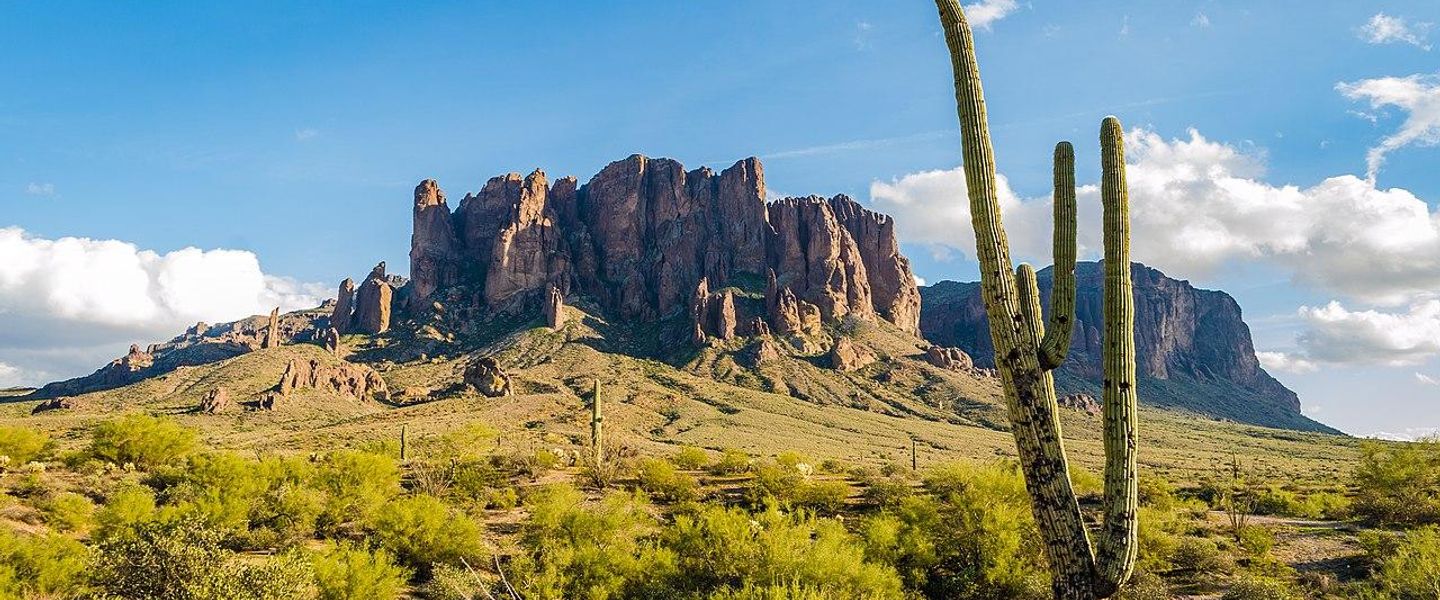
Superstition Mountains, Arizona Travel Guide
Explore the mysterious Superstition Mountains in Arizona, where legends of lost gold and breathtaking desert landscapes await adventurers and nature lovers.
The Superstition Mountains, located in Arizona, United States, are a stunning range shrouded in mystery and natural beauty. Known for its rugged peaks, breathtaking vistas, and rich folklore, this destination offers an unforgettable experience for outdoor enthusiasts and history buffs alike. The mountain range is steeped in legend, most notably the tale of the Lost Dutchman’s Gold Mine. This story has captivated treasure hunters for generations, adding an element of intrigue to your visit. Whether you are hiking through the diverse desert landscape or exploring the many intriguing trails, the Superstition Mountains provide a unique blend of adventure and enigma. Beyond the legends, the region is home to a variety of wildlife and unique flora, making it a paradise for nature lovers. The landscape is dotted with saguaro cacti, and the area is a haven for birdwatchers and photographers. The stunning vistas, particularly at sunrise and sunset, offer perfect opportunities for capturing the majestic beauty of the desert. For those interested in history, the nearby Superstition Mountain Museum offers a fascinating glimpse into the area's past. From Native American history to the tales of early settlers, this museum provides a comprehensive understanding of the region’s cultural heritage.

Know before you go
Hi, I'm Eve. Here are a few practical things to know before exploring Superstition Mountains.
- Visit during the cooler months of the year, typically from October to April, to avoid the extreme summer heat.
- Carry plenty of water and sun protection, as the desert environment can be harsh and unforgiving.
- Hiking trails vary in difficulty; research and choose one that matches your fitness level and experience.
- Stop by the Superstition Mountain Museum to learn about the rich cultural and historical background of the area.
- Be mindful of local wildlife and stay on marked trails to preserve the natural environment and ensure your safety.
Explore Superstition Mountains: Things to Do, Places to Eat, Hotels & More
Handpicked recommendations for top attractions, local dining, accommodations, and more

Top Attractions & Sightseeing in Superstition Mountains
Top-rated picks
Best Attractions

Goldfield Ghost Town and Mine Tours Inc.
Experience the Wild West at Goldfield Ghost Town, a historic gold mining town in Apache Junction, Arizona, filled with captivating attractions and rich history.

Lost Dutchman State Park
Explore the scenic beauty and rich history of Lost Dutchman State Park in Apache Junction, Arizona, an outdoor paradise for all adventurers.

Superstition Mountain - Lost Dutchman Museum
Explore the captivating history and legends of the Superstition Mountains at the Lost Dutchman Museum in Apache Junction, Arizona.

Saguaro Lake
Explore the natural beauty of Saguaro Lake in Arizona, a perfect destination for relaxation and outdoor adventures amidst stunning desert landscapes.

Best landmarks in Superstition Mountains
Top-rated picks
Best Landmarks

Goldfield Ghost Town and Mine Tours Inc.
Step back in time at Goldfield Ghost Town: Experience Arizona's Wild West history with mine tours, gunfights, and stunning Superstition Mountain views.

Prospector's Palace
Explore Arizona's gold rush history at Prospector's Palace in Apache Junction, with exhibits, artifacts, and stunning views of the Superstition Mountains.

Best restaurants in Superstition Mountains
Top-rated picks
Best Restaurants

Tortilla Flat Saloon
Discover the unique flavors and vibrant atmosphere at Tortilla Flat Saloon in Arizona's historic Tortilla Flat.

Board & Batten
Experience the vibrant culinary scene at Board & Batten in Mesa – where modern American cuisine meets exceptional service.

Mammoth Steak House and Saloon
Experience hearty steaks and live music at Mammoth Steak House & Saloon in Apache Junction - where flavor meets fun!

Sam and Luca Italian Bistro
Experience authentic Italian cuisine at Sam and Luca Italian Bistro in Mesa - where every dish tells a story.

Best bars in Superstition Mountains
Top-rated picks
Best Bars

The HUB Grill and Bar
Discover the ideal sports bar experience at The HUB Grill and Bar in Mesa, where family-friendly dining meets vibrant sports entertainment.

BJ's Restaurant & Brewhouse
Savor the flavors of BJ's Restaurant & Brewhouse in Superstition Springs, where craft beer meets delicious New American cuisine in a vibrant setting.

The Handlebar Pub and Grill
Experience the lively atmosphere and delicious American cuisine at The Handlebar Pub and Grill in Apache Junction, Arizona.

The Monastery
Discover The Monastery in Mesa, where great food, refreshing drinks, and a lively atmosphere come together for the perfect social experience.

Best nightclubs in Superstition Mountains
Top-rated picks
Best Nightclubs

September's Bar & Grill
Experience the vibrant atmosphere and delicious cuisine at September's Bar & Grill in Mesa, Arizona - the perfect spot for food, drinks, and fun!

Denim & Diamonds
Discover the electrifying nightlife of Denim & Diamonds, where live music, dancing, and great drinks create unforgettable evenings in Mesa, Arizona.

Rodeo Lounge
Discover the lively vibe at Rodeo Lounge in Gold Canyon, AZ, where great music, refreshing drinks, and a fun atmosphere await tourists.

Skies Bar and Grill
Discover the vibrant flavors and stunning views at Skies Bar and Grill, a must-visit culinary destination in Apache Junction.

Best shops in Superstition Mountains
Top-rated picks
Best Shops

Goldfield Ghost Town and Mine Tours Inc.
Experience the allure of the Wild West at Goldfield Ghost Town, a historic mining town offering guided tours, shopping, and stunning views in Arizona.

Superstition Springs Center
Discover the ultimate shopping and dining experience at Superstition Springs Center in Mesa, Arizona, where leisure meets lifestyle in a vibrant atmosphere.

Mesa Market Place Swap Meet
Uncover unique treasures and savor local delights at Mesa Market Place Swap Meet, where community and creativity meet.

Hobby Lobby
Explore Hobby Lobby in Mesa, Arizona: Your ultimate destination for crafting supplies, DIY inspiration, and creative workshops.

Explore Superstition Mountains on the Map
A handpicked selection of must-see spots in Superstition Mountains, mapped for you.
Superstition Mountains Essentials
-
The Superstition Mountains are located in central Arizona, east of the Phoenix metropolitan area. The nearest major airport is Phoenix Sky Harbor International Airport (PHX), approximately 40 miles west of the Superstition Mountains. From Phoenix, you can rent a car, take a shuttle service, or use ride-sharing services to reach the area. The drive typically takes about an hour via US-60 E.
-
To explore the Superstition Mountains, having a car is highly recommended as public transportation options are limited. Rental cars are readily available at Phoenix Sky Harbor International Airport. For those preferring not to drive, guided tours often include transportation. Within the area, there are several trailheads and parking areas where you can start your hikes or exploration.
-
The official currency in the United States is the US Dollar (USD). Credit cards are widely accepted in most establishments, including restaurants, hotels, and shops in the Phoenix area. However, it's advisable to carry some cash for use in more remote areas or at smaller vendors who may not accept cards. ATMs are available in nearby towns such as Apache Junction.
-
While the Superstition Mountains are generally safe, visitors should take standard precautions. Avoid hiking alone, especially in remote areas, and always inform someone of your plans. Be aware of your surroundings and secure your belongings. Certain areas in nearby Apache Junction may have higher crime rates, so exercise caution, especially after dark. The desert environment also poses risks such as extreme heat and wildlife, so prepare accordingly.
-
In case of emergency, dial 911 for immediate assistance. Be aware that cell phone reception can be spotty in remote sections of the Superstition Mountains. It is advisable to carry a first aid kit, plenty of water, and a map. For non-urgent medical needs, the nearest hospital is Banner Goldfield Medical Center in Apache Junction. Travel insurance that covers medical emergencies is recommended.
-
Fashion: Do wear appropriate hiking gear, including sturdy boots, hats, and sun protection. Don't wear open-toed shoes or flip-flops on trails. Religion: Respect the spiritual significance of certain sites to Native American tribes. Public Transport: As public transportation is limited, don't rely solely on it for your travel plans. Greetings: A friendly handshake is a common greeting. Eating & Drinking: Do bring your own water and snacks, as amenities in the mountains are scarce. Don't litter; always pack out what you pack in.
-
To experience the Superstition Mountains like a local, consider visiting during the cooler months from October to April. Start your hikes early in the morning to avoid the midday heat. Engage with local rangers and guides who can provide valuable insights into the area's history and geology. Don't miss the Lost Dutchman State Park and the Superstition Mountain Museum for a deeper understanding of the local lore and legends. Also, try the local cuisine in nearby Apache Junction to get a taste of Southwestern flavors.
When is the best time to visit Superstition Mountains?
Useful Local Phrases for Superstition Mountains
You don't need to speak the language perfectly. Even learning a few simple words can make conversations warmer—and locals usually appreciate the effort.
— Eve

Here are the phrases I use most often in Superstition Mountains. Try a few—you'll be surprised how far they go! 😊
❤️
-
- HelloHowdy
[Haudi] - GoodbyeSee ya later
[See ya lay-ter] - YesYep
[Yep] - NoNah
[Nah] - Please/You're welcomeNo problem
[No prob-lem] - Thank youThanks
[Thanks] - Excuse me/SorryPardon me
[Par-don me] - How are you?How ya doin'?
[How ya doin'?] - Fine. And you?Good, you?
[Good, you?] - Do you speak English?Do ya talk English?
[Do ya talk English?] - I don't understandI ain't gettin' it
[I ain't gettin' it]
- HelloHowdy
-
- I'd like to see the menu, pleaseCan I see the menu?
[Can I see the menu?] - I don't eat meatI don't do meat
[I don't do meat] - Cheers!Bottoms up!
[Bottoms up!] - I would like to pay, pleaseCan I get the check?
[Can I get the check?]
- I'd like to see the menu, pleaseCan I see the menu?
-
- Help!Help!
[Help!] - Go away!Leave me alone!
[Leave me alone!] - Call the Police!Call the cops!
[Call the cops!] - Call a doctor!Get a doctor!
[Get a doctor!] - I'm lostI can't find my way
[I can't find my way] - I'm illI'm not feelin' good
[I'm not feelin' good]
- Help!Help!
-
- I'd like to buy...I want to buy...
[I want to buy...] - I'm just lookingJust browsin'
[Just browsin'] - How much is it?What’s the price?
[What’s the price?] - That's too expensiveThat costs too much
[That costs too much] - Can you lower the price?Can ya make it cheaper?
[Can ya make it cheaper?]
- I'd like to buy...I want to buy...
-
- What time is it?What time ya got?
[What time ya got?] - It's one o'clockIt's one
[It's one] - Half past (10)Half past ten
[Half past ten] - MorningMornin'
[Mornin'] - AfternoonAfternoon
[Afternoon] - EveningEvenin'
[Evenin'] - YesterdayYesterday
[Yesterday] - TodayToday
[Today] - TomorrowTomorrow
[Tomorrow] - 1One
[One] - 2Two
[Two] - 3Three
[Three] - 4Four
[Four] - 5Five
[Five] - 6Six
[Six] - 7Seven
[Seven] - 8Eight
[Eight] - 9Nine
[Nine] - 10Ten
[Ten]
- What time is it?What time ya got?
-
- Where's a/the...?Where's the...?
[Where's the...?] - What's the address?What's the address?
[What's the address?] - Can you show me (on the map)?Can you point it out?
[Can you point it out?] - When's the next (bus)?When's the next bus?
[When's the next bus?] - A ticket (to ....)A ticket to...
[A ticket to...]
- Where's a/the...?Where's the...?
History of Superstition Mountains
-
The Superstition Mountains have been home to Native American tribes for thousands of years, including the Apache who named the range. The area is rich with archaeological sites, including petroglyphs and ancient dwellings, offering a glimpse into the lives of the indigenous people who once thrived here.
-
One of the most enduring tales associated with the Superstition Mountains is the legend of the Lost Dutchman’s Gold Mine. According to folklore, a German immigrant named Jacob Waltz discovered a rich gold mine in the mountains in the 19th century. Despite numerous expeditions and countless treasure hunters, the location of the mine remains a mystery to this day.
-
In the 16th century, Spanish conquistadors explored the region in search of gold and other riches. Many believe that they left behind hidden treasures in the Superstition Mountains. The Peralta family, Spanish settlers in the 1800s, are said to have mined gold in the mountains, further fueling the legends of hidden wealth.
-
The Superstition Mountains were a significant location during the Apache Wars in the late 19th century. The rugged terrain provided a strategic advantage for the Apache tribes who were resisting U.S. military forces. Numerous skirmishes and battles took place in and around the mountains, adding to their historical significance.
-
In the 1840s, the Peralta family allegedly experienced a brutal massacre at the hands of Apache warriors while attempting to transport gold from their mines. This event, known as the Peralta Massacre, has become part of the lore surrounding the Superstition Mountains and adds a dark chapter to their history.
-
In 1939, the Superstition Wilderness Area was officially designated to protect the unique landscape and cultural history of the Superstition Mountains. Today, it spans over 160,000 acres and offers opportunities for hiking, camping, and exploring the natural beauty and historical sites within the range.
-
In recent decades, the Superstition Mountains have drawn adventurers, historians, and conservationists alike. Efforts have been made to preserve the natural environment and historical artifacts of the area. The mountains remain a popular destination for those seeking to uncover the mysteries and beauty of this storied landscape.
Neighbouring Regions of Superstition Mountains
The closest regions to Superstition Mountains, if you have time for more than one.


Your all‑in‑one travel companion app
Explore expert travel guides, compare and book tours, experiences, hotels, and more—all from the palm of your hand. Download now for seamless trip planning wherever your wanderlust takes you.


Explore More of Arizona

Looking beyond Superstition Mountains? Discover Arizona for broader travel guides, local hot-spots, and regional highlights.
Explore ArizonaSuperstition Mountains in Photos
Browse through our photo collection highlighting the charm and character of the destination.


The Enigmatic Beauty of the Superstition Mountains
The Superstition Mountains, located in Arizona, United States, are a stunning range shrouded in mystery and natural beauty. Known for its rugged peaks, breathtaking vistas, and rich folklore, this destination offers an unforgettable experience for outdoor enthusiasts and history buffs alike. The mountain range is steeped in legend, most notably the tale of the Lost Dutchman’s Gold Mine. This story has captivated treasure hunters for generations, adding an element of intrigue to your visit. Whether you are hiking through the diverse desert landscape or exploring the many intriguing trails, the Superstition Mountains provide a unique blend of adventure and enigma. Beyond the legends, the region is home to a variety of wildlife and unique flora, making it a paradise for nature lovers. The landscape is dotted with saguaro cacti, and the area is a haven for birdwatchers and photographers. The stunning vistas, particularly at sunrise and sunset, offer perfect opportunities for capturing the majestic beauty of the desert. For those interested in history, the nearby Superstition Mountain Museum offers a fascinating glimpse into the area's past. From Native American history to the tales of early settlers, this museum provides a comprehensive understanding of the region’s cultural heritage.