

Free Okanagan Travel Guide & Mobile App
Explore Okanagan with free travel guides. Discover regional history, expert tips, proposed trips, and audio guides on web or mobile app.


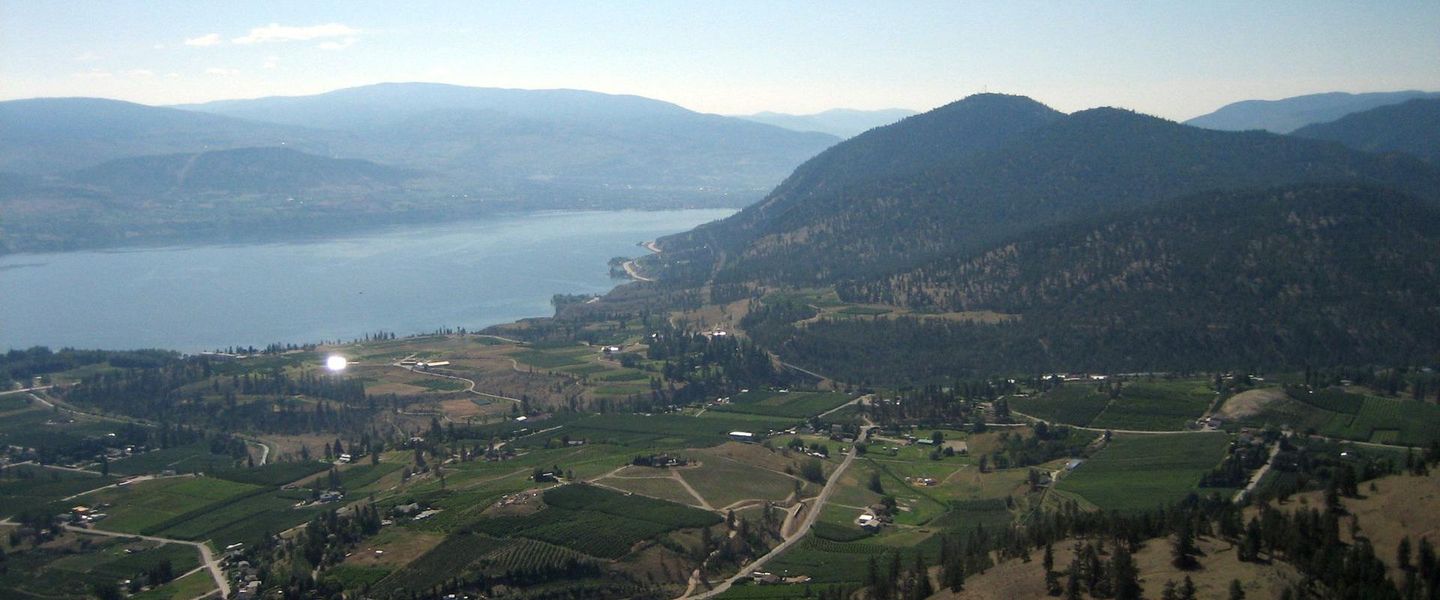


Explore British Columbia’s Okanagan for warm lakes, vineyards, orchards, Indigenous culture, cycling routes and dry Interior landscapes.
Read more about Okanagan
When is the best time to visit Okanagan?
Best: June–August · 22–26°C| Month | High (°C) | Rainfall (mm) |
|---|---|---|
| January | 0 | 40 |
| February | 2 | 35 |
| March | 7 | 40 |
| April | 13 | 45 |
| May | 18 | 50 |
| June (best) | 22 | 45 |
| July (best) | 26 | 30 |
| August (best) | 26 | 35 |
| September | 20 | 40 |
| October | 13 | 45 |
| November | 5 | 40 |
| December | 1 | 45 |
Getting to and around Okanagan
How to get there
Transportation
Best attractions in Okanagan
The Okanagan’s attractions combine lakeside recreation, agricultural tourism, Indigenous cultural interpretation and accessible Interior landscapes. Kelowna offers galleries, museums, waterfront parks and a useful base for nearby vineyards and orchards, while Penticton links two lakes with beaches, cycling routes and access to the Kettle Valley Rail Trail. Around Vernon, Kalamalka Lake and Kalamalka Provincial Park provide opportunities for swimming, paddling, hiking and wildlife observation, with the agricultural landscape of Coldstream close by. South of Penticton, the vineyards and farm roads of Oliver and Osoyoos lead into drier grassland ecosystems, where the Nk’Mip Desert Cultural Centre presents Syilx Okanagan knowledge and the character of the southern valley. Myra Canyon’s historic railway trestles offer one of the region’s best-known walking and cycling settings, while Okanagan Mountain Provincial Park and other protected areas provide more rugged terrain. Wineries, cideries, breweries, orchard stands and seasonal markets form an attraction network of their own, particularly during harvest. In winter, the surrounding uplands support skiing and snow-based recreation, although these areas are separate from the valley floor and require appropriate seasonal planning.
-
 Plaza
Yonge-Dundas Square
Explore the vibrant Yonge-Dundas Square, Toronto's premier urban plaza filled with entertainment, dining, shopping, and cultural experiences.
-
Tourist attraction
Withrow Park
Discover the serene beauty of Withrow Park in Toronto, a perfect destination for families, dog lovers, and outdoor enthusiasts alike.
-
Mattamy Athletic Centre
Experience the vibrant atmosphere of the Mattamy Athletic Centre, Toronto's premier sports complex, where athleticism meets community spirit.
-
Art center
Lighthouse ArtSpace Toronto
Explore the immersive world of art at Lighthouse ArtSpace Toronto, where creativity and technology blend to create unforgettable experiences.


Best landmarks in Okanagan
Okanagan landmarks are closely tied to water, transport, agriculture and the valley’s dry southern ecology. Okanagan Lake provides the region’s defining geographical axis, with Kelowna and Penticton occupying important points along its shoreline and public viewpoints revealing how the lake shapes settlement. Kalamalka Lake near Vernon is recognisable for its unusually changeable blue-green appearance and forms the centrepiece of a landscape of wooded slopes and protected shoreline. Myra Canyon’s historic railway trestles are a significant reminder of the engineering and transport networks that connected the Interior, while the preserved railway landscape of the Kettle Valley Rail Trail reflects the wider importance of rail to farming and mining communities. In the south, Osoyoos Lake and the arid hills around Osoyoos create a marked contrast with the forested northern valley. The Nk’Mip Desert Cultural Centre provides an Indigenous-led setting for understanding this dry ecosystem and Syilx Okanagan relationships with the land. Orchard benches, vineyard slopes and lake-facing communities are not single monuments, but together form the visual identity that distinguishes the Okanagan from British Columbia’s wetter coastal regions.
-
Tourist attraction
The Prairie Lily
Discover the beauty of Saskatoon aboard The Prairie Lily, a scenic riverboat offering unforgettable cruises and stunning views of the South Saskatchewan River.
-
English language school
Connect International School (CIS)
Enhance your English skills in the heart of Toronto's vibrant Fashion District with Connect International School's diverse programs and supportive environment.
-
Flight school
Great Lakes Helicopter
Experience breathtaking helicopter tours over the stunning landscapes of Ontario at Great Lakes Helicopter in Cambridge, providing unforgettable aerial adventures.
-
Shipping and mailing service
PenguinPickUp
Visit PenguinPickUp in Scarborough for seamless shipping services, ensuring your packages are sent with care and efficiency during your travels.


Explore Okanagan on the map
Plan your trip on one map. See where the top cities, national parks and sights are, and book hotels and experiences in a few clicks.
Best hotels in Okanagan
Best restaurants in Okanagan
Okanagan dining is shaped by its orchards, vineyards, farms and lakes rather than by a single signature dish. Summer menus commonly feature cherries, peaches, apples, apricots, berries and locally grown vegetables, while wineries and restaurants around Kelowna, Penticton, Oliver and Osoyoos often pair regional produce with British Columbia wines. Farm shops and seasonal roadside stands are practical places to find fresh fruit, preserves, baked goods and cider, though availability follows the agricultural calendar. Breweries, cafés, pubs and contemporary restaurants provide much of the everyday choice, with more focused vineyard dining in the wine-producing districts. Trout and other freshwater fish may appear on menus, but should not be assumed to represent a single defining local cuisine. Indigenous food traditions and cultural interpretation are important parts of the region’s story; visitors should seek Indigenous-led experiences rather than treating these traditions as a decorative addition to wine tourism. Reservations are sensible for popular summer restaurants and winery dining rooms.
-
-
Oyster Bar
Rodney’s Oyster House
Discover Toronto's premier oyster bar offering fresh seafood delights in a vibrant setting.
-
Restaurant
The Keg Steakhouse + Bar - Southside
Experience fine dining at The Keg Steakhouse + Bar - Southside in Winnipeg, where succulent steaks meet an extensive wine selection.
-
Restaurant
JOEY Kenaston
Discover culinary excellence at JOEY Kenaston in Winnipeg – where modern dining meets local flavor in an inviting atmosphere.


Best bars in Okanagan
Evening life in the Okanagan is concentrated in Kelowna, Penticton and the larger lakeside communities, with a quieter rhythm in orchard and vineyard districts. Kelowna has the broadest selection of pubs, cocktail bars, breweries, live-music venues and late-evening restaurants, while Penticton combines brewery taprooms, pubs and seasonal waterfront activity. Vernon and Osoyoos offer smaller selections centred on restaurants, traditional pubs, wine bars and occasional live entertainment. Across the valley, tasting rooms and craft breweries are generally daytime or early-evening experiences rather than substitutes for a nightclub district. Summer brings more activity around lakefronts and festival periods, but opening arrangements and events change regularly. Rural evenings are typically based around a meal, a pub, a brewery or accommodation at a winery, and driving between venues requires advance planning and a sober driver. Visitors should not assume that every vineyard operates as a nightlife venue.
-
Restaurant
JOEY Kenaston
Savor the flavors of JOEY Kenaston, a trendy restaurant and pub in Winnipeg offering a diverse menu and vibrant atmosphere for an unforgettable dining experience.
-
Bar
Bar Poet
Discover Bar Poet: A lively Toronto bar offering eclectic drinks and a vibrant atmosphere for an unforgettable night out.
-
Bar
SPIN Toronto
Discover SPIN Toronto, where vibrant social gatherings meet exciting activities in a unique bar and event venue.
-
Bar
Plank Restobar
Experience a charming waterfront dining at Plank Restobar in Oakville, where delicious cuisine meets a lively atmosphere.


Best nightclubs in Okanagan
Evening life in the Okanagan is concentrated in Kelowna, Penticton and the larger lakeside communities, with a quieter rhythm in orchard and vineyard districts. Kelowna has the broadest selection of pubs, cocktail bars, breweries, live-music venues and late-evening restaurants, while Penticton combines brewery taprooms, pubs and seasonal waterfront activity. Vernon and Osoyoos offer smaller selections centred on restaurants, traditional pubs, wine bars and occasional live entertainment. Across the valley, tasting rooms and craft breweries are generally daytime or early-evening experiences rather than substitutes for a nightclub district. Summer brings more activity around lakefronts and festival periods, but opening arrangements and events change regularly. Rural evenings are typically based around a meal, a pub, a brewery or accommodation at a winery, and driving between venues requires advance planning and a sober driver. Visitors should not assume that every vineyard operates as a nightlife venue.
-
Bar
Bar Poet
Experience Toronto's nightlife at Bar Poet, a lively bar offering eclectic drinks and a vibrant atmosphere in the heart of the city.
-
Bar
SPIN Toronto
Discover SPIN Toronto: A vibrant bar and event venue featuring ping pong, delicious food, and a lively atmosphere in the heart of the city.
-
Bar
Leopold's Tavern Winnipeg - Osborne South
Discover the lively ambiance and delicious offerings at Leopold's Tavern, a must-visit bar in Winnipeg's Osborne South area.
-
Bar
The Keg Steakhouse + Bar - Saskatoon Brighton
Experience fine dining at The Keg Steakhouse + Bar in Saskatoon Brighton, where delicious steaks and an extensive wine selection await you.


Best shops in Okanagan
Shopping in the Okanagan is strongest in its independent food, craft and agricultural products rather than in large-scale luxury retail. Kelowna provides the widest choice of high-street shops, galleries, specialist food stores and contemporary retail, while Penticton, Vernon, Summerland, Oliver and Osoyoos have compact commercial centres with locally oriented businesses. Seasonal farmers’ markets and farm stands are important places to buy cherries, peaches, apples, preserves, honey, baked goods, cider and wine, although products vary with the harvest calendar. Winery cellar doors offer bottles and regional food gifts, and breweries and cideries may sell packaged products where permitted. Galleries and craft shops are useful for pottery, jewellery, paintings, textiles and other work by British Columbia artists. Indigenous-made products should be purchased through reputable Indigenous artists, nations or businesses, particularly when cultural designs or materials are involved. Check border and airline rules before buying wine, fresh produce or other agricultural goods for travel beyond Canada.
-
Shopping mall
Bramalea City Centre
Explore Bramalea City Centre, a premier shopping destination in Brampton, Ontario, featuring over 300 stores and diverse dining options.
-
Shopping mall
Erin Mills Town Centre
Discover Erin Mills Town Centre, Mississauga's vibrant shopping mall with over 200 stores, diverse dining, and family-friendly amenities.
-
Shopping mall
Erin Mills Town Centre
Explore shopping, dining, and entertainment at Erin Mills Town Centre in Mississauga, a vibrant hub for every visitor's delight.
-
Shopping mall
Upper Canada Mall
Discover Upper Canada Mall, the ultimate shopping and dining experience in Newmarket, Ontario, with a wide variety of stores and family-friendly amenities.



Get your free copy of our complete guide to Okanagan, delivered straight to you.
Everything on this page, from attractions and restaurants to essentials and local phrases, in one PDF you can read offline, print or share.
Already have an account? Sign in
Your Okanagan guide is ready.
We'll send it to · Not you? Sign out

Getting your guide ready…
We are putting together a fresh copy of the Okanagan guide. This can take up to a minute.
This can take a few moments. If your browser asks, choose Allow so the download can start. You'll find the guide in your Downloads folder.
Nothing happened? Download it again
Sorry, the guide is taking longer than usual. Please try again in a minute, or get it by email instead.
Okanagan essentials
Currency and Payment
Safety
Emergency Situations
Do's and Don'ts
Local Tips
From Eve
Local phrases worth knowing
You don't need to get them perfect. A few words go a long way, and locals appreciate the effort.
Basics
| English | Local | Say it |
|---|---|---|
| Hello | Hi | [hai] |
| Goodbye | See you later | [si yu leiter] |
| Yes | Yeah | [yeh] |
| No | Nah | [nah] |
| Please/You're welcome | No problem | [no prob-lum] |
| Thank you | Thanks | [thangs] |
| Excuse me/Sorry | Sorry | [sor-ree] |
| How are you? | How's it going? | [howz it goin] |
| Fine. And you? | Good. You? | [gud. yu?] |
| Do you speak English? | Do you know English? | [do yu noe ing-glish?] |
| I don't understand | I don’t get it | [i dont get it] |
Eating & Drinking
| English | Local | Say it |
|---|---|---|
| I'd like to see the menu, please | Can I see the menu? | [can i si the men-u?] |
| I don't eat meat | I'm vegetarian | [im vege-tair-ee-an] |
| Cheers! | Cheers! | [cheerz] |
| I would like to pay, please | Can I get the bill? | [can i get the bil?] |
Emergencies
| English | Local | Say it |
|---|---|---|
| Help! | Help! | [help] |
| Go away! | Leave me alone! | [leev me a-lone] |
| Call the Police! | Call the cops! | [call the cops] |
| Call a doctor! | Get a doctor! | [get a dok-tor] |
| I'm lost | I can't find my way | [i cant find my wei] |
| I'm ill | I'm not feeling well | [im not feeling wel] |
Shopping
| English | Local | Say it |
|---|---|---|
| I'd like to buy... | I want to buy... | [i want to biy...] |
| I'm just looking | Just browsing | [just brow-zing] |
| How much is it? | What's the price? | [whats the prais?] |
| That's too expensive | That's way too much | [thats wei too much] |
| Can you lower the price? | Can you give me a deal? | [can yu giv me a deel?] |
Time & Numbers
| English | Local | Say it |
|---|---|---|
| What time is it? | What’s the time? | [whats the taim?] |
| It's one o'clock | It's one | [its won] |
| Half past (10) | Half past ten | [haf past ten] |
| Morning | Morning | [mor-ning] |
| Afternoon | Afternoon | [af-ter-noon] |
| Evening | Evening | [eev-ning] |
| Yesterday | Yesterday | [yes-ter-day] |
| Today | Today | [to-day] |
| Tomorrow | Tomorrow | [to-mor-row] |
| 1 | One | [won] |
| 2 | Two | [too] |
| 3 | Three | [three] |
| 4 | Four | [for] |
| 5 | Five | [fiv] |
| 6 | Six | [siks] |
| 7 | Seven | [sev-en] |
| 8 | Eight | [ait] |
| 9 | Nine | [nain] |
| 10 | Ten | [ten] |
Transport & Directions
| English | Local | Say it |
|---|---|---|
| Where's a/the...? | Where’s the...? | [wheres the...?] |
| What's the address? | What’s the address? | [whats the ad-dress?] |
| Can you show me (on the map)? | Can you point it out? | [can yu point it out?] |
| When's the next (bus)? | When's the next bus? | [wenz the nekst bus?] |
| A ticket (to ....) | One ticket to... | [won tik-it to...] |
History of Okanagan
Syilx Okanagan Homeland
The Okanagan is part of the traditional and continuing homeland of the Syilx Okanagan people, whose communities are connected across the valley and adjoining plateau country. Syilx knowledge, governance, seasonal movement, food gathering and relationships with water, animals and plants long predate colonial settlement. The Okanagan Indian Band, Westbank First Nation, Osoyoos Indian Band, Penticton Indian Band and other Syilx communities remain central to the region’s cultural life. Visitors encounter this living history through Indigenous-led cultural interpretation, land-based initiatives and contemporary community enterprises.
Fur Trade and Early Colonial Contact
In the early nineteenth century, fur-trade networks brought European traders and missionaries into the Interior, although Indigenous trade routes and economies were already well established. The Hudson’s Bay Company and later colonial authorities used routes through the Okanagan to connect the Interior with the Pacific coast and the Columbia basin. Contact introduced new commercial pressures, religious missions and diseases, while colonial expansion gradually restricted Indigenous autonomy and access to land. The effects of these changes remain part of the region’s historical context.
Colonial Settlement and Land Dispossession
Following the creation of the Colony of British Columbia and its entry into Confederation in 1871, non-Indigenous settlement expanded through ranching, farming, transport and government land policies. Colonial authorities established reserves for Syilx communities while settlers acquired land elsewhere in the valley, creating a pattern of dispossession and unequal access to resources. Mission work, residential-school policies and later administrative decisions caused lasting harm. Contemporary reconciliation in the Okanagan must therefore be understood alongside the continuing presence and leadership of Syilx nations.
Orchards, Irrigation and Agricultural Transformation
The valley’s dry climate and long growing season encouraged fruit farming, but reliable agriculture depended on irrigation. From the late nineteenth and early twentieth centuries, irrigation works and expanding settlement converted dry benches into orchards and vineyards. Towns such as Kelowna, Penticton, Summerland, Oliver and Osoyoos developed around farming, packing, transport and agricultural services. Apples became particularly important, while peaches, cherries, apricots and other fruits helped shape the seasonal economy and the roadside farm-stand culture still visible today.
Railways and Regional Connection
Railways altered the Okanagan’s economic geography by linking farms and towns with markets beyond the valley. The Kettle Valley Railway, constructed in the early twentieth century as part of the Canadian Pacific system, crossed difficult terrain south of Penticton and served mining, agriculture and settlement. Although much of the railway is no longer operational, former grades and engineering works survive in routes such as the Kettle Valley Rail Trail and Myra Canyon trestles. These remnants illustrate the infrastructure required to connect the Interior with the coast.
Postwar Growth and Lake Tourism
After the Second World War, improved roads, private car ownership and rising prosperity accelerated tourism and suburban growth around the Okanagan’s lakes. Kelowna expanded into the valley’s principal urban and commercial centre, while Penticton, Vernon, Osoyoos and smaller communities developed strong summer economies based on beaches, boating, accommodation and recreation. Agricultural land was increasingly pressured by housing and commercial development. The present landscape reflects this tension between a productive rural economy, growing cities and a highly seasonal visitor industry.
The Rise of British Columbia Wine
The modern Okanagan wine industry developed from small experimental plantings into a major agricultural and tourism sector, particularly from the late twentieth century onwards. Warmer southern districts around Oliver and Osoyoos became important for vineyards, while wineries also spread through the central and northern valley. The industry encouraged tasting rooms, cellar-door sales, culinary tourism and vineyard restaurants, while strengthening the region’s reputation for produce-led travel. It remains part of a broader agricultural economy rather than a replacement for the Okanagan’s orchard tradition.
Okanagan in Photos
Browse through our photo collection highlighting the charm and character of the destination.
Neighbouring regions of Okanagan
The closest regions to Okanagan, if you have time for more than one.
-

-

-

-

-


Swipe for more regions
Explore more
Explore more of Canada
Discover Canada's breathtaking landscapes, diverse cities, and rich cultural heritage. A must-visit destination for outdoor adventures and vibrant urban experiences.
Explore Canada