

Aarhus Cathedral, Aarhus Travel Guide
Free Guide: Denmark’s longest church and Aarhus’ defining spired landmark, where medieval brickwork, gilded art and Gothic light meet above the bustle of Store Torv.


A brief summary of Aarhus Cathedral
Denmark’s longest church and Aarhus’ defining spired landmark, where medieval brickwork, gilded art and Gothic light meet above the bustle of Store Torv.
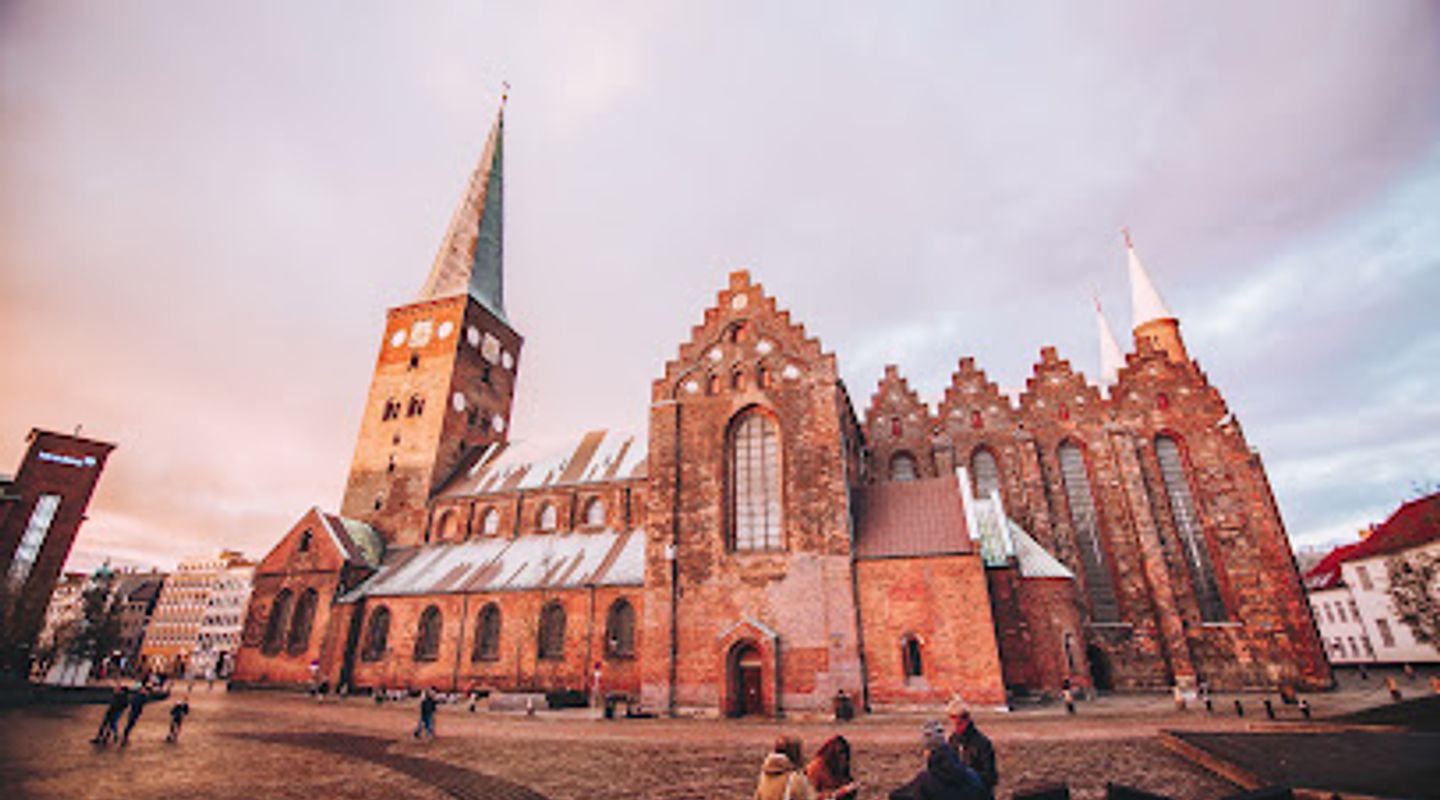
Rising above the cobblestones of Store Torv, Aarhus Cathedral is Denmark’s longest church and a defining landmark of the city’s historic centre. Begun in the late 12th century and later transformed into a soaring Gothic basilica, it blends Romanesque red-brick walls, luminous whitewashed vaults and delicate frescoes. Inside, a gilded late-medieval altarpiece by Bernt Notke, a monumental organ and richly painted chapels create a space that feels both austere and intricate. Entry to the church itself is free, and for a small fee you can climb the tower for wide views over Aarhus’ rooftops and harbour.
On-site amenities
 Restrooms
 Seating areas
 Sheltered areas
 Information boards
Opening hours
- Mon–Sat10 am–3 pm
- SunClosed
Opening hours as listed on the venue’s Google Business Profile. Hours can change for services and special events, so check with the venue before you go.
- Address
- Store Torv, 8000 Aarhus
- Phone
- Website
Getting there
City bus and tram within Aarhus
On foot from central Aarhus
Bicycle in the city centre
Regional train and short onward walk
Discover more about Aarhus Cathedral
A red-brick giant in the heart of Aarhus
Aarhus Cathedral dominates Store Torv with its tall copper-green spire and long red-brick body, instantly orienting you in the middle of the old town. Dedicated to St Clement, patron saint of sailors, it has always been closely tied to the sea routes that helped shape Aarhus. With a length of about 93 metres, it holds the title of Denmark’s longest church, and its nave can seat around 1,200 people, reflecting the city’s importance as a medieval trading centre.Although the exact start date is uncertain, work on the cathedral began in the last decades of the 12th century, overseen by Bishop Peter Vognsen. Early builders used red brick at a time when it was still a novel material in Denmark, giving the structure its warm, earthy appearance. Today, the remaining Romanesque walls and chapels along the eastern transept hint at that first, heavier basilica that once stood here.
From Romanesque roots to Gothic light
In the 15th century the cathedral underwent a dramatic transformation. A major rebuilding campaign replaced the relatively low, fortress-like interior with a much taller Gothic space inspired by churches of the Hanseatic towns around the Baltic. Cross and star vaulting lifted the ceilings high above the nave and aisles, while slender pillars and pointed arches drew the eye upward.The chancel was completely reimagined as a bright three-aisled space with an ambulatory and a ring of tall pointed windows. In daylight, these windows pour ribbons of light into the choir, illuminating the pale walls and making the building feel surprisingly airy for such a massive structure. This interplay of weighty brick and luminous Gothic detail is one of the cathedral’s most memorable qualities.
Altarpiece, frescoes and golden details
The cathedral’s showpiece is the large late-medieval altarpiece, created around 1479 by the Lübeck master Bernt Notke. Carved and richly gilded, it opens like a cupboard to reveal scenes from the life of Christ and saints associated with the cathedral, with figures coated in fine gold leaf. The central panels highlight St Clement and St John the Baptist, while the upper section depicts the Coronation of Mary surrounded by archangels.Running along the walls, a series of medieval frescoes survived later whitewashing and were uncovered during restorations. These paintings range from saints and biblical episodes to more symbolic images, adding colour and storytelling to the otherwise white interior. Elsewhere, iron latticework portals crafted by the German smith Caspar Fincke form intricate "golden" gates, especially the chancel portal with its circles and quadrangles symbolising heaven and humanity.
Music, silence and the rhythm of services
Beyond its architecture, Aarhus Cathedral is a working parish church and a key liturgical space for the city. Regular services, baptisms, weddings and concerts fill the calendar, and the building’s acoustics make it a favoured venue for choral and organ music. The large Baroque organ, mounted high on the wall, can fill the nave with powerful sound, from delicate solo passages to full, resonant chords.At quieter times the atmosphere shifts to hushed contemplation. Simple wooden pews, candle stands and side chapels offer corners to sit and let the scale of the building sink in. Visitors are asked to respect ongoing services, which may limit access to certain areas, but experiencing the cathedral during a hymn or organ prelude can be a highlight of a visit.
Climbing the tower and exploring the surroundings
For those willing to tackle a tight staircase, the cathedral tower can be climbed for a small fee when opening hours and church activities allow. The route winds up through the interior of the spire, past beams and bell frames, before emerging at viewpoints over the city. From here, rooftops, harbour cranes and the streets of the Latin Quarter spread out in every direction, underlining why the tower remains one of central Aarhus’ most recognisable silhouettes.Outside, Store Torv functions as an informal forecourt, framed by shops, cafés and neighbouring historic buildings. The cathedral’s façades, buttresses and spire repay a slow circuit around the exterior, especially where fragments of the older Romanesque structure meet later Gothic additions. Whether you step in for a brief look or linger to explore every chapel and detail, Aarhus Cathedral anchors any exploration of the city’s historic core.
Evendo Review Centre
 Google
Guest reviews
Best time to go
Quietest: Jan, Feb & Mar · before 7am or from 8pm
Busy times are Evendo estimates for a typical year, to help you plan. Actual crowds vary with events, school holidays and the weather.
Explore Aarhus Cathedral on the map
A handpicked selection of must-see spots near Aarhus Cathedral, mapped for you.
Get your free copy of our complete guide to Aarhus Cathedral, delivered straight to you.
Everything on this page, from opening hours and how to get there to Eve’s tips and the best time to go, in one PDF you can read offline, print or share.
Already have an account? Sign in
Your Aarhus Cathedral guide is ready.
We'll send it to · Not you? Sign out

Getting your guide ready…
We are putting together a fresh copy of the Aarhus Cathedral guide. This can take up to a minute.
This can take a few moments. If your browser asks, choose Allow so the download can start. You'll find the guide in your Downloads folder.
Nothing happened? Download it again
Sorry, the guide is taking longer than usual. Please try again in a minute, or get it by email instead.
Unlock the best of Aarhus Cathedral
Skip-the-line tickets, guided tours with entry, and walking tours of the area, booked in a few clicks.
 Tour with entry
Aarhus Walking Tour: Explore Top Sights & Hidden Gems
from $39.90 Tour with entry
Aarhus City Highlights Tour: History, Culture & Street Art
from $95.93 Tour with entry
Aarhus Private Custom Walking Tour With A Guide
from $111.92 Tour with entry
Surprise walk of Aarhus with a local
from $117.28


Other nearby places you may find interesting
The closest places of the same kind, if this one is not quite what you had in mind.
-
-
-
-
-


Swipe for more places
More to explore near Aarhus Cathedral

 Best experiences near Aarhus Cathedral
 Best hotels near Aarhus Cathedral
 Best landmarks near Aarhus Cathedral
 Best attractions near Aarhus Cathedral
 Best shops near Aarhus Cathedral
 Best restaurants near Aarhus Cathedral
 Best bars near Aarhus Cathedral
Do you manage this location?
Take control to get all the benefits, like improved information, better appearance, and stronger visibility across AI-powered discovery.
Explore more

Explore more of Aarhus
Discover Aarhus, Denmark's second-largest city, where ancient history meets modern culture. Explore historical sites, vibrant arts, and a thriving food scene in the City of Smiles.
Explore Aarhus
Explore more of Denmark
Discover Denmark: A perfect blend of history, modern design, and the cozy concept of hygge. Explore vibrant cities, serene landscapes, and world-class cuisine.
Explore Denmark
