

Ejegod Windmill Travel Guide
Free Guide: Denmark's most complete windmill ensemble—a 1816 octagonal landmark with original barn and miller's house.


A brief summary of Ejegod Windmill
Denmark's most complete windmill ensemble—a 1816 octagonal landmark with original barn and miller's house.
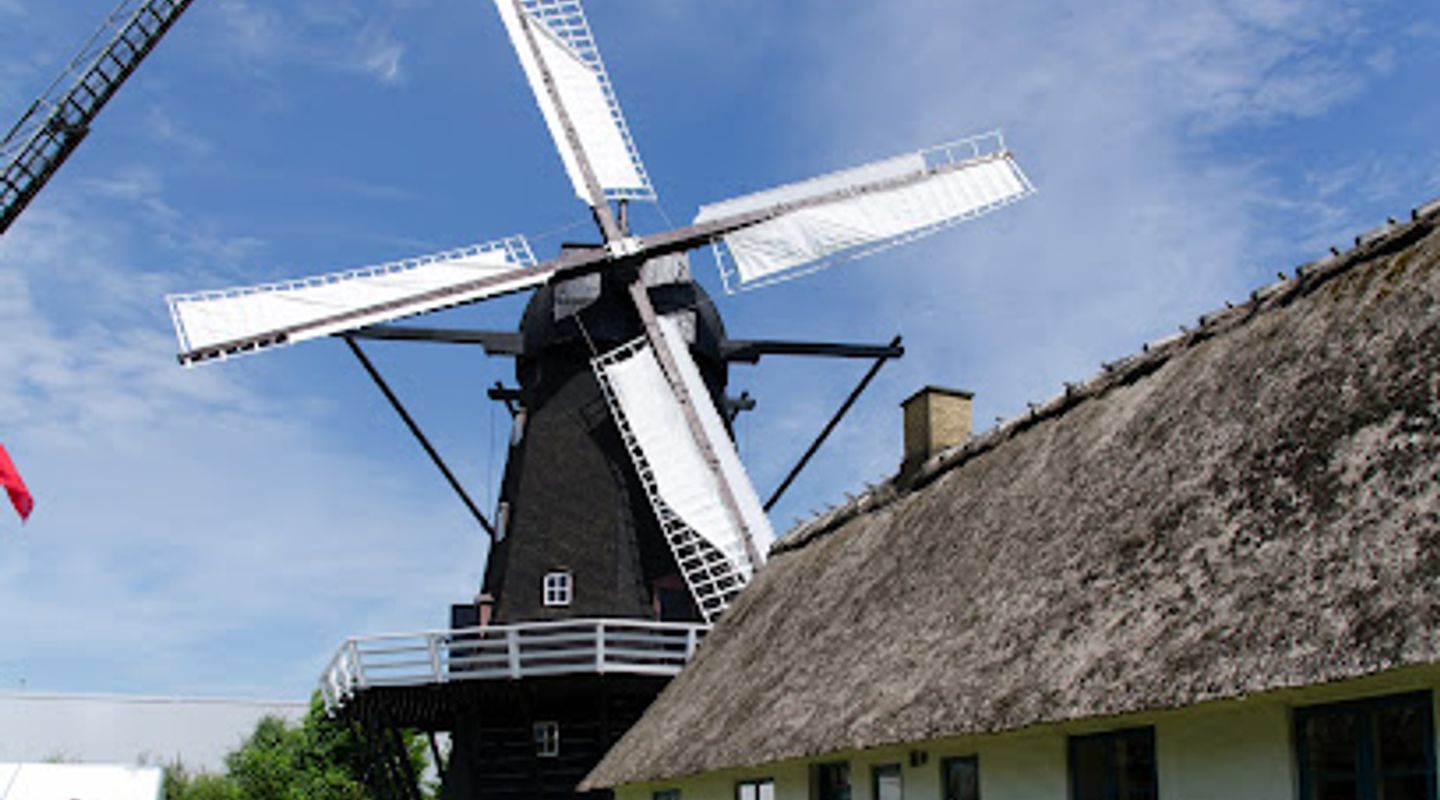
A striking octagonal Dutch windmill built in 1816, Ejegod Windmill stands as one of Denmark's most complete examples of traditional milling heritage. Located in northern Nykøbing Falster on the island of Falster, this protected landmark retains its original barn and miller's house—a rare ensemble in Danish architecture. Though the mill ceased operations in the mid-1950s, extensive restoration work between 2002 and 2010 has preserved its distinctive brick and shingle exterior. A toy museum now occupies the miller's house, offering visitors a glimpse into both industrial history and childhood nostalgia.
On-site amenities
 Restrooms
 Food options
 Seating areas
 Information boards
 Visitor centre
- Address
- Ejegodvej 4, 4800 Nykøbing Falster
- Phone
- Website
Getting there
By Car
By Bus
By Bicycle
On Foot
Discover more about Ejegod Windmill
A Monument to Danish Milling Heritage
Ejegod Windmill is a striking octagonal smock mill that has dominated the northern landscape of Nykøbing Falster since 1816. Built by diplomat Michael Classen for the now-demolished Ejegod farm, the mill represents a pivotal moment in Denmark's agricultural history. Its distinctive octagonal tower, constructed with a masonry foundation and fieldstone base, rises with brick-built lower sections faced in planks, while the upper portion is clad in shingles that match the ogee cap. The mill features automatic sails with manual yaw control, allowing millers to adjust to changing wind conditions with precision.What makes Ejegod Windmill exceptionally rare is its completeness. Unlike any other windmill remaining in Denmark, it still retains all of its original auxiliary buildings: a barn and the miller's house, both preserved in excellent condition. Together, these three structures form a unique historical ensemble that tells the story of how milling families lived and worked in 19th-century Denmark. The mill, barn, and miller's house were officially designated as a listed monument in 1964, recognizing their cultural significance.
From Working Mill to Cherished Landmark
For more than a century, Ejegod Windmill served as the economic and social heart of its community. The mill was operated by copyholders—tenant farmers who rented the land—among them Jens Nicolai Jappe, who came from a distinguished family of millers. However, by the 1850s, the mill began to face serious competition. A new stream-driven mill established in Nykøbing itself proved more efficient and reliable, gradually eroding the windmill's viability. By the mid-1950s, Ejegod Windmill ceased operations entirely, its working life spanning roughly 140 years.Following closure, the mill deteriorated steadily until 1939, when Nyborg Municipality acquired it to preserve this important piece of local heritage. Despite public ownership, the structure continued to decline through the mid-20th century. It was not until the 1960s and 1970s that a citizens' initiative sparked restoration efforts. These early conservation projects, though significant, were insufficient to halt further decay. The turning point came in 2002 when the guild Ejegod Møllelaug assumed stewardship of the site and launched an ambitious external restoration program.
Modern Preservation and Public Access
Between 2002 and 2010, Ejegod Møllelaug undertook extensive external restoration work that transformed the mill's appearance. The project included installing a new gallery and replacing the roof shingles, returning the structure to its historical appearance while ensuring structural integrity for future generations. The guild continues to raise funds for internal restoration, demonstrating a long-term commitment to preserving this irreplaceable landmark.In 2009, a toy museum opened within the adjoining miller's house, supported by Ejegod Møllelaug. This museum adds a layer of cultural interest to the site, inviting visitors to explore childhood heritage and the domestic life of milling families. While the windmill itself is not open for interior tours, the exterior can be enjoyed from the surrounding grounds, and the toy museum provides insight into the historical context of the site. The mill's location on Møllebakken in the northern part of town makes it accessible to visitors interested in heritage, architecture, and Denmark's industrial past.
Architectural Significance and Landscape Context
Originally standing in open countryside, Ejegod Windmill has gradually become integrated into the expanding town of Nykøbing Falster, yet it remains a visually dominant landmark that anchors the area's sense of place. The octagonal form, characteristic of Dutch-influenced smock mills, reflects the architectural traditions that shaped Danish milling culture. The combination of functional design and aesthetic presence makes the mill a compelling subject for photographers and heritage enthusiasts alike.Today, under the stewardship of Guldborgsund Municipality and the dedicated work of Ejegod Møllelaug, the windmill stands as a living testament to Denmark's agricultural heritage and the ingenuity of traditional craftspeople. Its preservation ensures that future generations can appreciate the engineering, craftsmanship, and social history embedded in this remarkable structure.
Evendo Review Centre
 Google
Guest reviews
Best time to go
Quietest: Jan, Feb & Dec · before 7am or from 8pm
Busy times are Evendo estimates for a typical year, to help you plan. Actual crowds vary with events, school holidays and the weather.
Explore Ejegod Windmill on the map
A handpicked selection of must-see spots near Ejegod Windmill, mapped for you.
Get your free copy of our complete guide to Ejegod Windmill, delivered straight to you.
Everything on this page, from opening hours and how to get there to Eve’s tips and the best time to go, in one PDF you can read offline, print or share.
Already have an account? Sign in
Your Ejegod Windmill guide is ready.
We'll send it to · Not you? Sign out

Getting your guide ready…
We are putting together a fresh copy of the Ejegod Windmill guide. This can take up to a minute.
This can take a few moments. If your browser asks, choose Allow so the download can start. You'll find the guide in your Downloads folder.
Nothing happened? Download it again
Sorry, the guide is taking longer than usual. Please try again in a minute, or get it by email instead.
Other nearby places you may find interesting
The closest places of the same kind, if this one is not quite what you had in mind.
-
-
-
-
-


Swipe for more places
More to explore near Ejegod Windmill

 Best experiences near Ejegod Windmill
 Best hotels near Ejegod Windmill
 Best landmarks near Ejegod Windmill
 Best attractions near Ejegod Windmill
 Best shops near Ejegod Windmill
 Best restaurants near Ejegod Windmill
 Best bars near Ejegod Windmill
Do you manage this location?
Take control to get all the benefits, like improved information, better appearance, and stronger visibility across AI-powered discovery.
Explore more

Explore more of Lolland-Falster
Discover Lolland-Falster: Denmark's serene southern islands with stunning beaches, historic castles, and charming coastal towns offering a perfect blend of nature and culture.
Explore Lolland-Falster
Explore more of Denmark
Discover Denmark: A perfect blend of history, modern design, and the cozy concept of hygge. Explore vibrant cities, serene landscapes, and world-class cuisine.
Explore Denmark
