Bjørnebrønden Travel Guide
Free Guide: Granite bear, flowing water and royal history converge in this compact fountain that anchors Nykøbing Falster’s main square and its stories.


A brief summary of Bjørnebrønden
Granite bear, flowing water and royal history converge in this compact fountain that anchors Nykøbing Falster’s main square and its stories.
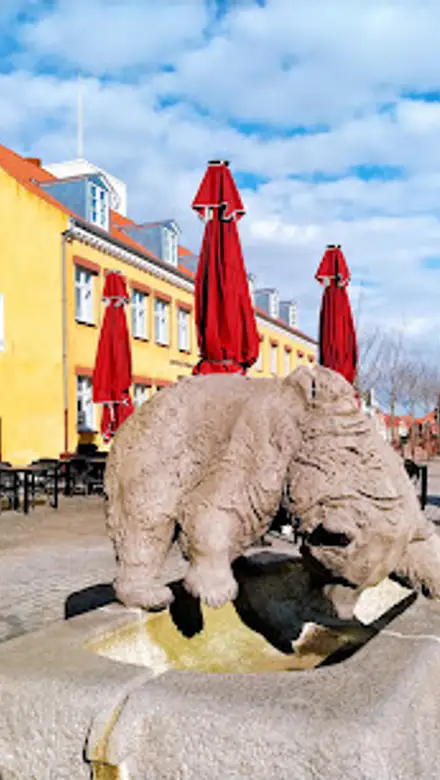
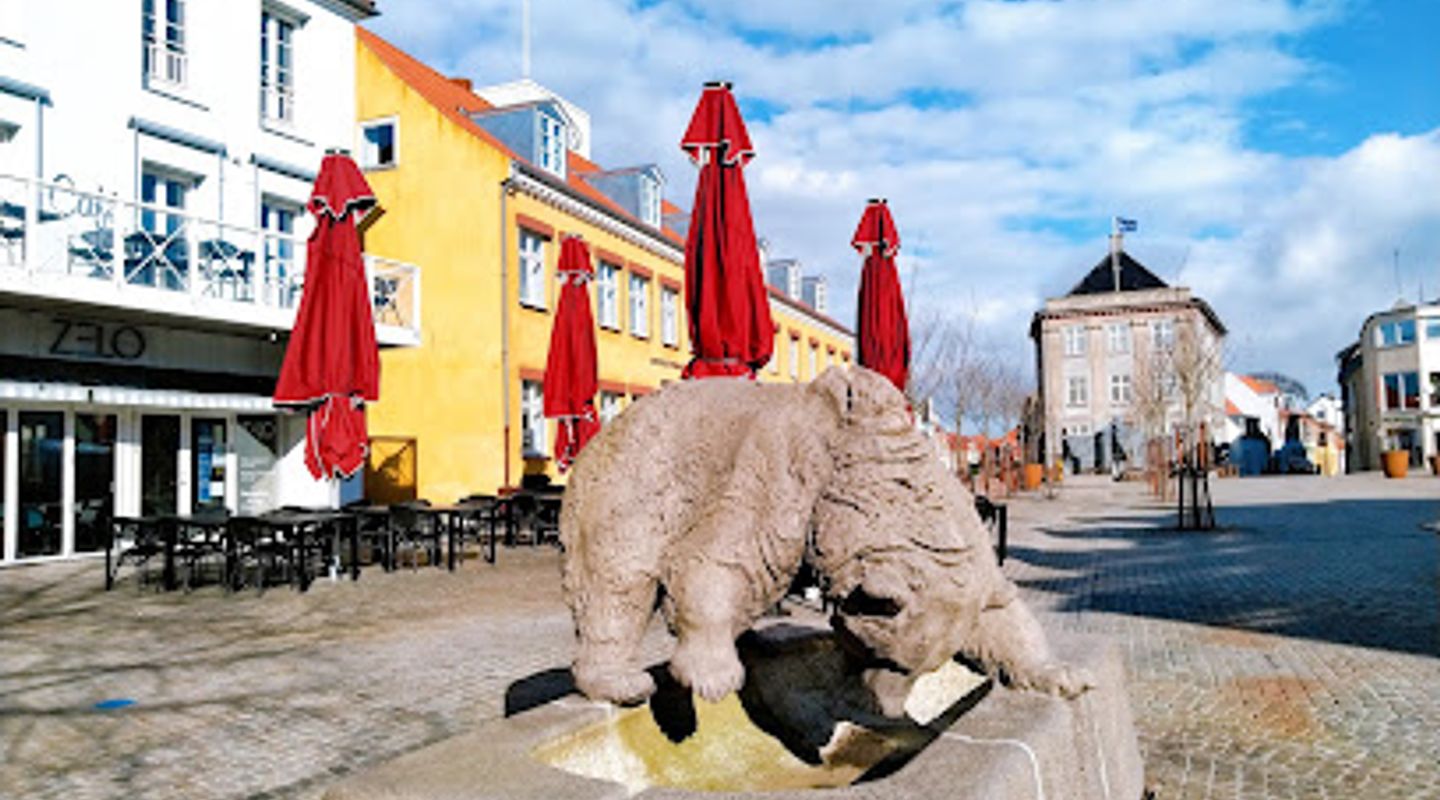
Bjørnebrønden, the Bear Fountain, anchors the main square of Nykøbing Falster with a striking granite bear poised above a circular well. Created by sculptor Mogens Bøggild and architect Kaare Klint, the 1939 fountain commemorates both the town’s 400th anniversary as a market town and Tsar Peter the Great’s visit in 1716. Encircled by benches and framed by the historic facades of Torvet, it serves as a compact open-air monument where local history, Danish design and everyday town life meet.
On-site amenities
 Seating areas
 Trash bins
 Information boards
 Food options
 Drink options
 Restrooms
- Address
- Torvet 11, 4800 Nykøbing Falster
Getting there
Train and short walk from Nykøbing Falster Station
Regional bus into central Nykøbing Falster
Car access to Nykøbing Falster centre
Discover more about Bjørnebrønden
A granite bear at the heart of the market town
Bjørnebrønden sits almost exactly where Nykøbing Falster’s daily life converges: the main square, Torvet. Here, a powerful granite bear rises above a low, circular basin, its body rendered with the characteristic realism of Danish sculptor Mogens Bøggild. Carved from stone quarried on Bornholm, the sculpture has a quiet solidity that suits the often breezy square, while the constant ripple of water softens its muscular pose.The fountain was installed in 1939 to mark 400 years since Nykøbing Falster received its market town charter. The commission brought together two major Danish figures: Bøggild as sculptor and Kaare Klint as architect for the setting. Their collaboration created not just a piece of sculpture, but a small, coherent urban space with carefully considered paving, steps and seating around the basin.
A tribute to a royal visitor from the east
The bear carries a story that predates the fountain itself by more than two centuries. In 1716, Tsar Peter the Great of Russia visited Nykøbing Falster and dined at a local inn, a timber-and-brick house from the late 1500s now known as Czarens Hus. The fountain was intended as a symbolic nod to that visit, drawing on the bear as a widely recognised emblem of Russia and its ruler.By choosing the bear, the designers linked the town’s central square directly to the Tsar’s House a short distance away. The fountain thus functions as a stone reminder of an episode when this small market town briefly stood in the orbit of great power politics, at a time when fleets and armies moved through the Baltic region.
Designing a square around a sculpture
From the outset, Bjørnebrønden was conceived as the focal point of a redesigned civic space. Klint argued for surroundings that would give the fountain “a work of art of rank” the setting it deserved. The final layout used gentle circular steps, low walls and round benches to draw the eye inwards and invite people to sit, talk and watch the life of the square unfold.A later renovation in the early 2000s restored these elements in oak and stone, replanting the trees and carefully respecting the original drawings. The ensemble of bear, basin, paving and benches has become part of the town’s cultural fabric, even as the square has seen further changes and debates about how best to adapt the space for modern events and uses.
A meeting place between history and everyday life
Today, the fountain is less a grand monument and more a familiar companion to daily routines. Market stalls, seasonal events and small concerts animate the square, while the bear stands in the middle as an unhurried observer. Children often gravitate towards the edge of the basin, and the steps around it offer an impromptu amphitheatre for people-watching or a quick pause with a coffee.Look up from the sculpture and you are surrounded by the architecture of a Danish market town: gabled facades, shopfronts, cafés and the subtle slope of the square. In this setting, Bjørnebrønden operates almost like a compass point, a fixed reference as you orient yourself among the streets radiating away from Torvet.
Reading layers of Nykøbing Falster’s story
Spending a little time at Bjørnebrønden reveals how a single artwork can hold multiple narratives. It marks the legal milestone that shaped Nykøbing Falster’s growth as a trading town. It recalls an early 18th-century visit by a foreign ruler whose presence is still traceable in the nearby Czarens Hus. It also showcases a 20th-century moment when Danish modern design engaged with public space, insisting that even modest provincial squares deserved thoughtful, well-crafted art.For visitors, this compact fountain offers a convenient starting point for exploring the rest of the town: the remains of the old castle by the water, the museum collections, or simply the side streets of shops and houses. Yet even without moving on, lingering by the bear is enough to sense how centuries of local and international history have quietly passed through this small corner of Torvet.
Evendo Review Centre
 Google
Guest reviews
Best time to go
Quietest: Jan, Feb & Mar · before 7am
Busy times are Evendo estimates for a typical year, to help you plan. Actual crowds vary with events, school holidays and the weather.
Explore Bjørnebrønden on the map
A handpicked selection of must-see spots near Bjørnebrønden, mapped for you.
Get your free copy of our complete guide to Bjørnebrønden, delivered straight to you.
Everything on this page, from opening hours and how to get there to Eve’s tips and the best time to go, in one PDF you can read offline, print or share.
Already have an account? Sign in
Your Bjørnebrønden guide is ready.
We'll send it to · Not you? Sign out

Getting your guide ready…
We are putting together a fresh copy of the Bjørnebrønden guide. This can take up to a minute.
This can take a few moments. If your browser asks, choose Allow so the download can start. You'll find the guide in your Downloads folder.
Nothing happened? Download it again
Sorry, the guide is taking longer than usual. Please try again in a minute, or get it by email instead.
Other nearby places you may find interesting
The closest places of the same kind, if this one is not quite what you had in mind.
-
-
-
-
-


Swipe for more places
More to explore near Bjørnebrønden

 Best experiences near Bjørnebrønden
 Best hotels near Bjørnebrønden
 Best landmarks near Bjørnebrønden
 Best attractions near Bjørnebrønden
 Best shops near Bjørnebrønden
 Best restaurants near Bjørnebrønden
 Best bars near Bjørnebrønden
Do you manage this location?
Take control to get all the benefits, like improved information, better appearance, and stronger visibility across AI-powered discovery.
Explore more

Explore more of Falster
Discover Falster: A blend of serene beaches, rich history, and lush landscapes in Denmark's southern island treasure.
Explore Falster
Explore more of Denmark
Discover Denmark: A perfect blend of history, modern design, and the cozy concept of hygge. Explore vibrant cities, serene landscapes, and world-class cuisine.
Explore Denmark