

Trehøje Mols Travel Guide
Free Guide: Three Bronze Age hilltop mounds with sweeping sea-to-sea panoramas, heathland colours and classic glacial scenery in the heart of Mols Bjerge National Park.


A brief summary of Trehøje Mols
Three Bronze Age hilltop mounds with sweeping sea-to-sea panoramas, heathland colours and classic glacial scenery in the heart of Mols Bjerge National Park.
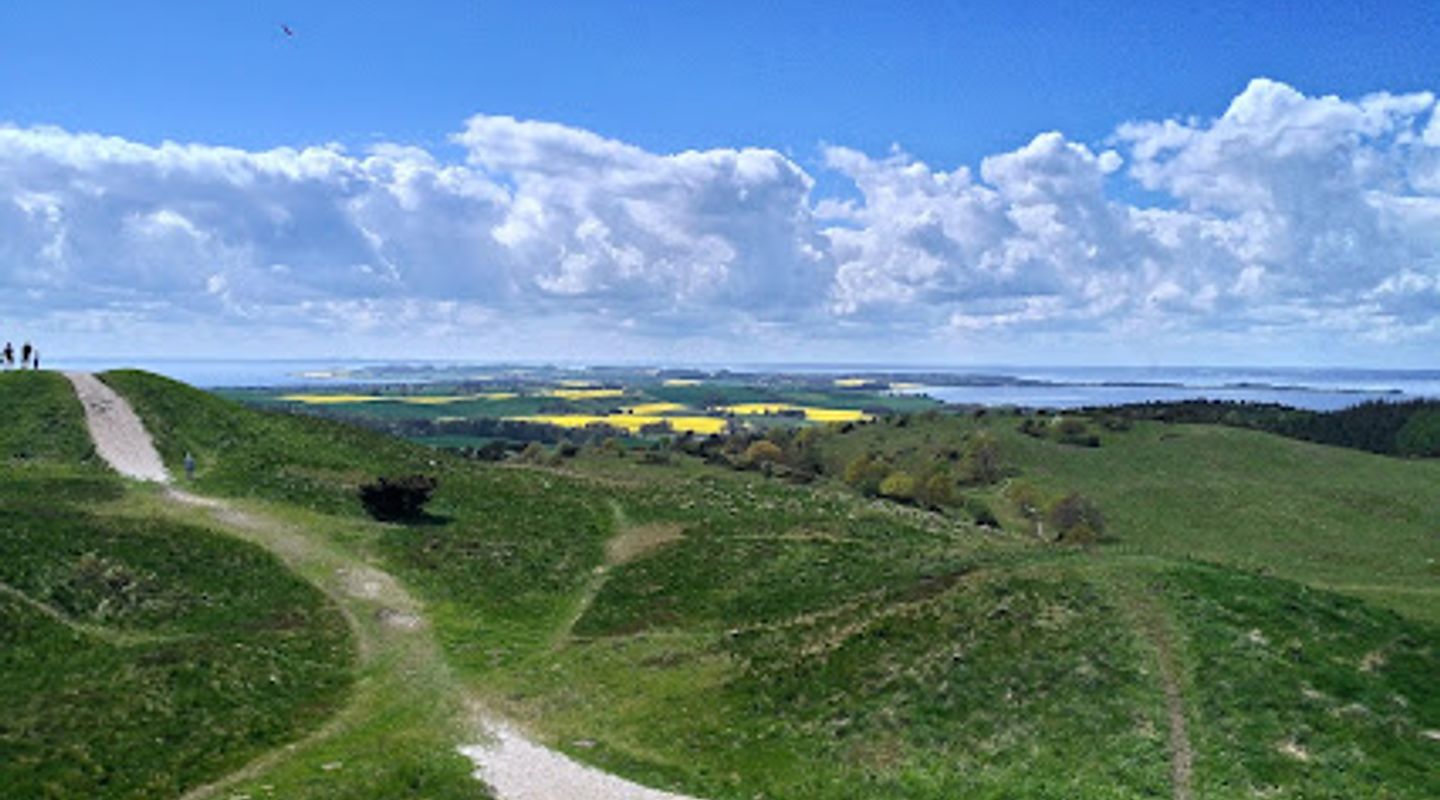
Trehøje rises as three distinct Bronze Age burial mounds atop the rolling hills of Mols Bjerge National Park near Knebel. At 127 metres above sea level, this open, windswept ridge offers one of Denmark’s most expansive panoramas, with views stretching from Aarhus Bay towards Ebeltoft and across inlets like Kalø, Begtrup and Knebel. Heathland, grazing pastures and glacial landforms create a classic Danish landscape that feels both ancient and wide open.
On-site amenities
 Information boards
 Trash bins
Opening hours
- Every dayOpen 24 hours
Opening hours as listed on the venue’s Google Business Profile. Hours can change for services and special events, so check with the venue before you go.
- Address
- 8420 Knebel
Getting there
Car from Aarhus
Bus and walking from Ebeltoft
Cycling in Mols Bjerge
Discover more about Trehøje Mols
Ancient mounds on a windswept ridge
Trehøje is a trio of Bronze Age burial mounds set along a high ridge in the heart of Mols Bjerge National Park. Standing here, you are quite literally on top of history: the mounds were raised more than 3,000 years ago as monumental graves for local elites, their silhouettes still clearly visible against the sky. The gentle approach up the hillside suddenly gives way to a surprisingly lofty summit, as the land rises steeply from the surrounding coast.At 127 metres above sea level, the mounds are not just archaeological monuments but also perfect natural vantage points. Simple grass paths weave between the rounded humps, inviting you to wander quietly from one to the next, pausing to imagine the rituals and beliefs that once centred on this exposed hilltop.
Panoramas across bays, inlets and islands
The real drama at Trehøje is the view. From the ridge you can sweep your gaze from Aarhus in the west, across Kalø, Begtrup and Knebel inlets, all the way towards Ebeltoft and, on very clear days, as far as Sjællands Odde on Zealand. Water seems to appear in almost every direction, tracing the deeply indented coastline that defines Djursland.The landscape below is a patchwork of fields, small villages and wooded slopes. To one side lies the town of Ebeltoft with its harbour and old-town rooftops; to another, the village of Knebel sits snugly by its bay. Far off, the Helgenæs peninsula stretches into the sea. On bright days the light over the bays can be dazzling; on misty mornings, low clouds and drifting fog soften the contours into muted layers.
Heathland colours and glacial shapes
Around the mounds, some of Denmark’s finest grazed heathland spreads over the hills. In high summer the dry grasslands turn almost brownish-purple as tufted grasses bloom, punctuated by brighter patches of heather. Sheep and cattle often graze here, keeping the vegetation low and preserving the open, windswept character of the hills.Under your feet is a textbook example of glacial landscape. The ridges, hollows and undulating slopes of Mols Bjerge were sculpted by ice and meltwater more than 10,000 years ago. From Trehøje, you can easily trace these forms in the terrain: steep-sided valleys, rounded summits and gentle shelves of land that step down towards the bays. Information boards in the wider national park help explain how ice sheets carved and deposited the sediments that became this distinctive terrain.
Walking, pausing and simply looking
Visiting Trehøje is essentially about being outdoors and taking your time. Narrow footpaths lead across open fields to the hilltops, with short but sometimes steep stretches that can be slippery in wet weather. Once up, you can follow the ridge between the three mounds or sit in the lee of a slope to shelter from the wind. Many travellers bring a small picnic or a thermos to enjoy on the grass.The exposed position means that conditions change quickly. On clear, calm days, it is an inviting place to sit for an hour or more, watching clouds drift and light shift across the bays. In strong winds you feel the full force of the weather, which can be exhilarating but also chilly even in summer. Sunrise and late evening light can be particularly atmospheric, though paths are unlit and the ground uneven, so good footwear and a flashlight are sensible if you linger.
A gateway to the wider Mols Bjerge
Trehøje also works as a natural anchor point for exploring the rest of Mols Bjerge National Park. From the hilltops you can spot Agri Bavnehøj, the park’s highest point, as well as other notable features such as kettle holes and additional burial mounds scattered over the ridges. Waymarked hiking trails in the area link Trehøje with nearby viewpoints and valleys, making it easy to extend a short visit into a half- or full-day walk.Despite its modest facilities, the site captures much of what makes Djursland special: big skies, open land, visible layers of history and a constant sense of sea close by. Whether you are pausing on a wider road trip or using Knebel or Ebeltoft as a base, Trehøje offers a compact yet far-reaching experience of the Danish landscape.
Evendo Review Centre
 Google
Guest reviews
Best time to go
Quietest: Jan, Feb & Mar · before 6am or from 9pm
Busy times are Evendo estimates for a typical year, to help you plan. Actual crowds vary with events, school holidays and the weather.
Explore Trehøje Mols on the map
A handpicked selection of must-see spots near Trehøje Mols, mapped for you.
Get your free copy of our complete guide to Trehøje Mols, delivered straight to you.
Everything on this page, from opening hours and how to get there to Eve’s tips and the best time to go, in one PDF you can read offline, print or share.
Already have an account? Sign in
Your Trehøje Mols guide is ready.
We'll send it to · Not you? Sign out

Getting your guide ready…
We are putting together a fresh copy of the Trehøje Mols guide. This can take up to a minute.
This can take a few moments. If your browser asks, choose Allow so the download can start. You'll find the guide in your Downloads folder.
Nothing happened? Download it again
Sorry, the guide is taking longer than usual. Please try again in a minute, or get it by email instead.
Other nearby places you may find interesting
The closest places of the same kind, if this one is not quite what you had in mind.
-
-
-
-
-


Swipe for more places
More to explore near Trehøje Mols

 Best experiences near Trehøje Mols
 Best hotels near Trehøje Mols
 Best landmarks near Trehøje Mols
 Best attractions near Trehøje Mols
 Best shops near Trehøje Mols
 Best restaurants near Trehøje Mols
 Best bars near Trehøje Mols
Do you manage this location?
Take control to get all the benefits, like improved information, better appearance, and stronger visibility across AI-powered discovery.
Explore more

Explore more of Mols Bjerge
Discover the natural beauty and historical charm of Mols Bjerge, Denmark's captivating national park in the heart of Djursland, perfect for nature lovers and adventurers.
Explore Mols Bjerge
Explore more of Denmark
Discover Denmark: A perfect blend of history, modern design, and the cozy concept of hygge. Explore vibrant cities, serene landscapes, and world-class cuisine.
Explore Denmark
