

King's Redoubt Travel Guide
Free Guide: Open earthworks, fluttering flags and far-reaching views on the Dybbøl Heights tell the story of war, loss and reunification at King’s Redoubt near Sønderborg.


A brief summary of King's Redoubt
Open earthworks, fluttering flags and far-reaching views on the Dybbøl Heights tell the story of war, loss and reunification at King’s Redoubt near Sønderborg.
King’s Redoubt (Kongeskansen) crowns the Dybbøl Heights near Sønderborg, overlooking the waters of Als and one of Denmark’s most symbolically charged landscapes. Part of the Dybbøl fortifications from the 1864 war between Denmark and Prussia, this open earthwork and memorial area combines sweeping views with heavy history. Today it is a peaceful grassy redoubt and ceremony site, closely linked with nearby Dybbøl Mill and the history centre, where flags, monuments and quiet paths invite reflection on loss, resilience and reunification.
On-site amenities
 Seating areas
 Trash bins
 Information boards
- Address
- 6400 Sønderborg
- Website
Getting there
Train and local bus from within Southern Jutland
Car from Sønderborg and nearby towns
Cycling from central Sønderborg
Walking from the Dybbøl area
Discover more about King's Redoubt
A hilltop battlefield turned national symbol
King’s Redoubt, or Kongeskansen, sits on the Dybbøl Heights just west of Sønderborg, at the heart of the landscape where Denmark fought Prussia in the war of 1864. From this grassy earthwork the Danish king watched parts of the fighting, giving the position its name. Today the low ramparts, flagpoles and memorial stones are all that hint at the trenches, gun positions and chaos that once filled this ridge.Standing here you look across undulating farmland and out towards the waters separating Jutland from the island of Als. It is a calm scene that sharply contrasts with the artillery duels and infantry assaults that once raged around these slopes. Informal paths and open lawns make it easy to wander, pause and let the historical weight of the place sink in.
Traces of the Dybbøl fortifications
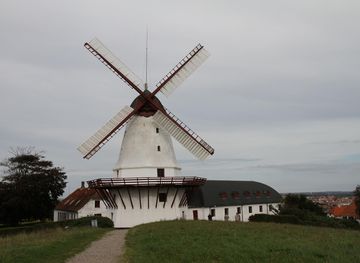
Kongeskansen was part of a wider belt of redoubts and entrenchments that lined the heights at Dybbøl, designed to protect the approaches to Sønderborg and Als. The original ramparts have softened over time, but you can still read their outlines in the ground, with raised banks, shallow ditches and strategic viewpoints over the surrounding terrain.Nearby you may glimpse Dybbøl Mill and, slightly further, the modern history centre, which together help explain the broader story of the 1864 conflict. Up here, though, interpretation is subtler: a few stones, plaques and flags, combined with the topography itself, let you imagine lines of soldiers, field guns and observation posts that once dominated this ridge.
From defeat to reunification
The defeat at Dybbøl in 1864 led to Denmark losing large tracts of territory, including Sønderjylland. For decades this frontier region remained outside the kingdom, and the landscape around Kongeskansen became closely associated with national mourning and reflection. After the 1920 plebiscite and the drawing of the modern Danish–German border, the area took on a new meaning as a symbol of reunification.Commemorative stones and ceremonies held at Kongeskansen mark this shift from loss to regained identity. The site is still used for official gatherings, anniversaries and flag events, which underline its ongoing role in Danish collective memory. When flags move gently in the wind above the old ramparts, you are witnessing a living tradition rather than a frozen monument.
A contemplative green space above Sønderborg
Despite its sombre backstory, King’s Redoubt today is a surprisingly peaceful green space. Simple grass, scattered trees and open sky dominate the experience, with few built structures to distract from the sense of landscape and horizon. The area feels informal and welcoming, more like a hilltop park shaped by history than a strictly curated monument.It is an easy place to linger: you can sit on the grass along the earthworks, take in views towards Sønderborg and Als, or follow short loops that link to other parts of the Dybbøl Heights. The setting makes it well suited to quiet reflection, low-key picnics and unhurried conversations about history, identity and the meaning of borders.
Exploring the wider Dybbøl Heights
Kongeskansen links naturally with the wider Dybbøl landscape, including Dybbøl Mill, the history centre and additional redoubts. Spending time here adds a spatial dimension to any museum visit: you can match maps and exhibits with real contours under your feet. Weather plays a big part in the atmosphere; on clear days the views underscore the strategic importance of the ridge, while mist or low clouds add a more introspective mood.Because the site is largely open and unfenced, you can explore at your own rhythm. There is no formal entrance sequence, just gentle slopes leading up to the earthworks. Whether you stay briefly to absorb the view or spend longer walking between related sites on the heights, King’s Redoubt offers a quietly powerful encounter with Denmark’s modern history in the open air.
Evendo Review Centre
 Google
Guest reviews
Best time to go
Quietest: Jan, Feb & Nov · before 8am or at 8pm
Busy times are Evendo estimates for a typical year, to help you plan. Actual crowds vary with events, school holidays and the weather.
Explore King's Redoubt on the map
A handpicked selection of must-see spots near King's Redoubt, mapped for you.
Get your free copy of our complete guide to King's Redoubt, delivered straight to you.
Everything on this page, from opening hours and how to get there to Eve’s tips and the best time to go, in one PDF you can read offline, print or share.
Already have an account? Sign in
Your King's Redoubt guide is ready.
We'll send it to · Not you? Sign out

Getting your guide ready…
We are putting together a fresh copy of the King's Redoubt guide. This can take up to a minute.
This can take a few moments. If your browser asks, choose Allow so the download can start. You'll find the guide in your Downloads folder.
Nothing happened? Download it again
Sorry, the guide is taking longer than usual. Please try again in a minute, or get it by email instead.
Other nearby places you may find interesting
The closest places of the same kind, if this one is not quite what you had in mind.
-
-
-
-
-


Swipe for more places
More to explore near King's Redoubt

 Best experiences near King's Redoubt

 Best hotels near King's Redoubt

 Best landmarks near King's Redoubt

 Best attractions near King's Redoubt

 Best shops near King's Redoubt

 Best restaurants near King's Redoubt

 Best bars near King's Redoubt
Do you manage this location?
Take control to get all the benefits, like improved information, better appearance, and stronger visibility across AI-powered discovery.
Explore more
Explore more of Sønderjylland
Sønderjylland: A Journey Through Denmark's Scenic Landscapes, Rich History, and Vibrant Traditions.
Explore Sønderjylland
Explore more of Denmark
Discover Denmark: A perfect blend of history, modern design, and the cozy concept of hygge. Explore vibrant cities, serene landscapes, and world-class cuisine.
Explore Denmark
