
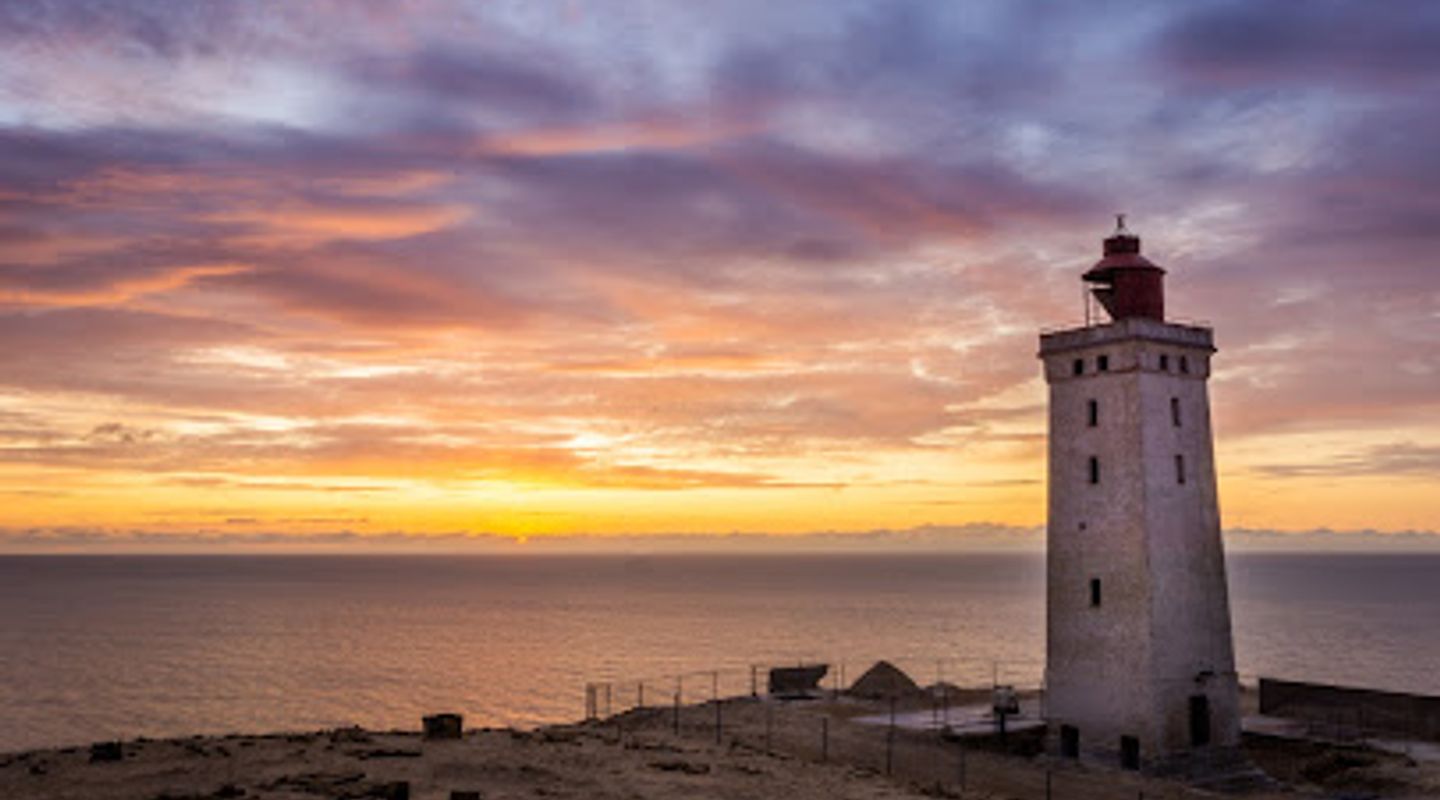
Rubjerg Knude, The North Sea Islands Travel Guide
A windswept dune, a rolling sea and a lighthouse that had to move to survive – Rubjerg Knude is Denmark’s most dramatic lesson in living coastal change.
High above Denmark’s wild North Sea, Rubjerg Knude is a vast, shifting coastal dune crowned by a solitary lighthouse. Once safely inland, the 23 m Rubjerg Knude Fyr has spent more than a century battling erosion and blowing sand, so dramatically that in 2019 it was moved about 70 m inland to delay its fall into the sea. Today you can climb the tower, wander the pale dunes and gaze over the steep cliffs, a vivid, windswept lesson in the raw power of nature.
A brief summary to Rubjerg Knude
- Fyrvejen 110, Løkken, 9480, DK
- Click to display
- Duration: 1 to 3 hours
- Free
-
 Outdoor
- Mobile reception: 4 out of 5

Know before you go
Hi, I'm Eve. Here are a few practical things to know before exploring Rubjerg Knude.
- Wear windproof layers and shoes that cope with soft sand; the exposed dune can feel significantly colder and windier than inland areas.
- Aim for sunrise or sunset for softer light, fewer people and spectacular views from the top of the lighthouse over the North Sea.
- Bring water and snacks from town; there are no facilities on the dune itself, only basic amenities at the parking areas.
- If you have limited mobility, you can reach the base of the sandbank on a firm gravel path, but the final stretch to the lighthouse is on deep sand.
- Check the wind forecast in advance and avoid days with gale-force conditions, when sandblasting on the ridge can be uncomfortable.
Do you manage this location?
Take control to get all the benefits, like improved information, better appearance, and stronger visibility across AI-powered discovery. Learn more about listing your business on Evendo
Activate your presenceOther nearby places you may find interesting
The closest places of the same kind, if this one is not quite what you had in mind.
Explore Rubjerg Knude on the Map
A handpicked selection of must-see spots near Rubjerg Knude, mapped for you.
Getting There
-
Car from Hjørring
From Hjørring, driving to Rubjerg Knude via the main local routes typically takes 20–30 minutes, depending on traffic. Parking at Fyrvejen near the lighthouse is free, and from the car parks you should allow another 15–25 minutes on foot across firm paths and sand to reach the dune. There are no entrance or parking fees, but in summer the car parks can fill quickly, so arriving earlier in the day helps avoid congestion.
-
Car from Aalborg
Travelling from Aalborg by car usually takes about 55–75 minutes through North Jutland’s countryside. The route uses major regional roads almost the entire way, making it straightforward in all seasons except during severe winter weather. Parking at the signed lots by Fyrvejen and Rubjergvej is free, and from there the walk to the lighthouse is roughly 1–1.5 kilometres over mixed gravel path and soft sand, which is not suitable for wheelchairs or strollers with small wheels.
-
Bus and walk via Lønstrup
Public transport travellers can use regional buses from Hjørring to Lønstrup; the ride usually takes 25–40 minutes and standard single tickets typically cost around 30–60 DKK, depending on operator and discounts. From Lønstrup’s church area it is about 3.5 kilometres on foot along established coastal paths and tracks to Rubjerg Knude, taking 45–70 minutes. The walk includes sandy stretches and some exposed sections along the cliff, so it is best in dry, daylight conditions.
-
Cycling from Løkken
From Løkken, confident cyclists can follow local roads and signposted cycle routes toward Rubjerg Knude, usually taking 30–50 minutes each way at a relaxed pace. The terrain is gently rolling but exposed to wind from the sea. There is no charge to bring a bike, and you can leave it at the bike racks or along the edge of the parking areas before continuing on foot across the dune. Strong coastal winds and occasional showers mean waterproof layers are advisable outside high summer.
For the on-the-go comforts that matter to you
-
 Restrooms
-
 Seating Areas
-
 Picnic Areas
-
 Trash Bins
-
 Information Boards
-
 Visitor Center
Discover more about Rubjerg Knude
Where Sand, Sea and a Lone Lighthouse Meet
Rubjerg Knude rises like a pale desert above the Danish North Sea coast, its soft dunes spilling toward a sheer cliff that drops to the surf below. Perched on this sandy ridge is Rubjerg Knude Fyr, a slender 23 m lighthouse that has become one of Denmark’s most distinctive coastal landmarks. The landscape feels almost otherworldly: cream-coloured sand underfoot, a restless grey-blue sea ahead and little to break the horizon but sky and waves.From the top of the dune, you stand roughly 90 m above sea level, with sweeping views along the Jutland coastline. On clear days, the panorama stretches far across Vendsyssel, while below you the North Sea crashes into the eroding clay cliffs. This collision of elements is what created Rubjerg Knude – and what continues to reshape it year after year.A Lighthouse Built to Last, Then Set in Motion
Construction of Rubjerg Knude Fyr began in 1899, when the coast here seemed stable and the sea lay more than 200 m away. The light was first lit in 1900, guiding ships along a busy but treacherous stretch of water. For decades it worked tirelessly, its beam powered first by gas, then petroleum and later electricity. But the combination of strong westerly winds and powerful waves soon turned on the lighthouse that watched over them.As storms ate into the cliff, the shoreline marched steadily inland, while wind drove sand up from the beach to bury the surrounding buildings. By the 1960s the dunes had grown so high that the lighthouse was often invisible from the sea, and its function was abandoned in 1968. A small museum operated for some years but also succumbed to the drifting sand. For a long time it was expected that the entire tower would collapse into the sea in the early 2020s, a slow-motion disaster everyone could date but not prevent.The Day the Lighthouse Rolled Inland
Instead of surrendering, engineers devised an audacious plan: move the entire lighthouse away from the crumbling edge. In October 2019, the brick tower was jacked up, set on steel rails and inched about 70 m inland in a carefully choreographed operation that drew huge crowds. In just a few hours the building that had stood in one place for more than a century rolled to a new position atop the dune.The move bought the lighthouse perhaps another 20 to 40 years before erosion again threatens its foundations. Today subtle traces of that feat remain in the landscape, and information panels near the tower explain both the engineering challenge and the wider story of coastal change. Standing beside the lighthouse, it is striking to imagine how far inland it once stood and how quickly the sea has advanced.Walking the Dunes and Climbing the Tower
Visiting Rubjerg Knude is as much about the journey across the sand as it is about the lighthouse itself. From the car parks near Fyrvejen and Rubjergvej, sandy paths lead through low heath and fenced grazing to the foot of the main dune. The final approach is on soft, shifting sand that can feel surprisingly strenuous, especially in strong wind. Each step sinks slightly, and the landscape ahead seems to move as gusts lift ripples of sand into the air.At the tower, a metal staircase inside allows you to climb to the former lantern room. From here, glassless openings frame the North Sea, steep cliffs and endless dunes in every direction. It is an exhilarating, slightly vertiginous vantage point, particularly when the wind whistles around the brickwork. Many visitors linger to trace the lines of coastal erosion, watch paragliders catch the updrafts along the cliff or simply sit on the sand and listen to the dull roar of the waves below.Nature on Its Own Terms
Rubjerg Knude is open at all hours and entry is free, underscoring its character as a piece of living coastline rather than a conventional attraction. There are no cafés on the dune itself, and the experience is shaped entirely by weather and light. On calm, hazy days the sea can look almost silky; in winter storms the wind drives sand in sheets across the ridge and the spray below turns the air to mist.The environment here is fragile. Vegetation struggles to gain a foothold, and every footprint is quickly softened by the wind, only to be replaced by new ones as more people arrive. It is an ideal place to reflect on how dynamic coastlines are, and how human structures adapt – or fail to adapt – to that reality. As you leave, the lighthouse gradually shrinks back into the dune, a pale vertical mark in a shifting sea of sand that will continue to change long after today’s visit.












Your all‑in‑one travel companion app
Explore expert travel guides, compare and book tours, experiences, hotels, and more—all from the palm of your hand. Download now for seamless trip planning wherever your wanderlust takes you.


Explore More of The North Sea Islands
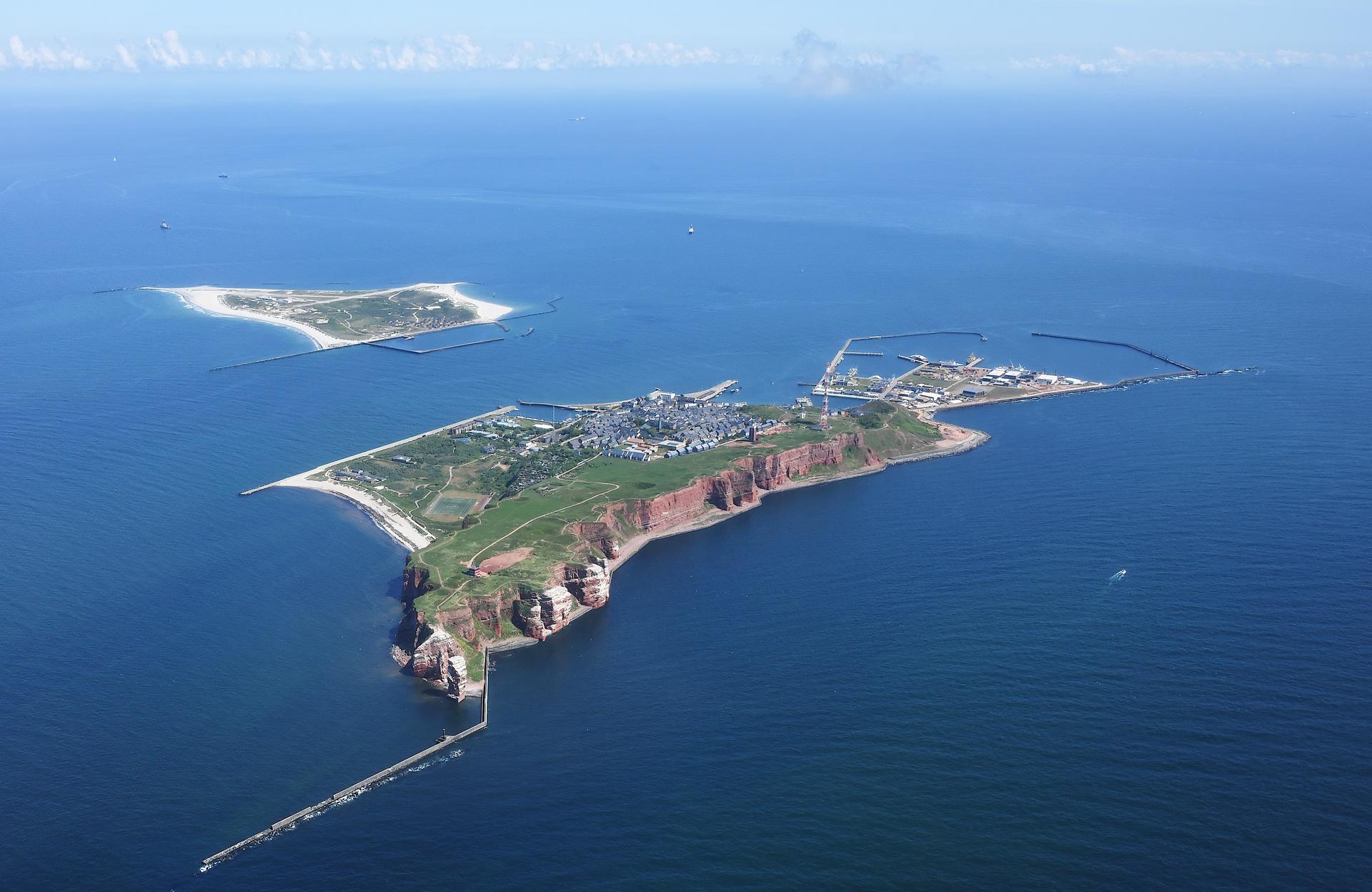
Looking beyond Rubjerg Knude? Discover The North Sea Islands for broader travel guides, local hot-spots, and regional highlights.
Explore The North Sea Islands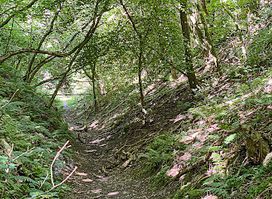
A steep, shaded ravine tucked into Denmark’s longest inland coastal cliff, where lush forest, erosion-sculpted slopes and demanding trails create a wild green pocket.

Denmark's iconic 10-km white-sand beach where fishing boats, bathing huts, and wartime bunkers meet the North Sea.
